
Social Justice Report 2006: Chapter 3: Addressing the fundamental flaw of the new arrangements for Indigenous affairs – the absence of principled engagement with Indigenous peoples
Social Justice Report 2006
Chapter 3: Addressing the fundamental flaw of the new
arrangements for Indigenous affairs – the absence of principled engagement
with Indigenous peoples
Chapter 2 << Chapter 3 >> Chapter 4
- Developments in ensuring the ‘maximum participation of Aboriginal persons and Torres Strait Islanders in the formulation and implementation of government policies that affect them’
- Engagement with Indigenous peoples at the local level – Indigenous perspectives on Shared Responsibility Agreements
- Addressing the fundamental flaw of the new arrangements – Ways forward
This is the third successive Social Justice Report to report on the
implementation of the new arrangements for Indigenous affairs at the federal
government level. The past two Social Justice Reports have emphasised the
importance of governments ensuring the effective participation of Indigenous
peoples in decision making that affects our lives. This includes the development
of policy, program delivery and monitoring by governments at the national, as
well as state, regional and local levels.
The Social Justice Report 2005 expressed significant concerns about
the lack of progress in ensuring processes were operating to ensure the
participation of Indigenous peoples in policy, particularly at the regional and
national levels. The report also provided a stern warning about the implications
of failing to address this issue as an urgent priority. It stated that the
‘absence of processes for Indigenous representation at all levels of
decision making contradicts and undermines the purposes of the new
arrangements’.[1] The report
called for principled engagement with Indigenous peoples as a fundamental
tenet of federal policy making.
This chapter does three things.
First, it provides an update on the progress made over the past twelve months
in ensuring the ‘maximum participation of Aboriginal persons and Torres
Strait Islanders in the formulation and implementation of government policies
that affect them’ with a particular emphasis on developments at the
national and regional level. It is clear that the mechanisms for Indigenous
participation in the new arrangements remain inadequate. Indeed this ongoing
failure to ensure Indigenous participation in decision making is the fundamental
flaw in the implementation of the new arrangements.
Second, it looks to developments at the local level through Shared
Responsibility Agreements (SRAs) to see how this program of activities is
unfolding. Substantial effort has been devoted to this program of small scale
interventions. This can be justified if it provides a pathway to improving
existing mechanisms for engaging with Indigenous communities at the local level
and identifying the crucial barriers to sustainable development within
communities. It is reasonable to expect such lessons after two years of solid
engagement.
The chapter examines progress under the SRA program by engaging with those
people affected most by them – namely, the Indigenous communities who have
entered into SRAs. This is achieved through a series of interviews with three
SRA communities and through analysing the results of a national survey of two
thirds of those Indigenous communities or organisations that had entered into an
SRA by the end of 2005.
Third, the chapter looks to ways forward which address the significant
concerns that are set out in the chapter. As the chapter makes clear, Government
commitments exist to ensure the maximum participation of Indigenous peoples in
decision-making and these commitments have been consistently re-affirmed. The
concerns in this chapter reflect a problem of implementation of these
commitments.
The absence of appropriate mechanisms for the participation of Indigenous
peoples in the new arrangements is a significant policy failure. It is
inconsistent with our human rights obligations, existing federal legislation,
and the government’s own policies.
The immediate impact of this policy failure is to render Indigenous voices
silent on new policy developments, in the legislative reform process and in the
setting of basic policy parameters and the delivery of basic services to
Indigenous communities. The chapter emphasises the potential danger of the new
arrangements to the well being of Indigenous peoples, if the concerns raised in
this report are not addressed as an urgent priority.
Developments in ensuring the ‘maximum participation
of Aboriginal persons and Torres Strait Islanders in the formulation and
implementation of government policies that affect them’
The importance of regional Indigenous participatory mechanisms in the
new arrangements
The legislation which forms the foundation for the new arrangements, the Aboriginal and Torres Strait Islander Act 2005 (Cth), has as one of its
objectives ‘to ensure maximum participation of Aboriginal persons and
Torres Strait Islanders in the formulation and implementation of government
policies that affect
them’.[2]
The government has continually emphasised the importance of ensuring such
participation as an integral component of its arrangements for Indigenous
Affairs. In June 2005, the then Minister for Immigration and Multicultural and
Indigenous Affairs confirmed that the government remained committed to
establishing representative bodies at the regional level:
We have always stated that, following the dissolution of ATSIC Regional
Councils from July 1 this year, there will be room for genuine Indigenous
representative bodies to emerge in their
place.[3]
This commitment has been constantly re-iterated by the Government since. They
have stated that through regional Indigenous Coordination
Centres, ‘the Australian government is committed to real engagement with
Indigenous people in the areas where they
live’.[4]
The Minister for Families, Community Services and Indigenous Affairs has also
stated that:
We aim to make it simpler for Indigenous people to deal with government. We
want to show respect by encouraging them to be active participants in solving
their own problems...(T)he one-size-fits-all approach will not work. We need different strategies
for urban, rural and remote areas. Indeed we must recognise that every
individual community is different and that local solutions need to be designed
with local people to suit their local
circumstances.[5]
The Government has emphasised that the new arrangements are intended to
ensure that programs are ‘being implemented more flexibly in response to
local Indigenous needs’ and that ‘Indigenous communities at the
local and regional level... have more say in how (funding) is
spent’.[6]
In their implementation, the new arrangements are
underpinned by five key principles. These include:
2. Regional and local need
ICCs are talking directly with Indigenous communities and groups about their
priorities and needs and their longer term vision for the future. Shared
responsibility Agreements (SRAs) may result from these discussions...The Australian government is also progressing negotiations on Regional
PartnershipAgreements (RPAs) to tailor government interventions across a region. RPAs
can also provide a framework for recognising the range of regional Indigenous
engagement arrangements that develop around Australia.5. Leadership
Strong leadership is required to make the arrangements work, both within
government and from Indigenous people.The regional engagement arrangements that Indigenous people establish will
provide leadership and be accountable to the people and communities they
represent.Where Indigenous leadership capacity and organisational governance need to be
strengthened, the Australian government can provide
support.[7]
What is clear from this is that the Government has acknowledged that
mechanisms for Indigenous participation at the regional level are essential if
the whole of government model it is seeking to implement is to work.
Regional Indigenous participatory mechanisms have an essential role in the
new arrangements as the link in the chain that connects policy making from the
top to service delivery that is relevant and appropriate at the grass roots. It
is essential to identify local need and to facilitate regional planning and
coordination.
In materials explaining the operation of the new service delivery
arrangements, the Government explains the role and importance of regional
engagement arrangements and agreement-making processes to facilitate
partnerships between Indigenous peoples and governments. Regional Partnership
Agreements are seen as a key mechanism to achieve this. The Government’s
approach is described as follows:
Through ICCs, the Australian government has been consulting with
Indigenous communities and state/territory governments about regional solutions to
regional needs.Regional Partnership Agreements (RPAs) are negotiated to coordinate
government services and deliver initiatives across several communities in a
region. They are a means of eliminating overlaps or gaps, and promoting
collaborative effort to meet identified regional needs and priorities. They may
also involve industry and non-government organisations.RPAs also seek to build communities’ capacity to control their own
affairs, negotiate with government, and have a real say in their region’s
future.RPAs may include shared responsibility Agreements (SRAs) with local
communities or groups that support the objectives of the
RPA.[8]
RPAs are a tool to facilitate and recognise regional Indigenous engagement
arrangements. As the Government explains:
Regional Indigenous engagement arrangements are evolving in a number of
regions to help Indigenous people talk to government and participate in program
and service delivery. These engagement arrangements are a mechanism for making
and implementing agreements between government and Indigenous people based on
the principles of partnership, shared responsibility and self-reliance.The Australian government does not want to impose structures but will support
and work with arrangements that are designed locally or regionally and accepted
by Indigenous people as their way to engage with government.The government has supported consultation with Indigenous people about the
types of engagement arrangements they want. Communities need time to think
through these issues, and views differ widely across regions on the most
appropriate models.In Western Australia and New South Wales, the Australian and state
governments are already supporting new engagement arrangements in the Warburton
and Murdi Paaki regions respectively.Bilateral agreements with state and territory governments are also pointing
to a variety of approaches to regional engagement. These approaches include
regional authorities in the Northern Territory and ‘negotiation
tables’ in Queensland.Regional Partnership Agreements are a primary mechanism for government to
provide funding for regional Indigenous engagement arrangements. More regional
Indigenous engagement agreements are likely to be finalised as indigenous groups
negotiate with the Australian and other governments on their funding. [9]
Regionally based Indigenous Coordination Centres (ICCs) provide the interface
with Indigenous communities for the establishment of regional indigenous
engagement arrangements and the finalisation of RPAs. To assist in this process
the Government has created four panels of experts to support ICCs, including for
the specific task of ‘developing regional engagement
arrangements’.[10]
Similarly, a ‘multiuse list of community
facilitators/coordinators’ has also been created to compliment the more
specialised and technical services of the Panels of Experts. Members of the
Multiuse List are intended to create links between communities and governments,
coordinate and develop service delivery, support communities and specific
groups, such as women and youth, in identifying their priorities, in negotiating
agreements with government, and in developing new regional engagement
arrangements.[11]
Progress in supporting Indigenous engagement at the regional
level
Last year’s Social Justice Report provided an extensive overview
of developments towards the establishment of regional Indigenous representative
bodies.
The report noted the considerable progress that had been made in negotiating
regional representative arrangements and structures. It reported that
consultations had been conducted across many regions to identify replacement
representative structures during the year, and that OIPC had provided funds
through the ICCs for Indigenous peoples to convene local and regional meetings
to discuss options for new regional representative
arrangements.[12]
An overview of progress on a state-by-state basis showed that there were
promising developments in determining culturally appropriate regional
representative models, although there were gaps and problems with some of the
models.[13] I emphasised the need to
finalise and operationalise representative organisations where negotiations were
largely complete, and to make greater progress in other areas where models had
not yet been finalised.
Overall, I found the situation to be of some concern:
The consequence of the current status of these models is that there are few
mechanisms for Indigenous participation at the regional
level...[14]Addressing the absence of regional representative structures is an urgent
priority for the 2005-06 financial year. It would be wholly unacceptable for
regional structures to not exist and not be operational in all ICC regions by
the end of this period.[15]
The report recommended that the Australian government, in partnership with
state and territory governments, prioritise, with Indigenous peoples, the
negotiation of regional representative arrangements and that Representative
bodies should be finalised and operational by 30 June 2006 in all Indigenous
Coordination Centre regions.[16]
At that time, the Government had finalised one RPA that recognised the
Ngaanyatjarra Council as the representative body for 12 communities spread
across the Ngaanyatjarra lands in Western Australia.
It had also finalised a Shared Responsibility Agreement which recognised the
Murdi Paaki Regional Assembly as the peak regional Indigenous body in the Murdi
Paaki region of far north-west New South Wales. It is understood that the Murdi
Paaki Regional Assembly is now close to signing a RPA to formalise strategic
planning arrangements proposed through community planning processes undertaken
as part of the SRA.
In brief, it is worth recalling developments relating to the creation of
regional representative structures as they stood 12 months ago:
- The government, through ICCs, supported consultations with Indigenous
communities to identify replacement regional representative structures following
the abolition of ATSIC; - At 30 June 2005, when ATSIC Regional Councils ceased to exist, no
replacement representative structures were in place; - The then Minister announced on 29 June 2005 that representative arrangements
had been ‘finalised’ in 10 of the 35 ICC regions, with consultation
and negotiation ongoing in other
regions;[17] and - All State and territory governments had indicated their support for regional
representation in their jurisdictions (based on different models).
As the Social Justice Report 2005 noted, ‘common to
all the existing proposals (for regional structures) is that the federal
government has not as yet outlined in concrete terms how they will support
them’.[18] In particular,
there was no clarity as to how regional bodies would be funded and the type and
level of administrative support they would be provided. The report noted that
Regional Partnership Agreements provided an appropriate model for developing
regional structures.
Throughout the past twelve months, the government has continued to state that
it is committed to establishing regional representative structures. In
correspondence with my Office in December 2006, the Office of Indigenous Policy
Coordination stated that RPAs are the primary mechanism for formally engaging
with Indigenous peoples and communities at a regional level, and that they:
... are a way of harnessing the potential of communities in a region through
genuine partnerships involving many sectors, backed by a serious commitment of
resources.[19]
As discussed further below, commitments to ensure Indigenous participation
and engagement are also contained in each bilateral agreement between the
Australian government and the states and territories.
The Government also released guidelines indicating the parameters of what
support they would provide for regional structures. These guidelines were for
‘Regional Indigenous Engagement Arrangements’ (RIEA) and were
intended to:
... [P]rogress RIEA proposals that are consistent with the Australian
Government’s principles of partnership, shared responsibility and
self-reliance, and to provide feedback to communities on proposals that are not
consistent with the Australian Government’s
objectives.[20]
A notable feature of these guidelines is that they do not use the phrase
‘representative structures’. This language of representation had
been acceptable during the first year of the new arrangements. Importantly, the
various proposals submitted to the government before 30 June 2005 were for
replacement representative structures.
The RIEA guidelines therefore elaborate the shift by the Government from
supporting ‘representation’ to supporting ‘engagement
arrangements’. The parameters for Australian Government funding set out in
the guidelines are as follows:
- Initial Australian Government funding be capped and limited to one year
after which further support be negotiated through RPAs; - Funds support meeting costs such as travel but not sitting fees or
remuneration; - State and Territory Governments participate through RPAs or bilateral
agreements; - The Government retain the right to engage directly with communities or other
bodies; - The Government be assured of the legitimacy of RIEAs among their
constituents; and - RIEAs not be ‘gatekeepers’ or have decision-making
responsibilities concerning Indigenous program
funding.[21]
A second key feature of the guidelines is that they substantially
reduce the scope of what the federal government would consider supporting and
funding. Regional Indigenous Engagement Arrangements will only get funding
support for a year, after which time any further support must be negotiated
through a Regional Partnership Agreement. Whilst this does not necessarily
preclude organisations with a degree of permanency, it shows that engagement
arrangements are to be contingent on RPAs.
The shift in focus that the guidelines present is problematic in that various
proposals were prepared prior to these guidelines being made public and
available. Indeed, the guidelines were in all likelihood developed as a response
to concerns by the government about the content of the proposals developed prior
to 30 June 2005.
This means that proposals submitted by Indigenous communities would be
assessed against guidelines that the proponents were unaware of and which would
require a much narrower and restricted proposal for support to be forthcoming.
The document outlining the guidelines made clear that the guidelines outlined
would be utilised ‘to progress RIEA proposals’ such as the 18 that
had been received at the time. This suggests that the Government would engage
with the proponents of regional models to consider their proposals in light of
the government guidelines.
Over the past eighteen months and since the adoption of these guidelines, the
Government has finalised two RPAs – in Port Hedland and the East Kimberly
(both signed in November 2006).
Neither of these agreements relate to supporting Regional Indigenous
Engagement Arrangements. Instead, they are the result of negotiations within two
trial sites under a Memorandum of Understanding (MoU) between the Government and
the Minerals Council of Australia.
The MoU with the Minerals Council is about building partnerships between the
government, mining sector and Indigenous communities. The MoU negotiation
process involved local Indigenous leaders through the Indigenous Leaders
Dialogue - a forum through which local Indigenous leaders advise the MCA
about Indigenous aspirations and anticipated outcomes from the MoU.
Case studies of these RPAs are included in the Native Title Report 2006. The Report notes that a concern during the
negotiation of the RPAs was the lack of sufficient Indigenous engagement. In
relation to the East Kimberly RPA, the Native Title Report 2006 states that:
From the outset, parties to the RPA saw it as an initiative of the Australian
Government. There is evidence that the negotiation processes were run according
to the Government’s own agenda and plans were hastily developed in a rush
to meet fixed deadlines leaving other parties feeling pressured to follow for
fear of being left behind... The level of community engagement (on the RPA) is
regarded as greatly inadequate.As a result of the lack of
engagement with Indigenous people, there is a critical lack of understanding
within the community about the RPA, and what it aims to deliver. For
example, there was reported confusion between the RPA and other changes to
regional governance arrangements including changes to the Community Development
Employment Project. This kind of confusion has the potential to skew commitment
and expectations of the RPA, and may lead to dissatisfaction with outcomes. In
addition, as long as communities are uncertain about the nature of the RPA, they
will be unable to take advantage of the opportunities it
creates.[22]
Aside from these RPAs emanating from the MoU with the Minerals Council, no
other RPAs have progressed in the past eighteen months.
In researching this report, my Office sought to contact the proponents of
proposed regional arrangements that had been identified by the Minister for
Indigenous Affairs as ‘finalised’ in June 2005. My purpose was to
identify what had transpired over the past 12-18 months and whether the
proposals as submitted had been considered and what advice had been provided
back to the proponents of these bodies in order to advance them (consistent with
the commitment given by the government when it announced its guidelines for
RIEAs). [23]
Those proposals that had been identified as ‘finalised’ related
to the following ICC regions:
- Many Rivers, Northern NSW;
- Gulf and West Queensland;
- Central Queensland;
- Cairns and District Reference Group;
- East Kimberly District Council;
- Kullari Regional Indigenous Body;
- Yamatji Regional Assembly;
- Nulla Wimla Kutja;
- Ngaanyatjarra Council; and
- Murdi Paaki Regional
Assembly.[24]
In Hansard in federal Parliament in May 2006 the Government stated
that two arrangements had been established and were receiving funding support
from the Australian Government and sixteen other reports from Indigenous groups
had been received by the Australian Government for
consideration.[25]
Information on progress was sought initially from the relevant ICCs and the
Office of Indigenous Policy Coordination. For some of the proposed regional
structures, the ICCs advised that they had no contact information for the
proponents of the models and that there had been no activity to advance
discussions within the region over the past year.
In a regular request for information to the OIPC that I make for each Social Justice Report I also specifically requested a region by region
update on progress in advancing RIEAs and in consideration of proposals that had
been submitted to OIPC through the ICCs. The OIPC provided no response to this
question.[26]
Discussions with Indigenous community members who had been involved in
proposing structures for these regions also revealed that little progress had
occurred in progressing RIEAs. Part of the difficulty in this was the fact that
most of the models had been presented by, or were facilitated by, the relevant
ATSIC Regional Council prior to their abolition. Accordingly, there is now no
institutional structure in place to progress the proposals made.
Various community members noted that the process of negotiating an RIEA had
not progressed due to a lack of communication from the OIPC and ICC, with the
proponents not hearing from the local ICC regarding their
proposal,[27] no financial support
from any level of government to facilitate progressing the proposal, lack of
communication on the proposal between the state or territory government and the
federal government, and/ or a lack of support for the proposal by the state or
territory government.[28]
The Government explains the current absence of consultative mechanisms as
follows:
Mr Yates - There was quite a lot of work done in the follow-up to the
abolition of the ATSIC regional councils, typically in conjunction with state or
territory governments where they were reviewing representative arrangements or
machinery for engagement with government. So there has been quite a lot of work
done over the last couple of years, but they have not all translated into
replacement arrangements. As far as possible we were looking to try and support
arrangements which both levels of government would be backing rather than having
multiple layers. Our focus in terms of the future has been on, at the regional
level, the engagement that we are having there where that translates into
regional partnership agreements. We are quite ready and willing to work with the
other parties and provide resources to support the effectiveness of Indigenous
groups engaging with government to enable those regional partnership agreements
to work well.[29]
There is an important change in approach here, from an emphasis on regional structures, to regional processes and agreements, particularly
RPAs.
Given the advanced state of discussions a year ago in a number of regions, it
is quite remarkable that progress towards recognising regional representative
structures has stalled, if not dissipated.
Even more remarkably, the OIPC has sought to suggest that this lack of
progress is a result in a shift in the thinking and preferences of Indigenous
people themselves!
In Senate Estimates they stated:
... what we [FaCSIA] have found is that some of the early thinking in a
number of regions, which was to re-establish something very similar to an ATSIC
regional council, has dissipated. They [Indigenous peoples] have realised that
that is not workable or meaningful for them and they have moved on. So we are in
a situation where we are having to work more case by case in different regions,
and it is taking a while, but the timetable is very much in the hands of
Indigenous people, as is the shape of any engagement arrangements that that
results in.[30]
This proposition needs to be tested further. It is not consistent with the
findings of discussions conducted by my Office and it is not consistent with the
apparent lack of activity by OIPC and ICC to progress this important issue.
As indicated above, immediately following the demise of the ATSIC Regional
Councils and over the course of the first year of the new arrangements, the
government expressed a clear intention to assist Indigenous peoples to establish
replacement bodies for regional participation. After an initial level of
activity by OIPC to this end, this undertaking was quietly dropped and replaced
with a commitment to RIEAs.
It now seems that the federal government would prefer to avoid anything
resembling the ATSIC Regional Council model. I have serious doubts that this
fully represents the will of Indigenous peoples in the regions, or that they
have ‘moved on’ in their thinking.
Given the unqualified nature of the government’s initial undertakings,
a more thorough explanation of what is being done to replace the ATSIC Regional
Councils with appropriate regional representative organisations is called
for.
While it is desirable not to foist a standard model on different regions, and
this is one of the reasons given for the slowness in getting regional engagement
arrangements in place or
supported,[31] I remain concerned
that the vacuum in Indigenous regional participation is creating problems.
It is difficult for Indigenous communities to deal with the volume of
changes, agencies and requirements under the new arrangements and the increasing
entanglements of red tape.[32] There
is a need to support authentic and credible structures and processes for
Indigenous communities that allow them to engage with governments, be consulted,
and where appropriate, provide informed consent.
In my view the government has adopted a cynical and disingenuous approach in
which the apparatus of the new arrangements play no active role in engaging with
Indigenous peoples on a systemic basis to ensure that mechanisms for Indigenous
participation can become a reality.
The Government has clearly stated that one of the priority areas for their
Expert Panels and ‘Multiuse list of community
facilitators/coordinators’ is to assist in the development of regional
engagement arrangements. This demonstrates that they are fully aware that such
arrangements will only become a reality if intensive support is provided to
Indigenous communities to develop models that are suitable to their local
needs.
It is fanciful to expect that RIEAs will emerge solely through the efforts of
Indigenous communities that are under-resourced and that in most instances do
not have the necessary infrastructure to conduct the wide-ranging consultation
and negotiation required to bring a regional engagement structure into
existence.
It is also convenient for Government to leave this issue solely up to
Indigenous peoples to progress. I would suggest that this is done in full
knowledge that the outcome of this approach will be an absence of regional
engagement arrangements.
There is a clear need for special assistance to ensure that Indigenous
peoples are able to, in the words of the object of the Aboriginal and Torres
Strait Islander Act 2005, ensure the ‘maximum participation of
Aboriginal persons and Torres Strait Islanders in the formulation and
implementation of government policies that affect them’.
Options for addressing this significant failure of the new arrangements are
discussed in detail in the final section of this chapter.
As noted in chapter 2 of this report, a related concern is that each regional
Indigenous Coordination Centre is now developing its own Regional Action Plan
which identifies the key issues that the ICC will focus on in a twelve month
period.
The plans will cover work completed through a variety of mechanisms including
RPAs and SRAs, strategic intervention arrangements and community in crisis
interventions. The plans are to be endorsed by federal government state manager
groups and will highlight the most significant community and government work
which the ICC is involved as well as link into national
priorities.[33]
It is a concern that ICCs are developing such action plans in the absence of
systematic engagement with Indigenous communities at a regional level and in the
absence of Regional Indigenous Engagement Arrangements in nearly all ICC
regions. Ensuring such engagement with Indigenous communities should be a
fundamental pre-requisite to determining service delivery priorities and in the
identification of need for each ICC region.
As I have travelled around the country I have discussed this situation with
Government staff in ICCs and OIPC state offices. These staff, particularly at
the field operative level, are observing the frustration, disengagement and
bewilderment of Indigenous peoples. Many of these staff have had long term
relationships with indigenous communities and peoples and they are experiencing
the pressures of top down impositions that are not likely to see any real and
sustainable outcomes for indigenous people. They also feel disempowered
themselves, and that the culture within the OIPC is one that does not value
their views and concerns. Many have expressed an unwillingness to raise their
concerns for fear of reprisals.
Government would benefit from conducting a confidential survey of all staff
in ICCs to gauge their views on the current directions in implementing the new
arrangements and to raise suggestions on the way forward to achieve sustainable
outcomes.
Indigenous participation in decision making at the national level
Last year’s Social Justice Report provided a detail overview of
the issues relating to Indigenous engagement at the national
level.[34] These include:
- difficulties in ensuring the involvement of Indigenous peoples in
inter-governmental framework agreements (such as health and housing agreements
with the states and territories); - the removal from the Aboriginal and Torres Strait Islander Act 2005 (Cth) of previously existing requirements for departments to consult with
Indigenous peoples in planning and implementing their activities; and - the absence of processes for engagement with Indigenous peoples at the
national level.
In the past twelve months, there have been limited changes at the
national level to the situation as described in the Social Justice Report
2005. The government has continued to utilise the National Indigenous
Council (NIC) as the primary source of advice on Indigenous
policy[35] and has not sought to
engage more broadly with Indigenous communities on matters of policy development
that affect our lives.
The result of this has been a noticeably low level of participation of
Indigenous peoples in inquiry processes (such as parliamentary committees) on
matters of crucial importance to Indigenous peoples and a new
‘unilateralism’ in policy development.
There are two principle concerns that I have regarding developments at the
national level over the past 12- 18 months.
- First, we have seen reforms being introduced extremely quickly with limited
processes for consultation and engagement from Indigenous peoples. Limited
processes for engagement are compounded by the lack of capacity of Indigenous
communities and low levels of awareness of the various reforms proposed. During
the course of some reform processes, the government has stated that they are
under no obligation to consult with Indigenous peoples – this has
contributed to the emergence of a culture within the federal government that
does not place sufficient value upon Indigenous engagement and
participation.
- Second, as the government has continued to bed down the new arrangements
they have continued to distance Indigenous peoples from processes for agreeing
to policy priorities – this includes through setting the key priorities
for inter-governmental cooperation through bilateral agreements with the states
and territories without Indigenous participation, and a changed focus in federal
processes, such as through the strategic interventions approach described in
chapter 2.
Last year’s Social Justice Report expressed concern at
the existence of multiple processes to reform Indigenous policy that were taking
place concurrently and the limited ability for Indigenous people and communities
to engage in these processes. I noted my concern that:
... the cumulative impact of the parallel reforms currently taking place is
overwhelming some communities and individuals.This renders it very difficult for Indigenous peoples to participate
meaningfully in policy development, program design and service delivery. This is
particularly so in the absence of representative structures to coordinate and
focus the input of communities, particularly in relation to legislative reform
and inquiry processes.The intention of the reforms is plainly to improve engagement and service
delivery with Indigenous peoples... The rapid rate of the reforms and the
accompanying impact it is having on communities and individuals needs to be
acknowledged by governments.[36]
This situation has continued over the past year.
For example, communities have had to deal with the following ongoing reform
processes that have been occurring simultaneously at the national level:
- Reforms to governance arrangements for Aboriginal councils and associations,
which had been held over for a further twelve months; - Reforms to the CDEP program, as well as processes for the lifting of Remote
Area Exemptions in some remote communities; and
- Reforms of other employment related services, such as Indigenous Employment
Centres, the Structured Training and Employment Program (STEP), and welfare to
work reforms.
At the same time, consultations have been conducted relating
to:
- Reforms to the Aboriginal Land Rights (Northern Territory) Act, including
substantial reforms for land tenure arrangements in townships and proposed
changes to the permit system; - Six inter-connected reform processes for different aspects of the native
title system, followed by draft legislation to implement the findings of some of
these consultation processes (with further amendments expected later on);
and - Reforms to the community housing and infrastructure program.
Legislation has also been introduced to the federal Parliament that
impacts on Indigenous communities relating to:
- Land rights reforms in the Northern Territory (through the Aboriginal
Land Rights (Northern Territory) Act 1975); - Indigenous heritage protection (through the Aboriginal and Torres Strait
Islander Heritage Protection Act 1984); - Indigenous governance (through the Aboriginal Councils and Associations
Act 1976); - Banning of consideration of Aboriginal customary law in federal sentencing
matters (through the Crimes Amendment (Bail and Sentencing) Act 2006); - The removal of consent procedures for traditional owners in the nomination
of sites for storage of radioactive waste on Indigenous lands (through the Commonwealth Radioactive Waste Management Legislation Amendment Bill
2006); and - Welfare to work reforms (through the Employment
and Workplace Relations Legislation Amendment (Welfare to Work and Vocational
Rehabilitation Services) Bill 2006)
Parliamentary inquiries have also been conducted into:
- petrol sniffing in remote Aboriginal Communities;
- national parks, conservation reserves and marine protected areas;
- the Indigenous
visual arts and craft sector; - Indigenous stolen wages;
- Native Title Representative Bodies (this inquiry was in addition to the four
separate consultation processes on native title issues conducted by the
Attorney-General’s Department); - Indigenous employment;
- health funding;
- the non-fossil fuel energy industry;
- mental health;
- civics and electoral education, including the non-entitlement of prisoners
(of whom Indigenous peoples make up a significant proportion) to vote; and - an identity card (which is likely to have a significant impact on Indigenous
peoples as high users of government services such as the welfare and health
systems).
These activities are just some of the reforms that have occurred at
the national level. They do not include significant reforms at the state and
territory level – such as to governance arrangements and local councils in
Queensland and the Northern Territory; the operation of the state based land
council system, care and protection and adoption systems in NSW; protections
through a Bill of Rights in the A.C.T, Victoria, Tasmania and Western Australia;
and inquiries into family violence and child sexual abuse in NSW and the NT,
among other things.
The consultation processes and reforms at the federal level have also been
difficult for Indigenous peoples to participate in due to the short timeframes
within which consultation for some of the reforms have taken place. The adequacy
of consultation processes for CDEP and related employment changes, for example,
were discussed in Chapter 2 of this report.
An issue of major concern has been the shortness of time for parliamentary
inquiries into issues of relevance to the situation of Indigenous peoples and
particularly for draft legislation. This has been particularly noticeable in
inquiries before the Australian Senate where public consultation on proposed
legislation has consistently been severely curtailed.
For example:
- The Senate Committee inquiry into changes to federal sentencing laws to ban
consideration of Aboriginal customary law was formed on 14 September 2006 with
submissions required to be submitted by 25 September 2006 – just 11 days
later (with the committee due to report by 16 October 2006). Just 5 submissions
were received from Indigenous organisations. The final report noted that the
Government confirmed that 'there was no direct consultation' on the content of
the Bill with groups who could be
affected.[37]
- The Senate Committee Inquiry into the provisions of the amendments to the Aboriginal Land Rights (Northern Territory) Act 1975 was created on 22
June 2006 for inquiry and report by 1 August 2006. The Committee received 4
submissions from Indigenous organisations. The final report of the inquiry (by
both government and non-government members of the Committee) stated:
‘The Committee considers the time made available for this
inquiry to be totally inadequate. The Aboriginal Land Rights (Northern
Territory) Act is one of the most fundamentally important social justice
reforms enacted in Australia and these are the most extensive and far reaching
amendments that have been proposed to the Act. There was insufficient time for
many groups to prepare submissions and a single hearing was complicated by the
necessity to include a number of teleconferences within the hearing.
Additionally, time constraints prevented the Committee hearing from a number of
witnesses’.[38]
The lack of emphasis given to ensuring that Indigenous peoples are able to
participate in decision making processes that affect us is of serious concern.
As I note elsewhere in this report, the lack of engagement generally with
Indigenous peoples ensures that the system of government, of policy making and
service delivery, is a passive system that deliberately prevents the active
engagement of Indigenous peoples. This contradicts the central policy aims of
the new arrangements, which includes commitments to partnerships, shared
responsibility and mutual obligation.
It is paradoxical for the Government to criticise Indigenous people for being
passive victims and stuck in a welfare mentality yet to continually reinforce a
policy development framework that is passive and devoid of opportunity for
active engagement by Indigenous peoples.
I find it particularly disturbing that there is a lack of acknowledgement of
the importance of Indigenous engagement and participation in policy making. I am
concerned that there is emerging a culture within the federal public service,
led by the Office of Indigenous Policy, which does not place sufficient value
upon such engagement.
This has been particularly notable in debates about reforms to land rights in
the Northern Territory, particularly those relating to changes to land tenure in
townships. The government has stated before the Senate Committee inquiring into
the amendments to the land rights legislation that it is not under an obligation
to consult with Indigenous peoples on the proposed changes, and that that role
lay instead with the land councils in the Northern
Territory.[39]
In subsequent discussions where I have expressed concern about the lack of
community consultation on the issue of town leasing, the OIPC have also noted
that they are not obliged under the legislation to consult with the community,
just with a section of it, that is traditional owners, which the government has
stated could mean just one person in some
instances.[40]
As a matter of practicality, processes for engaging with stakeholders about
proposed reforms are integrally linked to achieving successful implementation at
the community level. It is a mistake to believe that reforms that are developed
in a vacuum will be embraced by communities. It is far more likely that such
reforms will be perceived as disempowering and paternalistic. As a consequence,
governments will face greater difficulties in realising their intended goals.
This will particularly be so if those goals are not shared by Indigenous
communities.
The absence of a national representative body exacerbates this situation.
It is my impression, from discussions with officials in different departments
and agencies and from observing current practices, that government departments
are struggling about how to consult and with who.
As reported in the past two Social Justice Reports, Indigenous peoples
have been giving attention to the necessary components of a replacement national
body for the Aboriginal and Torres Strait Islander Commission (ATSIC).
The National Indigenous Leaders Conference was convened in Adelaide in June
2004 and set out principles that must be met for any national body to be
credible.[41] A smaller steering
committee of participants in that process have met since that initial meeting,
including at a meeting in Melbourne in 2006, to advance their proposal.
To date, there has been limited information made publicly available about
this process or its outcomes. This is unfortunate given the urgent and
compelling need for a national representative body to be in place.
The Social Justice Report 2004 set out a number of options for
ensuring the effective participation of Indigenous peoples in decision making at
the national level. These included the establishment of a national congress of
Indigenous representative organisations, annual meetings of Indigenous service
delivery organisations, and the establishment of a national Indigenous
non-government organisation.[42]
My current assessment of these options is as follows:
- Establishing a national body comprised of the chairpersons of Regional
Indigenous Representative Structures – this is essentially the model
proposed by the ATSIC Review Team in 2004. It is presently not a feasible model
due to the absence of regional representative structures, as discussed in this
chapter. The convening of a national forum should still be treated as a high
priority once regional structures have been established across the country.
- Establishing a National Forum of existing Aboriginal and Torres Strait
Islander peak organisations – This could provide an interim approach
to a more inclusive national representative model. The Forum could be attended
by National Secretariats and State Associations for:
- Indigenous women’s legal
services; - Torres Strait Islander
organisations; - native title organisations and land
councils; - legal services;
- childcare services;
- community controlled health
organisations; - justice advisory committees;
- stolen generations
organisations; - peak Indigenous education
organisations; - networks for CDEP; and
- Job Network providers and so forth.
- Indigenous women’s legal
I would see enormous value in bringing together these
organisations to share common experiences and consider mechanisms for improved
coordination and consideration of issues in a whole of government matter. The
absence of such a coordinated approach from Indigenous organisations (who are
clearly not equipped or resourced to operate in this way) creates a mismatch
between the Government’s new whole of government approach and the ability
of Indigenous peoples to participate in it.A National Forum of Service Providers and peak bodies would be useful as an
ongoing mechanism, but ultimately would not substitute the need for a
representative body to ensure effective engagement with Indigenous
communities.
- Establishing a national non-government organisation of Indigenous peoples – This may well be the result of current consultations being
undertaken by Indigenous peoples. The difficulty that this model will face is
ongoing funding and adequate resourcing. In addition to issues around
establishing a mandate for the organisation, time will need to be devoted to
options for resourcing such a body to ensure that it has the capacity to
undertake the necessary level of activity. Where this model exists
internationally, such as the Assembly of First Nations in Canada, the Indigenous
peoples it represents have a secure land and resource base that assures the
ongoing viability of such a mechanism.
This is, in my view, achievable. Lessons regarding funding
arrangements and structure can be learnt from similar organisations
internationally but also from domestic organisations in other sectors –
such as the Federation of Ethnic Community Councils of Australia and the
Australian Council for Overseas Aid.
The current lack of effective participation of Indigenous peoples at the
national level is a matter of major concern. If the current approach is to
continue unabated, we risk government policy processes entrenching existing
problems of lack of engagement. This will result in systemic problems in
Indigenous policy and service delivery.
Due to my ongoing concerns about this issue, I have identified the following
as a follow up action for my Office over the coming year.
Follow Up Action by Social Justice Commissioner
The Social Justice Commissioner will work with Indigenous organisations and
communities to identify sustainable options for establishing a national
Indigenous representative body.
The Commissioner will conduct research and consultations with
non-government organisations domestically and internationally to establish
existing models for representative structures that might be able to be adapted
to the cultural situation of Indigenous Australians, as well as methods for
expediting the establishment of such a body given the urgent and compelling need
for such a representative body.
Indigenous participation in determining priorities for
inter-governmental cooperation
Concurrent to these developments, the government has continued to bed down
the new arrangements and to confirm changes in policy through processes that do
not include Indigenous participation at the outset. This has primarily occurred
through a new focus on ‘intensive interventions’ and through an
emphasis on setting priorities and agreed areas for action through bilateral
agreements with the states and territories.
Generally speaking, Indigenous engagement is limited to the implementation of
the priorities once they have already been agreed between governments. Chapter 2
of this report discussed the federal government’s movement towards a bilateral interventionist model of ‘strategic interventions’ or
‘intensive interventions’ in some communities designated as being
‘in crisis’.
As noted in chapter 2, the interventionist model puts the strategic
decision-making clearly in the hands of government – the Indigenous
community only becomes involved after the basic decision to intervene has
been made and respective levels of commitment have been agreed between different
governments.
‘Strategic intervention’ in this context in fact means
‘restricted Indigenous participation’ at a governmental and
priority-setting level. Priorities are determined by outsiders (governments),
and only then are the insiders (the community) invited to participate in the
detailed planning and implementation. This does not appear to provide a sound
basis for ‘ownership’ of initiatives undertaken as part of such
strategic interventions.
This approach is more broadly applied through the negotiation of bilateral
agreements on Indigenous affairs between the federal government and the states
and territories.
In general terms, the bilateral agreements commit each government to work in
partnership and in accordance with principles as agreed through the Council of
Australian Governments (COAG). They also include schedules of priority actions
which are agreed solely by governments without Indigenous participation.
In contrast to this lack of engagement prior to the finalisation of the
bilateral agreements, each agreement then commits the Australian government and
the relevant state or territory government to ensure Indigenous participation in
the implementation of the agreement. For example:
- The Bilateral Agreement with the Northern Territory Government: identifies the Northern Territory’s proposed local government reforms
through the creation of Regional Authorities under the NT Local Government
Act 1994 as the main model for Indigenous participation and engagement. As
noted in last year’s Social Justice Report, this is primarily
focused on rural and remote areas and does not address the needs of Indigenous
peoples in urban centres in the Northern Territory. This model is also not
universally accepted by Indigenous peoples in the Territory as the appropriate
mechanism. To address this, the bilateral agrees to consider representational
issues ‘through flexible arrangements (including options that bring
together Indigenous peak
bodies)’[43] although there
have been no developments in progressing this in the past year.
- The Bilateral Agreement with the Queensland Government commits both
governments to ‘work with Aboriginal and Torres Strait Islander people to
determine community engagement arrangements at the local level’ and to use
the Queensland government’s ‘negotiation table’ process as
‘the key community engagement
mechanism’.[44]
- The Bilateral Agreement with the New South Wales Government: recognises the NSW Government’s Two Ways Together Framework as the
foundation for cooperation between the two governments on service delivery to
Aboriginal communities, including through Shared Responsibility
Agreements.[45]
The NSW Government’s Operational Guidelines for SRAs require
NSW government agencies to satisfy themselves that there has been a proper
consultative process with Indigenous peoples in developing an
SRA.[46]
- The Bilateral Agreement with the South Australian Government: commits
both governments to ‘work with Indigenous people to determine arrangements
for engagement at the local and/ or regional levels’ and in
acknowledgement of the large proportion of Indigenous people who reside in urban
areas in South Australia to ensure that modified arrangements are put in place
for engagement in urban areas.[47] Consistent with this, the South Australian government commenced a four month
consultation process with Indigenous communities in October 2006 to identify an
appropriate structure for a state-wide Aboriginal Advisory
Council.[48] I commend the
Government of South Australia for undertaking this initiative.
- The Bilateral Agreement with the Western Australian Government:
Commits both governments to work with Indigenous people to determine effective
arrangements for engagement, through the conduct of consultations with
Indigenous communities.[49] In
August 2006, the Western Australian government also commenced a consultation
process to identify better ways to engage with Indigenous leaders and to
identify long-term strategies to strengthen the participation of Aboriginal
people in the state’s development. This process is due to conclude by 31
August 2008. [50] I commend the West
Australian Government for undertaking this initiative.
It is unclear how any engagement arrangements agreed at the state
level, such as the processes currently underway in South Australia and Western
Australia, will link to the federal level. It can be expected, however, that
there will be a connection due to the commitments made in the bilateral
agreements. It remains to be seen whether such cooperation is forthcoming from
the federal government once the models freely chosen by Indigenous peoples have
been revealed – particularly if these models extend beyond the acceptable
parameters for the federal government as laid down in their Guidelines for
Regional Indigenous Engagement Arrangements.
It remains unfortunate that priorities have been identified through the
bilateral agreements without Indigenous participation and engagement and that
there continues to be a lack of any mechanism to facilitate Indigenous
participation as the agreed actions for inter-governmental cooperation are
undertaken..
Engagement with Indigenous peoples at the local level
– Indigenous perspectives on Shared Responsibility Agreements
Over the first two years of the new arrangements, there has been considerable
effort devoted to developing Shared Responsibility Agreements (SRAs) with
Indigenous communities and organisations. This stands in marked contrast to the
lack of activity in ensuring the existence of regional mechanisms for Indigenous
participation and engagement.
This section of the report considers what lessons can be learnt from this
local level engagement, particularly in light of the concerns at the
inappropriate mechanisms and processes for engagement that currently exist at
the regional, state and national levels.
Why focus on SRAs?
Considerable emphasis has been placed on SRAs by the Office of Indigenous
Policy Coordination since the inception of the new arrangements.
They have been described as forming one of the beacons of innovation that
they hope will be the hallmark of the new arrangements. SRAs have been
identified as having the potential to open up communities to new streamlined
forms of service delivery that ‘cut red tape’ and address the
longstanding problems of accessibility of mainstream programs, by
‘harnessing the mainstream’. Officers responsible for negotiating
SRAs within regional ICCs are optimistically named ‘solution
brokers’ in accordance with these expectations.
SRAs have also been prominent due to the policy emphasis within them on
mutual obligation: they have been promoted as one of the key approaches for
addressing passivity in communities by instilling a culture of reciprocity,
through mutual obligation for the delivery of services over and above basic
citizenship entitlements.
As such, SRAs provide one of the main tools through which regional Indigenous
Coordination Centres engage with Indigenous communities or organisations at the
local level, alongside the continued administration of existing grant processes.
In both practical terms and also the ‘publicity’ of the new
arrangements, SRAs have occupied an importance that far outweighs the percentage
of expenditure that they represent.
This is the primary reason why there should continue to be detailed attention
and analysis devoted to the effectiveness of this program.
SRAs have emerged out of the COAG trial model and were quickly applied more
broadly prior to that model being evaluated and its particular challenges
identified, such as the high input costs and intensive effort required for
engagement prior to the delivery of services hitting the ground in communities.
The previous two Social Justice Reports have highlighted the
significant challenges for SRAs to meet the expectations placed upon them by the
government – both legal, in ensuring compliance with human rights and
specifically the Racial Discrimination Act 1975 (Cth), and practical, in
ensuring sound engagement with Indigenous communities to ensure that the process
can contribute to the long term needs of those communities rather than
distracting attention and effort away from the urgent needs of communities.
As the previous chapter of this report notes, the initial focus on SRAs has
produced only modest outcomes in relation to improving mainstream accessibility.
This has been hampered by limited flexibility at the regional level, with all
SRAs originally having to be sent back to Canberra for approval prior to
proceeding, no matter what level of expenditure was involved.
Similarly, the definitions of and approaches to SRAs have continuously
changed, with current references to ‘single issue’ SRAs,
comprehensive SRAs, holistic SRAs and with the additional blurring of
distinctions between SRAs and Regional Partnership Agreements. This lack of
clarity and singular focus is consistent with the instability that characterises
the new arrangements more than two years into their implementation (and as
discussed in detail in the previous chapter).
There has also been a tendency for particular SRAs to blur the boundaries of
what is acceptable in terms of service provision for basic entitlements to
communities. The application of mutual obligation principles within agreements
has also been problematic on occasion, and has moved away from the initial
intention of supporting communities to become active participants to being
perceived as providing a punitive approach to service delivery.
The Social Justice Report 2005 gave extensive consideration to the
Shared Responsibility Agreement (SRA) making process. It included human rights
guidelines for the process of making SRAs as well as guidelines to guide the
content of SRAs.[51]
The report also identified a number of ‘follow up actions’ that
my Office would undertake over the subsequent period in relation to SRAs. These
included that my Office would monitor the SRA process, including by:
- considering the process for negotiating and implementing SRAs;
- considering whether the obligations contained in agreements are consistent
with human rights standards; - establishing whether the government has fulfilled its commitments in SRAs;
and - consulting with Indigenous peoples, organisations and communities about
their experiences in negotiating
SRAs.[52]
I have continued to monitor SRAs over the past year through a three
stage process.
First, the Office of Indigenous Policy Coordination has forwarded copies of
all SRAs to my Office. This arrangement will no longer be necessary as all SRAs
are now published online on the OIPC website at: http://www.indigenous.gov.au/sra.html.
Second, a national survey was conducted with Indigenous communities and
organisations who had entered into an SRA. My office received many responses to
the survey, and Indigenous people from numerous communities also contacted staff
in my office to discuss their SRA in more detail.
Third, I sought first hand information from Indigenous organisations and
communities by means of interview based case studies. My staff visited some
communities and organisations from which we had received responses through the
survey, and conducted interviews in order to enhance the feedback already
obtained from the surveys. These interviews provide a richer qualitative
sampling of community perspectives on SRAs.
So what then have been the outcomes of SRAs to date for Indigenous peoples, as defined by Indigenous peoples?
This section of the report provides the outcomes of the national survey of
communities who have entered into SRAs as well as of specific case studies which
provide further specific information about the challenges faced during the
negotiation process.
Through both of these processes the purpose was to find out directly from
Indigenous peoples about their experiences and identify whether they were
satisfied with the process. Some of the questions I was interested in asking
through the survey and case studies include:
- Has the community been satisfied with the outcomes of the SRA?
- How did the community come to enter the SRA and how did they find the
process? - Did the service as outlined in the SRA get delivered to the community?
- What supports, if any did the community receive from government?
- What were the critical factors for the community in achieving the objectives
of the SRA? - Has the SRA had longer term benefits – e.g. simplified service
delivery, improved communication with government?
The outcomes of the national survey are discussed first, followed
by the case studies. This section of the report then ends by drawing together
the implications from these to guide the SRA process into the future.
Findings of the national survey of Indigenous communities that have
entered into Shared Responsibility Agreements
- Introduction and Survey methodology
A national survey of Indigenous groupings that had entered into a
SRA was conducted between 4 September 2006 and 15 November 2006. The survey
results reflect the perceptions and understanding of the SRA process by those
Indigenous communities, organisations, families and individuals who had entered
into an agreement.
I invited all communities who had entered into an SRA before 31 December 2005
to complete a survey about the process involved in developing and implementing
their SRA. The cut off date was chosen to ensure that there had been sufficient
time for the SRA to come into effect and for its objectives to be realised.
The survey consisted of 27 questions, with a combination of standard response
questions and open questions to gain contextual qualitative information. All of
the questions gave respondents the opportunity to add their own information.
The survey focused on the content of the SRA, the negotiation process and the
community’s views on the SRA process. The full survey questionnaire is
reproduced as Appendix 3 of this report.
The survey was undertaken on a voluntary basis. Participants were informed
that their responses were to be kept confidential and all responses would be
sufficiently de-identified to preserve their privacy, and in turn enable them to
offer frank feedback on the SRA process.
To increase accessibility for communities and organisations, the survey was
posted on the HREOC website. Each community representative was able to complete
and submit the entire survey online. I sent a letter to the communities before
the survey was posted, explaining why I was interested in conducting the survey
and encouraging communities to participate. Paper copies were also available on
request and my staff also assisted some respondents to complete the survey over
the phone.
The survey sample includes SRAs signed before 31 December 2005. For this
period there were 108 SRAs finalised, involving 124 communities.
In addition to communities that had entered into a SRA prior to 31 December
2005, the Survey results include data relating to a further four SRAs in four
communities who had entered into SRAs in early 2006. These communities had been
referred to the online Survey forms by other communities that had been invited
to submit results.
At the close of the survey, responses had been received relating to 67 SRAs
finalised prior to 31 December 2005, and 71 SRAs in
total.[53]
Based on 67 SRAs, out of a possible 108 SRAs prior to 31 December 2005, the
survey had a 62% response rate. This is considered a very good response rate,
especially given that some of the SRAs were for relatively small projects and
the survey required at least an hour to complete.
In disseminating the survey there was two interesting administrative issues
faced:
- The OIPC and ICC did not have an accurate record of signatories to SRAs. The
OIPC could not identify the relevant contact people for each SRA. This required
working with each regional ICC to identify the relevant organisations or
communities in order to distribute the Survey. During this process, it was not
possible for the ICC or OIPC to identify all signatories to SRAs.
- Some communities refused to participate in the survey on the basis that: a)
the SRA in their community was for such an insubstantial sum of money that they
felt they were already required to over-report and spend too much time in
relation to the agreement; and b) for some communities, the SRA had been
dependent on a particular individual who had left the community since the SRA
was signed. In this situation, some communities stated they had insufficient
knowledge about the SRA to comment on its effectiveness – the SRA clearly
had no relevance or currency in those communities.
- Key Features of SRAs – Survey responses
The greatest numbers of survey respondents were from Western
Australia with 21 responses (32%) and the Northern Territory with 15 responses
(24 %). Respectively, 10 (16%) were from Queensland, 8 (13%) South Australia, 6
(10%) NSW, 3 (5%) Tasmania, and no responses from Victoria. The high response
rates for Western Australia were not surprising given the large number of SRAs
in operation during the survey period.
To understand what type of communities or community organisations have been
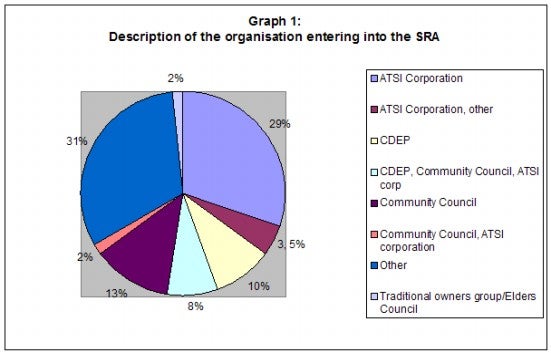
utilising SRAs, the survey asked respondents to describe their organisation. Graph 1 below shows that 29% of the respondents described their
organisation as an Aboriginal/ Torres Strait Islander corporation, and 13% as a
Community Council. A large number of organisations (31%) fell into the
‘other category’. This included a range of organisations including
schools, Aboriginal housing services, charitable trusts, a police unit or other
organisations which fell into a number of different categories.
While the survey did not specifically ask whether the organisation responding
was Indigenous community controlled, 7 schools and 1 police unit completed the
survey in relation to the SRA they had negotiated. In relation to the SRA with
the police unit, further discussions with an Indigenous organisation in that
community which had a specific role in the SRA revealed that they had had no
involvement in its development.
The survey asked respondents to identify what the SRA is about, selecting
from a list of identified categories. The categories were:
- capacity building;
- municipal services;
- sport and recreation;
- health and nutrition;
- community revitalisation;
- cultural activities;
- leadership activities;
- housing;
- economic development;
- family wellbeing;
- law and order and
- other.
Respondents were able to select as many of the subject areas that
they felt applied to their SRA.
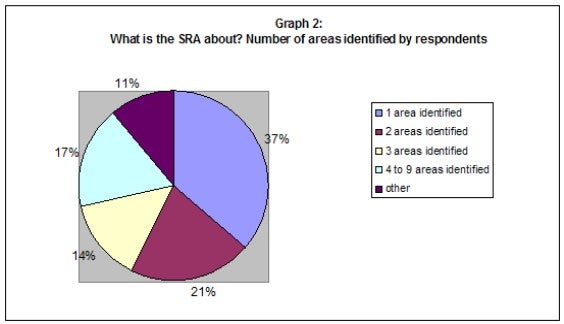
As shown below in Graph 2, 37% of respondents identified a single
category, while the remainder reported that their SRA fell into a number of
different categories. There were no clear patterns arising from how the
communities described their SRAs, which in itself may reveal something about
community perceptions of the SRAs. This may suggest that many communities
perceive the aims of the SRA as much broader than a single issue.
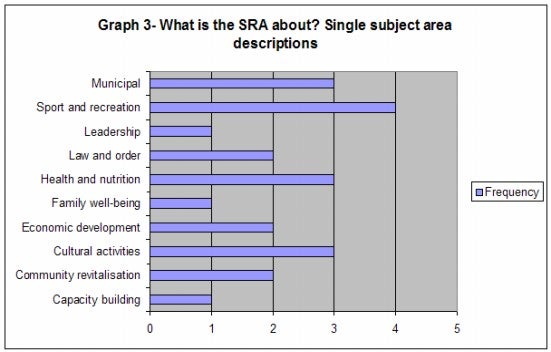
Of those 37% of respondents that were able to categorise their SRA into a
single subject area, Graph 3 shows the spread of SRA subject areas.
As shown in Graph 2, a large number of communities listed more than category
to describe their SRA. Given the unique combinations nominated by respondents no
clear groupings arise but a further breakdown is provided in Table 1 below. Table 1 shows how many communities nominated each category. The most
reported category was ‘other’ (24 respondents), followed by capacity
building and cultural activities (18 respondents).
Table 1: What is the SRA about?
|
Category
|
Frequency
|
|
Cultural revitalisation
|
18
|
|
Capacity building
|
18
|
|
Sport and recreation
|
17
|
|
Health and nutrition
|
16
|
|
Community revitalisation
|
12
|
|
Family wellbeing
|
10
|
|
Leadership
|
10
|
|
Law and order
|
5
|
|
Municipal services
|
6
|
|
Economic development
|
8
|
|
Other
|
24
|
- Obligations contained in SRAs
As SRAs impose obligations on both parties entering into the
agreement, respondents were asked to describe the respective obligations of the
federal government, state governments and community.
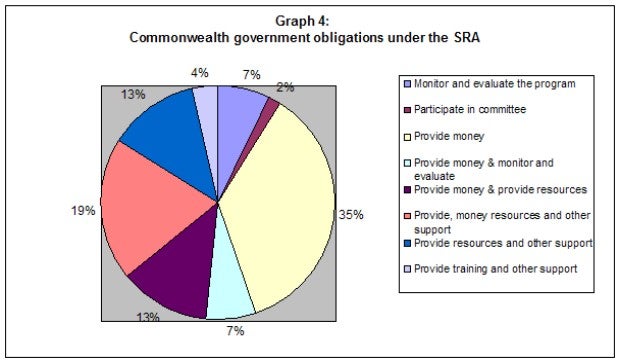
In relation to the federal government, Graph 4 shows that 35% of
communities report that the federal government contributed money to either fund
a salary or a specific project. The next most common obligation (19%) was a
combination of money, resources such as infrastructure, equipment, staff or
consultants and any other form of support.
The range of different federal obligations reported by communities suggests
that at least in principle, the federal government is committing to a greater
range of support mechanisms. This result appears to suggest that through these
SRAs the government is moving away from purely providing funding, to greater
involvement in the actual implementation of a program. This may be through
monitoring and evaluation, provision of resources and infrastructure, as well as
training and participation in steering or other committees.
Given that SRAs are a federal government initiative it is not surprising,
that almost half (42%) of respondents reported no state government involvement
or obligations in the agreement. Graph 5 illustrates the various
obligations of state governments under the SRAs, according to the survey
responses.
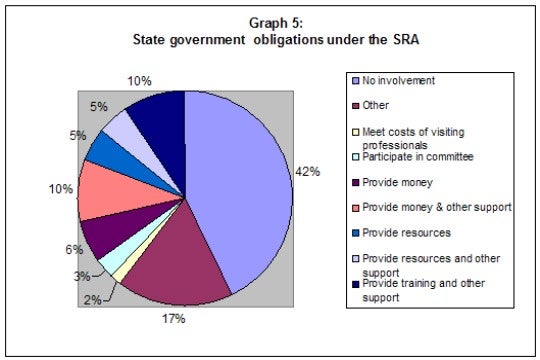
The absence of state government participation in many SRAs may reflect the
simple, single issue nature of the SRAs that have been negotiated to
date.[54] As the process becomes
more sophisticated and ‘comprehensive SRAs’ begin to emerge, it is
anticipated that the level of state government involvement will increase.
Some communities reported positive interactions with state governments and
constructive use of state government obligations in SRAs. For instance, one
community used the SRA process as an opportunity to develop Memorandums of
Understanding (MoUs) with state government partner agencies to improve service
delivery and coordination. One respondent also reported that the state
government made the major contribution, with the federal government taking a
less active role, namely, only participating in steering committees. This may be
entirely appropriate, depending on the individual needs of each community and
each SRA.
The very nature of SRAs bestows obligations on communities in return for the
benefit negotiated with government. As shown in Graph 6 below, the
respondents reported a wide range of obligations.
74% of communities reported that they were required to fulfil two or more
different obligations. The most commonly reported obligation was to provide
labour and other support, which can include either one or a combination of the
other obligations. Other obligations set out in the survey were, to be active
participants in the community, to provide maintenance and security, to organise
sporting and recreational activities or to undertake training.
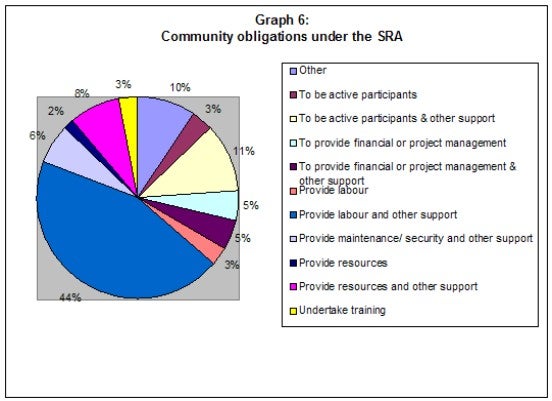
A large number of communities listed more than one obligation. This is
represented in Graph 6 as ‘other support’. A further breakdown
provided in Table 2 below shows how many communities nominated each
category. The most reported community obligation was to provide labour (31
respondents), closely followed by providing financial or project management (29
respondents).
Table 2: Community Obligations
|
Community Obligation
|
Frequency
|
|
Provide labour
|
31
|
|
Provide financial or project management
|
29
|
|
To be active participants in the community
|
20
|
|
To provide maintenance and security
|
19
|
|
Other
|
18
|
|
To provide resources
|
17
|
|
To undertake training
|
16
|
|
To organise sporting or recreational activities
|
14
|
Most of the respondents were able to categorise their obligations. However,
those that provided additional information gave another dimension on the nature
and scope of community’s obligations. In particular, one community
reported obligations on individuals to participate in health treatment, health
education and be supported by family during this treatment in return for
treatment facilities and support.
Another community reported that in return for a municipal service, community
members were obligated, among other requirements, to actively work on addressing
substance misuse issues. Addressing substance misuse is a complex, often
entrenched and resource intensive process. There is concern that this sort of
obligation may be disproportionate to the obligation and commitment made by the
federal government, particularly if the SRA is not accompanied by related
services and programs. This may ultimately place an unfair burden on Indigenous
communities and has the potential to fail and consequently discredit the
Indigenous participants, not the funding party.
Given the large proportion of communities obligated to provide labour and
other resources, it is not surprising that 61% of respondents reported that
their local CDEP scheme is involved in activities for the SRA. A further 29%
reported no CDEP involvement and 10% of the respondents didn’t know if the
CDEP were involved in the SRA.
Of note is the very low number of respondents who reported that the federal
government agreed under the SRA to increase CDEP places in the community. Only
three communities indicated a government commitment to increase places, combined
with other obligations. As noted in last year’s Social Justice
Report, it is important that if an SRA requires CDEP labour from the
community, this should be negotiated so that the SRA does not result in the
re-allocation of necessary places away from existing activities, rather than
resulting in the provision of additional SRA CDEP
places.[55]
- Monitoring process for the SRA
To ensure obligations are being met by all parties, monitoring and
evaluation is crucial to the SRA process. Nearly all of the respondents reported
some form of monitoring of the SRA, with a small number of nil responses, or
respondents unsure about the exact process. On the whole, most respondents
appear satisfied with the processes in place.
Almost a third of the respondents specifically reported that their local
Indigenous Coordination Centre (ICC) is involved in the monitoring and
evaluation of the SRA. Once again, most descriptions of their role was
favourable although one community did express concern, describing their
monitoring process as:
... to be hounded by the ICC Broker to spend the money and only in a
particular way or process. Our organisation had to carry all the administration
costs as well - no provision for that by the ICC broker or the SRA.
However, most of the monitoring processes in place did not appear to be too
onerous on the community. Many communities seem to have incorporated monitoring
and reporting into existing meetings or providing data and documentation that
should be readily accessible. Other examples of monitoring processes
included:
- monthly steering committee meetings;
- council and community meetings included discussion and monitoring of the
SRA; - quarterly or monthly progress reports on project, often completed by the
community project worker; - provision of photos documenting work completed;
- provision of financial records related to the project;
- provision of statistics, for instance, about the number of participants in a
project or any improvements against agreed performance indicators; - participant satisfaction surveys; and
- consultations and interviews with relevant staff working on the project.
- The negotiation process for the SRA
SRAs are a new way for government to engage with Indigenous
communities about their needs. In last year’s report I set out guidelines
for agreement making that incorporates the free, prior and informed consent of
communities.[56] This year, through
the national survey, I have been able to examine how communities feel the
negotiation process is working for them, and in turn how it upholds these key
human rights principles.
When asked why communities decided to negotiate an SRA most indicated a
particular community need or service delivery gap that they thought could be
addressed by the SRA. It is noted that five respondents (8% of the sample)
stated that they entered into the SRA negotiations as they felt they had no
other alternative to access much needed funding.
In the survey I was interested in how the SRA negotiation process was
initiated and progressed. As illustrated in Graph 7 below, 39% of
respondents indicated that the government, usually through the local ICC,
approached the community and suggested the SRA. The next most frequent
initiation process was by the community identifying a need itself and then
approaching government (30%).
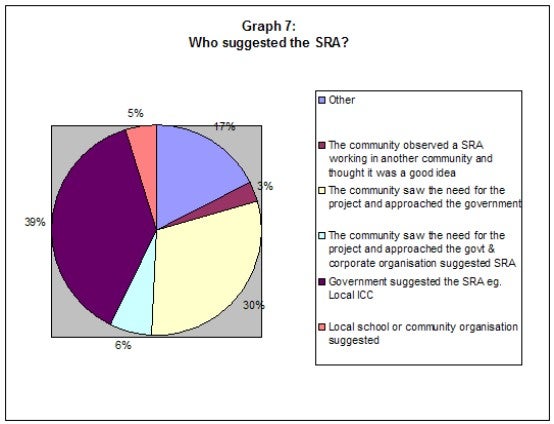
Once the SRA had been suggested, Graph 8 shows that 19% of the
respondents reported that community consultations were undertaken in preparation
for the negotiation process. Community consultations were used to help prepare
the community negotiators for the SRA negotiation and to discuss the content of
the SRA and the obligations on the community. A further 27% of respondents
stated that community consultations were held in combination with another method
of preparation, such as community planning or engaging a negotiator. The
exclusive use of professional negotiators or advisors occurred in a small number
of reported SRAs (3%). Communities were much more likely to utilise members of
staff from their organisation to negotiate on behalf of the community, in
conjunction with community consultation or community planning processes or
negotiators, totalling 33% of all respondents.
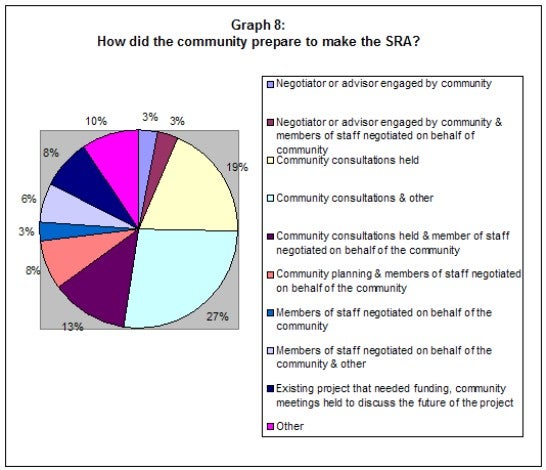
In recognition of the possible complexities and barriers impacting on
effective negotiation, the survey also asked participants about any assistance
they received from government to facilitate the process. Graph 9 illustrates these results.
The local ICC seems to have been most instrumental, with 33% of the
respondents reporting that a staff member from the local ICC assisted in writing
a community plan, with a further 3% providing resources as well. Respondents
identified that a Solution Broker from the local ICC was used in 5% of cases.
Solution brokers from the ICC, in addition to other support/ specialist
consultant from the ICC were used in 16% of the cases reported. These results
suggest that there is not an understanding of the concept of ‘solution
brokers’ among Indigenous communities, as in most instances ‘a staff
member from the local ICC’ will be a solution broker.
11% of the communities surveyed stated that they received no assistance to
facilitate the SRA. Through a correlation of answers, it is clear that
communities that received no assistance were more likely to be dissatisfied with
the SRA process overall.
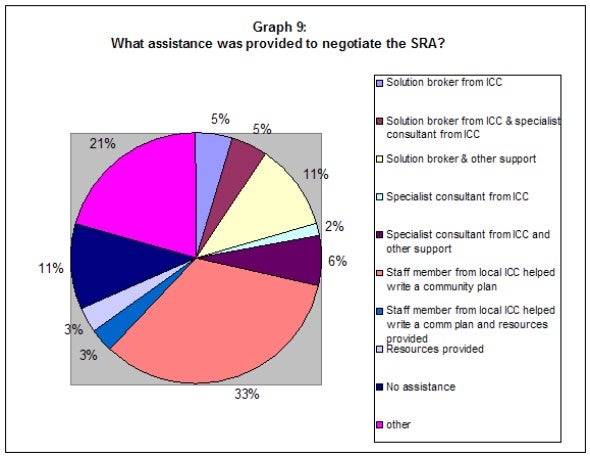
The federal government designed SRAs seems to be a responsive, flexible way
for Indigenous communities to access government assistance. They aim to cut down
‘red tape’ and therefore should occur in a timely manner. Graph
10 shows that 10 % took less than 1 month, 27% took up to 3 months to
negotiate, 39% took 3-6 months and 24% took 6-12 months. Notably, one respondent
indicates that the process has ‘gone on for 18 months and there is still
no sign off’.
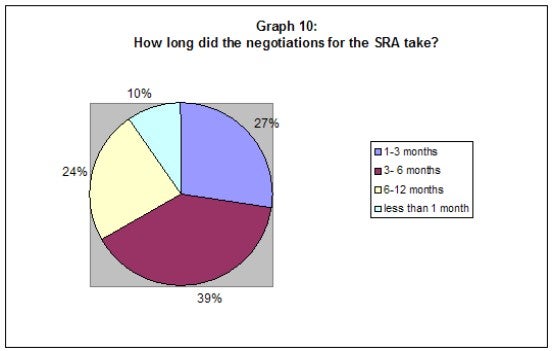
While the amount of time spent negotiating the SRA is one indicator of
efficient processes, another significant consideration is whether the community
considered the negotiation timeline appropriate. If the process is too slow
there can be frustration that can ultimately undermine the relationship between
an Indigenous community and government. Conversely, if the process moves too
quickly, a community may be unable to consider the full implications of the SRA,
compromising their free, prior and informed consent to the SRA. The measure of
efficiency must then be once the community has signed off on the SRA and the
time it takes for the delegate to consider, approve and release funds.
Graph 11 shows community perceptions of the timeline for negotiating
the SRA. 45% of the communities felt that the process went at the right pace for
them. 27% felt the process was too slow; either as the community was ready to
finalise the agreement but had to wait for the government to approve the
agreement; there were delays during the negotiation process which meant that the
agreement took longer than it should have; there was a lack of community
knowledge; or a combination of all these factors. 9% of the respondents found
the process too fast and felt either that the government had pressured the
community to finalise and sign the agreement too quickly; that the government
had set timeframes that did not allow enough time for the community to consider
the implications of the proposed obligations; or both.
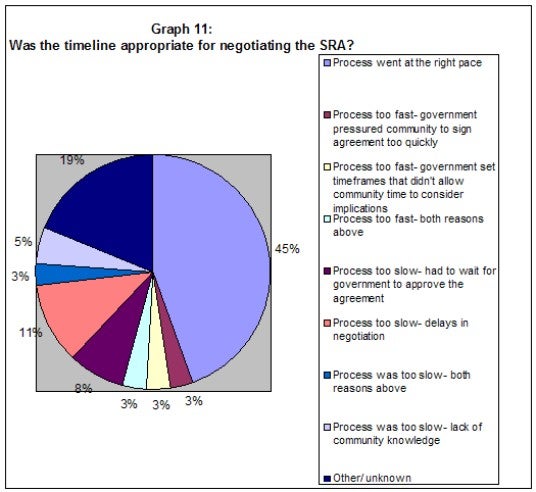
In order to ascertain whether the free, prior and informed consent of
Indigenous communities was sought, the survey asked about the amount of
information provided to the community during the SRA negotiation process. Graph 12 shows that 53% of communities felt that they had received the
right amount of information about SRAs; this is a disturbingly low figure for
this question.
20% of the respondents didn’t feel the community had enough
information. For instance, one community specifically stated, ‘All we knew
was it was a funding grant, it only became apparent later that it was a SRA when
they came visiting to monitor the activities’. This statement implies that
the community was not aware of their respective obligations under the SRA until
ICC staff visited to monitor the activities. 27% of respondents responded
‘other’, many of who acknowledged that the SRA process was new and
not enough was really known by both sides at that juncture.
Some respondents commented that information needs to be in a more accessible
format. This sentiment was echoed by the 6% of respondents who thought that too
much information was provided about SRAs.
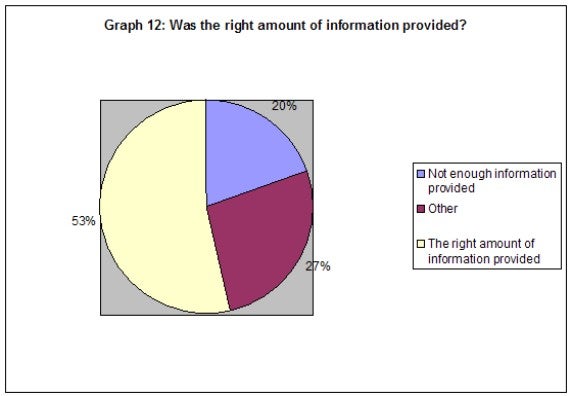
Relating again to free, prior, informed consent, the survey asked how
approval was sought for the SRA and how community members were informed of their
obligations. Graph 13 below shows the results. The community board/
council approved 27% of the SRAs in the survey sample, and were involved in a
further 27% of approvals, combined with approval from the CEO and/ or
Chairperson, or a community meeting.
Significantly, 8% of the respondents reported no approval from the community.
Two of the SRAs which did not receive community approval appear to have been
negotiated by non Indigenous organisations. The survey does not, however, enable
us to determine the quality of the consultation process leading to approval. In
one reported case where a non-Indigenous organisation appeared to have
negotiated the SRA, the only form of consultation reported was a morning tea to
go through the SRA with stakeholders so that they could approve and sign the
document.
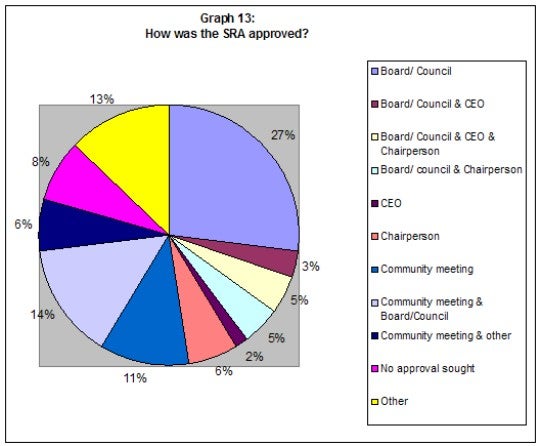
Multiple methods have been used to inform community members of their
obligations under the SRA, as shown in Graph 14. The most popular (33%)
was a community meeting, combined with some other method such as displaying a
copy of the SRA in the community centre, providing a copy to community members
or providing information at board or council meetings.
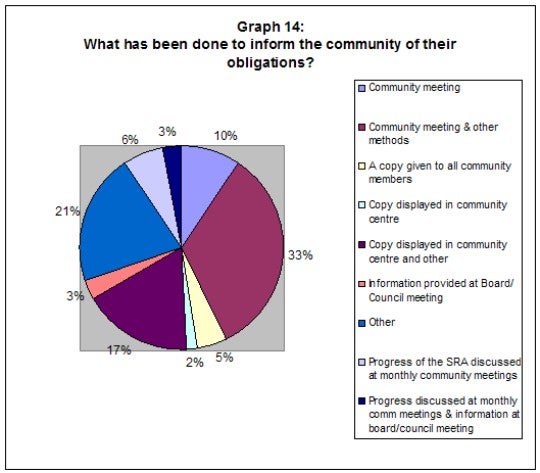
- Delivery of commitments and community satisfaction with the SRA
process
One indicator of general community satisfaction was whether or not
the federal government had met its obligations under the SRA. Graph 15 shows 57% of communities reported that they were satisfied with how the
government had met its obligations. Only 3% reported that the government had not
met its obligations, but 19% reported that while the government had met its
obligations, they were not satisfied with how they had done so. That nearly one
quarter of respondents were unhappy with the nature of how government met its
obligations is of significant concern.
When asked to explain their answer, very few respondents with positive
feedback provided explanation. Those with less positive perceptions cited issues
around lack of recurrent funding; unreasonable reporting and administration
requirements; inflexibility once the SRA is signed off; lack of ongoing
government support to make the SRA work and an unequal relationship between
communities and government, with communities facing a heavier burden of
obligation under the SRA than government stakeholders.
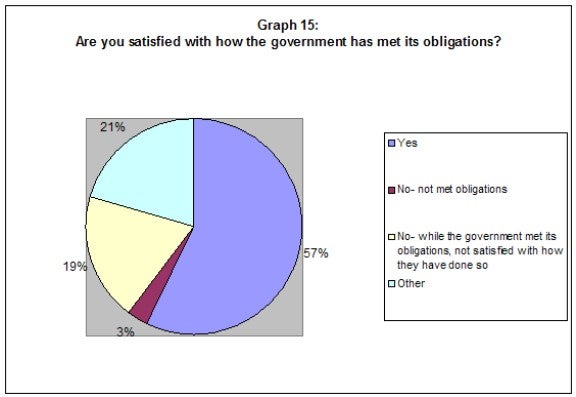
Communities were also asked to identify and rate the three main positive
impacts of SRAs on their relationship with the federal government. All but five
of the survey respondents were able to identify some positive impact on the
relationship. Common themes in the responses were:
- greater accountability of government to the community;
- local and accessible staff to assist the community from the ICC;
- greater awareness of government functions, relevant policies and
programs; - better communication between government and communities;
- greater understanding of the SRA process;
- more consultation; and
- improved linkages with other government departments.
When asked about the three main negative impacts on their
relationship with the federal government, almost 70% of the respondents did not
list any issues, implying that the majority of survey respondents ultimately saw
the SRA process as having either no effect, or a positive effect on their
existing relationship with the federal government.
Of those 30% that did report that the SRA had a negative impact on their
relationship with the federal government, issues were raised around:
- Unclear expectations, according to two respondents, governments ‘keep
moving the goal posts’ and therefore it is difficult for communities to
understand and fulfil their obligations under the SRA.
- Lack of flexibility in the relationship between the community and the
government. This was commented on by three respondents who noted that when
circumstances necessitated that the SRA change, the government was unwilling to
do so. For example, in one SRA the community had agreed to renovate an old
building to be converted for use as a school. Once the agreement had been
signed, it was found that the building would require repairs far beyond the
capacity of the community and as agreed upon in the SRA. No additional funding
was supplied to the project and the organisation was then required to
‘pick up the pieces’ and find the additional funds for the project
to go ahead.
- Lack of cultural awareness and the unique needs of each community, or as one
community described government practice, ‘putting everyone in the same
category’.
- Lack of recurrent funding impacting on the sustainability of project.
- Perception that a failure to enter into an SRA may jeopardise other funding
applications.
- A perceived condescending attitude of government.
All but three communities were able to identify positive impacts on
the community resulting from the SRA. Most were outcomes related to the actual
SRA, ranging from modest impacts such as children being able to play basketball
to increases in school support and retention, better access to nutritious food
and reductions in juvenile offending. Some respondents also noted an increase in
community pride and cohesion and a sense of ownership of the SRA. One community
reported ‘confidence in the government post ATSIC’ and another
suggested the process has encouraged them to undertake another SRA.
Some communities saw SRAs as a way to increase accountability, with one
community stating:
The SRA is a fantastic tool to develop a range of ‘tied
outcomes’, not only for the Indigenous community/organisation but also for
the other stakeholders such as federal departments, state and territory agencies
and other stakeholders.
Other communities felt that the SRA was a good concept that could work, but
had concerns about the implementation. For instance:
The idea of SRAs is good but it has to be done properly. It has to help the
community to have sole commitment to make sure that their part of the deal is
done properly. If only there is enough money (because) this is the best way to
in which the community can learn to stand on their own feet.
50% of the respondents reported some negative impacts as a result of entering
into the SRA. The most common concern was the short term nature of the funding
effecting the sustainability of projects and creating, according to one
respondent, ‘false hope’. One community in particular notes that if
a SRA fails:
... it effects other programs. They become very disappointed about
everything...It is hard to start another project because the trust and the faith
in doing something are not there anymore.
Particularly in remote areas, there was a perception among communities that
support needed to be in place for ‘at least three years’ to yield
any positive change. One respondent stated that:
My concern is that SRAs are often short term fixes or band aid solutions.
What most organisations need is reliable, ongoing and viable funding to enable
forward planning to take place in projects to assist Indigenous communities.
Another common theme was under funding and under resourcing, with communities
either needing to make up the short fall or reduce the scope and expectations of
the SRA project. One example of this relates to a SRA for a swimming pool where
the funding did not take into account the additional power costs and required
staffing levels to operate the swimming pool. As a result, the community did not
have adequate resources to meet all the swimming pool costs from the SRA and was
required to keep the swimming pool operational through other funds.
Similarly, another community noted that during the time that passed between
negotiating the SRA and actually commencing the project, the costs involved had
substantially increased and the short fall had to be made up by the community.
As most communities do not have ready access to discretionary funds, there is
potential to misuse funding provided for another purpose to prop up the SRA.
Other negative impacts included confusion in the community about the SRA, and
the amount of time and resources spent on administration. One respondent sums up
this perception, ‘SRAs are very time consuming for not a lot of
return’. Some communities suggested that this could be overcome through
additional support to assist in meeting reporting commitments, or reducing the
frequency of reporting.
There is also a sense among a small number of communities that the SRA was
not actually addressing the cause of the issue. One respondent stated that the
SRA:
... does not address the core issues - people raise their very real concerns,
often pouring out their hearts, and think their views are being taken into
account and then NOTHING (emphasis in the original).
In some ways, this may reveal more about community perceptions of SRAs and
the lack of accurate information they have received about the scheme, than the
actual SRA. Given that SRAs provide ‘a discretional benefit in return for
community obligations ... (in) the form of extra services, capital or
infrastructure over and above essential services or basic
entitlements’[57] it is
unlikely that SRAs do in fact have the capacity to address complex, entrenched
problems, at least in their current form. It is therefore imperative that
government works with communities to properly inform them about reasonable
expectations of the SRA scheme.
Finally, communities were asked whether they would enter into another SRA. Graph 16 shows 63% stated they would, 5% would not and 32% were not sure.
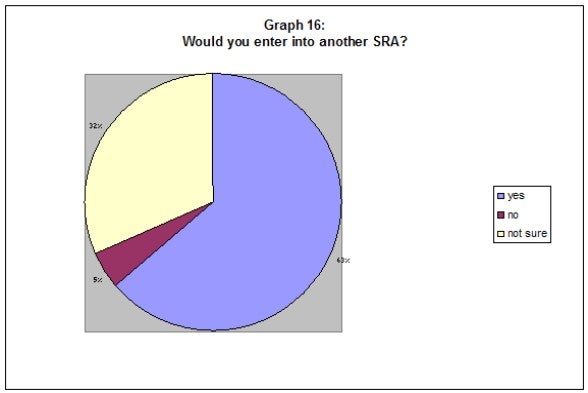
An analysis of quantitative and qualitative responses, looking at
indicators of satisfaction such as any positive changes in the community, the
relationship with the federal government, whether obligations have been met,
whether the community would enter into another SRA and any other comments, is
demonstrated below in Graph 17.
Accordingly, 39% of participants were generally positive about the SRA
process. A further 13% were also positive but noted some significant areas of
concern around the process or negotiation of community obligations. 16% were
negative about the process and another 8 % also gave substantial negative
feedback, but stated that they would probably enter into anther SRA. The
remaining 24% were quite ambivalent about the process or there was not enough
information in the survey response to categorise the feedback.
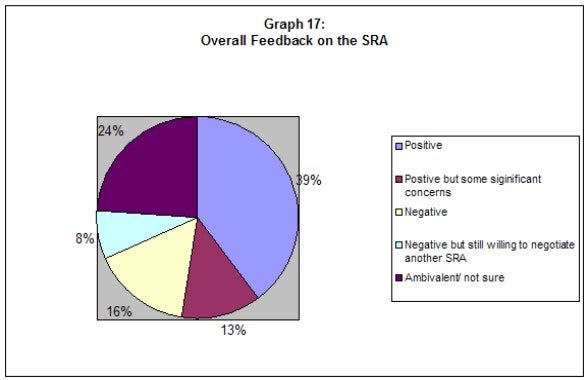
- Lessons learnt from entering a SRA
In order for the SRA process to function it is important that
communities are well resourced and have the capacity to negotiate an appropriate
agreement. The survey asked respondents what communities or organisations need
to successfully negotiate a SRA. While this varied across communities, commonly
reported themes were:
- community input;
- community leadership;
- sufficient information about the SRA;
- good literacy skills;
- a professional/ skilled negotiator;
- sufficient time to consult and consider the implications;
- communication between the government and community;
- long term financial support to ensure the SRA project is viable;
- involvement of state and local government;
- a clear timeframe;
- outcomes that are realistic and can be measured;
- good management practices in the community/organisation, and
- experience with grant administration and financial accountability.
While the survey did not ask the respondents whether they in fact
thought their community possessed these qualities, it is probably safe to assume
that some capacity building and community development will need to take place if
communities are to feel confident in negotiating SRAs.
Many of the respondents also noted how important a good, open relationship
with the local ICC was in negotiating the SRA. Related to this, a few
respondents called for greater ‘backbone’ for the ICC to make
decisions rather than referring back to head office. However, it should be noted
that financial delegation to ICC managers has increased in the past year which
may partially address this in the future. There was also a general concern that
ICC staff needed to better understand community development principles to ensure
that the SRA best addresses community advancement.
- Survey conclusions
The survey has provided valuable feedback about how SRAs are being
negotiated and implemented in a wide range of communities across the nation.
From the survey responses it appears that the majority are generally positive
about the process and report improvements in the relationships with government.
Many communities are enthusiastic about their ability to access flexible funding
tied to their own initiatives and all parties should be commended for developing
some innovative projects.
There are also valuable lessons to be learnt from the feedback provided in
the survey. The quality of support, consultation and information is very
important and could be improved. There were instances reported in the survey
where no support was given to communities to negotiate the agreement and even
more worrying, some communities report feeling rushed through the process with
inadequate time to consider the full implications of the SRA. Communities need
to give their free, prior and informed consent when they are negotiating these
agreements. Support, consultation and accessible information are therefore
imperative if this is to be achieved.
The effective participation of Indigenous communities in the negotiation
process is not only important to achieve good outcomes, but is also an issue in
human rights compliance. Those communities that report feeling rushed or ill
informed may not have had the opportunity to give their full, prior and informed
consent as required by human rights standards.
The role of the local ICCs has been generally praised by the respondents and
seems to be working as an effective link between government and local Indigenous
communities in this area of service delivery.
However, community confidence and satisfaction in the SRA process seems to be
limited by the short term nature of the funding, the bureaucratic burden of
additional paperwork, disproportionate accountability requirements, lack of
flexibility once the agreement is signed and unrealistic expectations of the
community party of the SRA.
Not all respondents had strong views, with the survey picking up on a
significant degree of ambivalence towards the process. For these respondents,
SRAs may seem to be just another government programme that may or may not assist
them. Many were pragmatic, recognising that they had no real alternatives to
access fund and were willing to utilise the scheme to the best advantage of
their community.
A common theme among respondents is the need for communities to have
significant capacity to consult with community members, strong leadership and
governance, experience in management and administration and strong negotiating
skills to gain a good, fair SRA. There seems to be considerable scope for
further community development and capacity building (for community and ICC
staff) to enable communities to make the most the SRA scheme and promote social
justice for Indigenous communities.
Overall, the Survey results suggest that SRAs have the potential to create or
improve relationships between the government and communities when they are done
well. Done poorly or without adequate consultation, they have the potential to
create disenchantment amongst the community that may prove difficult to shift in
the future.
The potential benefits of SRAs can quickly dissipate, particularly where
agreements relate to one off, short term projects and in the absence of ongoing
interaction. SRAs can provide an entry point into genuine consultative processes
at the community level – so long as the momentum and goodwill created in
communities is acted upon in a timely manner and on a basis of mutual benefit
and partnership.
Text Box 1: Selected quotes from survey respondents about SRAs
Positive impact on community relationship with the federal
government
‘Establishment of a positive professional relationship and networks
with government departmental officers in several portfolios.’
‘We see government officials more regularly.’
‘Confidence in engagement with government post ATSIC.’
Positive outcomes from the SRA
‘The children have enjoyed going to school because of the bikes and
equipment.’
‘Assisted with much needed accommodation.’
‘Pride by the elders in the role they play.’
‘Improved self esteem for local Indigenous people and the delivery
of practical and relevant training developments programs which have resulted in
real employment outcomes for members of the local Indigenous
community.’
‘Better health for community members.’
‘A community response to solve issues in the
community.’
Concerns about the SRA process
‘SRAs are very time consuming for not very much
reward.’
‘The process of the SRAs has not been successfully explained. Key
personnel deal with the bureaucracy and then have the task of explaining the
process to communities. Not enough real education/promotional material
available.’
‘My concern is that SRAs are often quick fixes or band aid
solutions. What most organisations need is reliable, ongoing and viable funding
to enable forward planning to take place in projects to assist Indigenous
communities.’
‘I felt that the accountability should be proportionate to the
amount of funds sought eg. Targets/reports/school visits etc for $10,000 seems
over the top when schools have several small grants to manage.’
‘Shared responsibility is only shared if both parties truly
understand what they have negotiated. There is no way this has happened in this
instance.’
Case studies of specific SRAs
This section contains the outcomes of three community consultations conducted
in late 2006. My aim was to select three communities and organisations in which
the SRAs reflect different subject matters and also to sample communities and
organisations that represented different types of organisations and relative
remoteness. The three case studies are:
- Girringun Aboriginal Corporation, Cardwell, Queensland;
- Cape Barren Island, Tasmania; and
- Baddagun Aboriginal Organisation, Innisfail, Far North Queensland.
The case studies provide a more detailed perspective on the
specific challenges faced in negotiating an SRA from the perspective of
Indigenous community organisations. They provide specific examples that
complement the survey results. I anticipate that further case studies will be
undertaken and reported in my 2007 Social Justice Report.
- Case Study 1: Girringun Aboriginal Corporation, Cardwell,
Queensland
a) Background
This case study is based on interviews conducted with Mr Phil Rist, the CEO
of Girringun Aboriginal Corporation.
Girringun Aboriginal Corporation, located in Cardwell, between Cairns and
Townsville, is a community based organisation formed from nine
cultural-linguistic groups (Bandjin, Djiru, Girramay, Gugu Badhun, Gulgnay,
Jirrbal, Nywaigi, Waragamay and Warungnu) of that region, and representing the
interests of the traditional owners of those groups.
Girringun entered into a SRA on 3 March 2005 with the Commonwealth Government
through the Townsville ICC, and with the Queensland Government through the
Department of Aboriginal and Torres Strait Islander Policy.
The SRA provided funding to enable the organisation to develop a corporate
plan, to strengthen governance structures, provide a forum to negotiate with the
different levels of government, and to develop a document that can be used as a
community resource and which outlines a longer term vision for the community.
The SRA was also meant to enable Girringun to engage a project officer to
develop the organisation’s corporate plan. In this SRA, the Commonwealth
provided $64,996, and the State Government provided in-kind support including
training for a project officer to participate in a project steering
committee.
Girringun works within a strong cultural context, and draws on this to
develop innovative approaches to the many challenges its communities face. One
such approach is based on outstations, which are community settlements on
country. Phil Rist provided an idea as to how some of the many critical issues
facing the community such as health, education and justice might be addressed by
further involving these outstations:
It’s the fact that you’re on country, contributing to the health
of your country that contributes to your wellbeing. The outstation program, it
could address this sort of thing, and make them feel good at the same time ....
They’re back on their country doing this stuff; but it’s also a
wellbeing thing, it’s a health thing, and it’s making them feel a
lot better.
As with the other case studies, the SRA for Girringun was introduced into a
context in which the organisation was already involved in negotiations with the
Australian and Queensland governments for a range of issues. As Phil Rist
recalled:
... our SRA was for extensive consultation with the community to gauge what
the community’s concerns were regarding a whole range of issues: health,
justice, education, the whole box and dice.
Prior to the introduction of the SRA, Girringun had already been
participating in a ‘negotiating table’, which is a forum established
to enable the community organisation to conduct ongoing discussions with
government. As Phil Rist explained:
Our SRA complemented the ‘negotiating table’. In this context, we
negotiated with the commonwealth about money for a corporate plan before the SRA
was even mentioned. So we got the money, and that process was happening.
b) Positive aspects of the SRA
For Girringun, there was a positive aspect to the SRA in that it presented a
good opportunity to facilitate community discussions, and the preparation of a
community plan that dealt with a range of important issues:
So in that document (the corporate plan), through the consultation process,
within our crowd, we raised those issues, but we also looked at within the plan,
hopefully, ways of addressing some of those issues. So on that aspect it was
good, and yes I would go for another SRA .... We’ve got a document;
we’ve gone through the community consultation, we’ve got a document
that highlights their concerns, and possible ways of how we can address them. So
from that sense it’s been a success.
Another benefit of the SRA ‘is that it informs the community
negotiating table’. Phil Rist explained that: ‘So we’ve done
that; we’ve completed that. That particular SRA is finished. It continues
to direct and inform the negotiating table as far as state agencies go. So
although it’s finished, it still has a life as far as directing where we
go with the whole thing, you know’.
Although in principle the SRA had presented a useful opportunity to further
focus the ongoing discussions, the CEO expressed some cynicism at the
introduction of these kinds of agreements: ‘Then all of a sudden,
‘hey, I know what, why don’t we make this a SRA!’’
A similar view had been put by other communities and organisations regarding
their perspectives on SRAs. There was a sense in which the SRA is regarded by
Girringun as an opportunistic device introduced by government to promote its own
achievements in Indigenous affairs:
So there was already that process, which had been going for two or three
months at the time. And to be honest, that SRA could not have happened at all,
because we were going to achieve it (the corporate plan); we were going to have
a document anyway, whether we signed off on this SRA or not. I think this was
just a way of the government saying ‘we’ve got another SRA;
we’ve signed an SRA with Girringun’. It was going to happen
anyway.
This cynicism was supported by the fact that for Girringun, the SRA to
develop its community plan was not an initiative from the community. As Phil
Rist explained: ‘Government came to us’. This in itself was not
necessarily a problem, especially in the vacuum left by the loss of ATSIC, and
as long as the opportunity presented by an SRA could be effectively harnessed by
Girringun in order to meet its own goals. Phil Rist elaborated:
With the demise of ATSIC, a lot of us in the community thought this might not
be a bad thing. They’ve taken away our entitlements, our government
structures; they’ve taken away our national voice. This might be an
opportunity for us to get some direct funding into the organisation and some
direct outcomes.
It was in this context that the Australian government seemed to be
articulating views that were in accord with Girringun’s own notion of how
funding should be provided to Indigenous organisations:
...the government were saying all the things we wanted to hear, ‘oh, we
want grass roots ... so that money can easily flow to the grass roots mob, and
where there’s good governance structures in place, good accountability,
and well functioning boards in place, that’s where we want the money to
go’. So all the rhetoric was there, and we thought, ‘oh this is not
too bad, might turn out to be alright after all’.
c) Concerns about the SRA
Despite this positive sounding ‘rhetoric’, in Phil Rist’s
view, Girringun nonetheless faced many problems in translating rhetoric into
effective actions from the government: ‘we’re still waiting.
We’re a grass roots organisation, but we still struggle to find where the
money is’.
A major concern expressed by Girringun, which was also found in discussions
with other Aboriginal organisations for these case studies, is that the SRA
process introduced into the community a sense that some real actions might be
forthcoming from government to address the community problems.
As Phil Rist explained: ‘What we do is raise peoples’
expectations through this consultation process; so we’ve got to be careful
how we manage that’. Yet these raised expectations also have the potential
to bring about great disappointment and frustration:
So if our mob have said ‘we’ve talked about this, we’ve
gone through this process, we thought we were going to get some outcome from
this thing, but we’re still none the better off, what the hell is going on
here?And then that dissatisfaction starts to eat away at our mandate, for whatever
reason. And then no longer have we got the mandate to negotiate on behalf of our
mob, and it really becomes a problem.The government, to some degree, both the state and federal, have backed us
into a corner ... but they’ve also raised expectations with this SRA. So
it really calls for a strategic approach on out part, how we sell that process
to our mob, with the view of not raising expectations, maintaining our mandate,
and trying to implement a process that will deliver some good outcomes for
us.
The ways in which these unmet expectations were experienced by Girringun is
illustrated by the establishment of the negotiating table. Phil Rist explained
this point:
I’ll give you my view of what I thought the negotiating table was. The
SRA with that document (the corporate plan) has achieved its goal. We’ve
got a document there, so that’s fine, and it’s informed the
negotiating. My idea of the negotiating table was that at the end of the day was
that more resources were going to come to this sort of thing because we’ve
jumped through the hoops of government monitoring; we’ve got a community
or corporate plan. We’ve got a good board, we’ve got financial
accountability; we’ve done all that sort of stuff. But we still struggle
to attract funds for long term sustainability.
The problem for Girringun is that the SRA had provided funding and support
for a negotiating forum for the community to discuss a range of issues of
critical importance, and to develop a community or corporate plane based on
these discussions. But there was inadequate scope within the SRA to provide
follow up implementation and ways of addressing the issues raised during the
negotiations and in the corporate plan:
We’ve got the document, the corporate plan. It’s raised issues.
... What I thought would be an outcome of the negotiating table was the position
at Girringun (to deal with education issues). We’ve highlighted the
problem in the corporate plan; let’s negotiate through the negotiating
table about ways of fixing that. And what I thought was a way of fixing it was
for a position based here at Girringun that would go and talk to education
providers, and investigate ways of addressing that problem, and start to
implement, start to initiate some of that stuff.
One of the major flaws, from Girringun’s perspective, was that the SRA
provided no for ongoing positions within the organisation. This meant that the
Girringun has been unable to achieve its longer term goals, thus casting
considerable doubt on the usefulness of the SRA process:
But what we’ve got through the corporate plan, through the negotiating
table is again, expectations. Well, we’ve come to a full stop, because
they (government) say we can’t employ someone to do it; and what
we’ve got instead is already stretched personnel here trying to fulfil
those expectations, and trying to look at implementing programs. So it’s
compounded the problem even further, and that’s right across the board,
whether it’s education, whether it’s health...
The negotiations to develop SRAs exposed many of the problems Indigenous
people encounter in their dealings with government:
In spite of all the problems out there – government keeps changing the
goal posts ... in spite of all that we still managed to progress, to go forward,
with no uncertainty about positions here; uncertainty about whether
they’re going to be here next year.
This ad hoc nature of government relations with Girringun creates an
uncertainty that impacts significantly on the latter’s capacity to operate
over the long term as a viable community organisation. Girringun operates on
project based funding, which covers wages and on-costs, but does not provide for
core funding for the organisation’s long term economic sustainability:
The way the government’s dealt with it at the moment, with project
based funding, we can put in for a project, but we get a person on board, and
it’s only for the life of that project, and that person’s gone
again.
A common problem for organisations such as Girrungun is that many members of
the community of which it is a part feel alienated from government. As Phil Rist
put it:
But governments have got to remember that we’re dealing with people
– a lot of our people haven’t got the basic understanding of the ...
I’m not saying that in a bad way ... but it’s a fact that a lot of
our people don’t have a basic understanding of government protocol.
This is an ongoing concern: ‘That’s the sort of stuff that
we’ve got to be careful about, because we have been consulted to death,
and there are no real outcomes’.
During the negotiations with government Girringun had argued for funding
support for the ongoing economic and cultural sustainability of the
organisation. Phil Rist said:
One of the main things we said we wanted through the negotiating table was
core funding for the long term sustainability of this organisation. The Plan is
great; put that Plan on the table here. But if we don’t address the long
term sustainability of this organisation it’s worth nothing...It’s been a struggle at times to maintain the enthusiasm, commitment to
the long term sustainability, to maintain (a) relationship with the ICC. But we
have to maintain a relationship: what hope do we have if we start bagging them?
... There’s no point doing that. So it’s really stretched the
relationship at times. But we have to (maintain a relationship), we have to keep
going. Because it’s not in the best interests of everybody if we started
bagging ICC staff; they’re guided by guidelines and policies as well.
Although the SRA provided a useful avenue through which the ongoing
negotiations with government could be focussed, there were some issues raised
about the relative mandates of the community, and of the government when
negotiating. Phil Rist explained that the government had indicated it had some
concerns about the nature of Girringun’s authority, or mandate for
negotiating:
Government always comes to us and says to us, when (Girringun’s CEO and
Chairman) walk into a room, we want to be comfortable with the fact that you
blokes have the mandate from your mob, to talk to us at the negotiating table.
And that’s always one of their fundamental expectations of us as office
bearers of this organisation.
In other words, the government had indicated that it thought
Girringun’s representatives at meetings did not have sufficient authority
from the wider Aboriginal community of which it is a part, to participate in
negotiations with government. This suggests a fundamental inequality in
negotiating, which goes to the heart of prior informed consent issues. However,
as Phil Rist elaborated, Girringun in turn, also had some concerns about the
government’s mandate:
It’s a problem, because they demand a mandate of us, but they
themselves (government) don’t have a mandate. We’ve managed to get
together nine traditional owner groups, and elected a board that represents
those nine groups, and speak with one voice. In some places you’re flat
out getting two families together. But here we have made a major achievement
getting nine groups together.
Phil explained that there are some problems with the same ICC officers not
attending meetings, and a lack of continuity:
Surely, if the CEO and Chairman of our organisation can go to those meetings
as decision makers on behalf of our mob, surely we can expect our equal from
those organisations to do the same. What it tells our Board and our hierarchy is
that – or it could be perceived as ... they’re (the government) not
taking us seriously, if they just send a junior officer to deal with it....in the light of what could be seen as lack of actions or outcomes, we
still have to maintain our relationship with those officers.Girringun had its mandate questioned; which they (the Board? the Elders?)
found ironic, when they (the government) themselves don’t have the
mandate.
The Girringun CEO made another observation about the unequal relations
between the government and Girringun in terms of mandate and authority:
Girringun operates over a huge area based on traditional boundaries that go
into the Cairns region and into the Townsville region. When we get DATSIP (State
Department of Aboriginal and Torres Strait Islander Policy) come along, and
they’re from the Townsville office, and we put a question to them, we say
‘Mr DATSIP, how are you going to address this problem in our area to the
north here?’ (and DATSIP says) ‘Oh, well, we’re going to have
to talk to Cairns DATSIP’.
Girringun’s concern here is that the government officer from a specific
regional office felt a need to obtain authority from another office before being
able to make a decision, or to have the authority to voice an opinion; whereas
Girringun already has the authority for its whole organisation and region. Phil
Rist continued:
So that is another problem; they’re broken up into administrative
boundaries, and the problems associated with that. They demand it (the mandate)
of us, but they haven’t got it themselves. And that’s even with
education, health, the whole lot.
There were also concerns at the lack of understanding about community and
cultural matters by government. Girringun is under increasing pressure to
conform more closely to the requirements of a white business entity, with little
or no scope for integrating community or cultural matters into its operation. It
used to be a place where Elders could meet around a campfire, and where they had
felt a sense of place and belonging. As Phil Rist explained:
We’ve got a fireplace at the back here, and very early in the piece
when a lot of our Elders were still alive – there’s a few left, but
a lot of them have gone, and there’s a fireplace at the back there, and
it’s there for a reason. They said to us here, said to me, ‘we
don’t want this place to become another big white bureaucratic thing. We
want to be able to come down here, and to sit down near that fire there, and
smell that smoke come through it, feel that smoke there, so we know that this is
still our place’. So that’s a very symbolic thing, that fireplace;
it’s there, but it’s never been lit for a long time. And we’re
kicking and screaming, trying to fight this government urge to make us another
white bureaucratic system. We’re being dragged further and further away
from that campfire. And that fire’s out; and now we’re becoming this
office –where’s our human rights in that? And I don’t know how
we get that back; I don’t know how we make government understand that. We
can find a balance, but we have got to also give a bit. I know it is
taxpayers’ money.
d) Follow up by government
As with the other case studies, governments had not provided sufficient
follow up of the SRA:
It’s sort of ad hoc. There was no structured follow up to it; there was
no structured lead up to it. That’s the way government is doing business
now. They just get people to sign it: ‘that’s another SRA signed
with people’.
Asked if Girringun would pursue a different approach in negotiating with
government for another SRA, Phil Rist replied:
... well, I would have a very clear direction going into one, with always the
option of pulling out. We’d have to be very clear about what this SRA is
going to achieve for us, how it’s going to achieve it, and some clear
product including implementation, a whole process. I think it would work; I
think you can make it work.
Girringun’s CEO expressed some frustration at the government priorities
being directed to Cape York Peninsula:
The government is looking at long term sustainability but they’re
focusing on Cape York. What about organisations outside the Cape?I don’t have a problem with my brothers and sisters on the Cape. What I
do have a problem with is that rural traditional owners are falling through the
cracks, because they think we can access mainstream services. I know people in
our communities who won’t go to the doctor because it’s not
culturally appropriate. And they’ve got mens problems or womens issues;
they die because its not culturally appropriate for them to access mainstream
services.But there isn’t a focus on rural traditional owners, because the common
thinking is that they can access mainstream just like everybody else.
These comments echo those by Gerry Surha of Baddagun organisation in
Innisfail (in case study 3 below). Similarly, that organisation seems caught in
a situation in which there is a perceived priority given to Cape York Peninsula
communities. For Girringun, location is thought to be a problem, as Cardwell is
between two major centres, Townsville and Cairns, which impacts on the relative
access the organisation has to services:
We’re remote. Townsville don’t want us, so their services
don’t come up as far; Cairns don’t want to come down. There’s
a high population of Aboriginal and Torres Strait Islander people living in this
area here that aren’t being serviced properly.
Phil Rist explained that this remoteness is one of the reasons Girringun has
taken on a role in the region as a provider of services for the Aboriginal and
Torres Strait Islander community. Phil Rist mentioned another project that
Girringun is involved in which had some more positive features than the SRA
process.
The example given is called the Cardwell Indigenous Ranger Unit (CIRU)
project, which is aimed at developing a partnership between Girringun, the Great
Barrier Reef Marine Park Authority (GRMPA), and Queensland Parks and Wildlife
Service, for joint management in conservation and Indigenous heritage. The
approach used for CIRU is called ‘adaptive management’:
‘there’s always a commitment by those agencies to get there ... and
we adapt as we go along’.
For this CIRU project: ‘one of the good things about it is that the
ownership is shared amongst us all; there’s another reason why people are
committed to that, is because we share ownership of it; it’s not just
Girringun, it’s all of us’.
The problems in program and service delivery by governments in the region
prompted Phil Rist to comment further on the role of Girringun. He suggested
that this organisation is well placed for government to enter into negotiations
with. He said that Girringun can play a key role, following the loss of ATSIC as
a peak Indigenous organisation. As a regional, community based organisation with
a good record in the region, he argued, Girringun presents a good opportunity
for the government to invest in for the provision of services and other
community based initiatives:
There’s a really good opportunity for the government to fill that void
to some degree with the demise of ATSIC and regional councils. At the moment,
who do they have if they want to talk to Traditional Owners? They might go to
land councils. Apart from that, where do they go to? And there’s no peak
organisation at the moment. There’s no structure in place where they can
go. It’s in their best interests as well to look at organisations like
Girringun. Because they’ve got a problem, and staring them right in the
face is a solution, a possible solution, but they’re not prepared to
invest in it, for the long term sustainability of the organisation that could
fulfil that role. Girringun here, we’re a land and sea centre, but we do
so much else as well, for a huge geographical area. It makes very good sense to
invest in that organisation, because in this particular area we are a point of
contact, and we are grass roots. So it makes good sense to invest in an
organisation, that’s if you want us.
- Case Study 2: Cape Barren Island Aboriginal Association,
Tasmania
Cape Barren Island Aboriginal Association is an organisation formed
in 1972 representing the approximately 80 members of the Aboriginal community on
the island. The Association is managed by an Aboriginal management committee.
Cape Barren Island Aboriginal Association negotiated 3 SRAs with the
Australian Government, although only two of the SRAs were community based
initiatives. One SRA was for ‘economic sustainability growing from a
stable and affordable power supply’; another was for a ‘community
wellbeing centre’; and the third, to address family violence.
Both the SRA for the community wellbeing centre, and the one to address
family violence were signed on 2 June 2005. The former was with the Australian
government, represented by the Departments of Health and Ageing, and Education,
Science and Training, and the Office of Indigenous Policy Coordination (OIPC).
The family violence SRA was agreed with the Australian Department of
Immigration, Multicultural and Indigenous Affairs (now the Department of
Immigration and Citizenship and whose relevant responsibilities have been
transferred to the Department of Families, Communities and Indigenous Affairs),
and the Tasmanian Department of Premier and Cabinet.
Sue Summers, the Administrator of the Association, provided detailed
background to the three SRAs that were negotiated by this community. Other
members of the community were also present and participated in the
interviews.
a) Process for negotiating a SRA for power supply
Because of its remoteness, the cost of supplying electricity to Cape Barren
Island is high. It is for this reason that the community had sought to obtain
subsidised costs.[58] Despite
ongoing discussions and negotiations over a considerable length of time, and
with a wide range of stakeholders, the SRA for the power supply was not
concluded, for reasons that Sue Summers explained in some detail.
The history of Cape Barren community’s attempts to negotiate for a more
affordable power supply go back some years, to the late 1990s or early 2000s.
The existing power station, utilising a combination of diesel and wind, was
built from infrastructure funding resulting from the 1991 Aboriginal Deaths
in Custody Report recommendations:
However, ‘no recurrent funding was ever provided to maintain or run the
power station. To this day it runs purely on what we can get in revenue from our
customers. So we own the power station and we run it’.
Sue explained that when Tasmanian power was privatised in the mid-nineties,
and split up into Hydro Tasmania and Aurora Energy, a Community Service
Obligation Agreement (CSO) was drawn up for the islands of Bass Strait,
‘but apparently this is the islands of the Bass Strait except Cape
Barren’.
King and Flinders Islands, known collectively as the Bass Strait Islands
(BSI), have an arrangement with the power supply authorities that enable them to
receive power at subsidised costs. Electricity is supplied by Hydro Tasmania,
using a combination of wind and diesel, while the business arm, Aurora Energy
provides ‘operational, distribution and retail services under contract to
Hydro Tasmania’. Since 1998 the BSI have had subsidised electricity
supplied to them under a CSO contract with the Tasmanian
Government.[59] Sue Summers remarked
on this: ‘no one had questioned before why Cape Barren wasn’t part
of that CSO’.
When this question was put to the relevant authorities, the reply was that
this was because responsibility for Aboriginal communities rested with the
Commonwealth government (the CSO was with the Tasmanian State Government). The
Commonwealth did, however, pursue discussions with Cape Barren Island community
in regard to a Council of Australian Governments (COAG) trial site:
That was the beginning: they came and they talked about COAG and about all
the great things they were going to do, and a new way of doing business, and how
levels of government were going to work together to provide really good outcomes
for Aboriginal communities.
Sue Summers commented that ‘I took it for somewhat of a test case as to
how levels of government were going to work together to provide really good
outcomes for Aboriginal communities’. It was thought that the COAG trial,
and the then newly introduced SRAs might offer an opportunity for the Cape
Barren Island Aboriginal community to work with governments to obtain a CSO in
order to receive subsidised power. The Administrator explained the importance of
obtaining subsidised costs for power to the community:
Very early on in the piece, for all of the people that live here, the cost of
providing energy to their household is probably something in the area of forty
to fifty percent of their net income. That’s because ... the power here
only really provides for electric lights and appliances. You couldn’t
afford to use power for heating or for hot water.
While the idea of a SRA for affordable power seemed reasonable at first, as
Sue Summers pointed out, ‘...it was later on that I realised, well, no,
they’re not going to come to the party on this because you can’t
have a SRA for essential services’.
The problem now was that both state and federal governments were saying that
they did not have responsibility for providing recurring funding to the Cape
Barren Island community for power generation:
... it is conflict between the state and federal levels of government; where
there is conflict, well, if your Shared Responsibility Agreement is not the
right mechanism to bring into practice the COAG way of doing business, what
is?
As with many Indigenous communities and organisations, Cape Barren had
already been engaged in discussions with governments and others before the
introduction of SRAs. Sue Summers explained:
The timeframe with the Shared Responsibility Agreement in its various forms
really wasn’t that long. But there had been, over time, even before we
started talking about SRAs, many community discussions with what was then ATSIC,
and the senior management of what was then the National Community Housing and
Infrastructure Program (CHIP), and community consultations with Hydro Tasmania
and Aurora and all sorts of things; so there had been a lot of
consultations.
The Administrator thought that one of the problems is that although there may
be discussions at one level through the COAG process ‘I’m sure that
they are not filtering it down properly through either the federal or state
bureaucracy’.
Although there had been lengthy discussions between the Cape Barren Island
community, the electricity supply companies, the State Government, and the
Australian Department of Families, Communities and Indigenous Affairs (FACSIA),
eventually these failed to reach any agreement regarding power supply to the
island. This was despite the community having provided some funding to support
those negotiations. Overall, the Administrator felt that, through the
community’s experiences with SRAs ‘I’m not sure they’re
necessary’, she had the feeling that ‘they’ve actually run
their course’.
b) Negotiating a SRA for a Health and Wellbeing Centre
The community achieved more success negotiating a Shared Responsibility
Agreement for a Health and Wellbeing Centre. This SRA was signed on 2 June 2005.
The community had funds it had acquired from the Office of Aboriginal and
Torres Strait Islander Health (OATSIH), and some for an aged care program. For a
long time, the Administrator explained, the community had wanted to develop an
appropriate space where community health and wellbeing activities could take
place. When SRAs were introduced, the community thought this might present an
opportunity to work with a number of government departments, to move ahead with
the health and wellbeing centre:
What the idea was – having discovered that no way could I get these
government departments to agree to put their money in together – then came
Shared Responsibility Agreements. Let’s have the State, the Feds, and
everybody help us to use up this surplus, give us a bit more if we need it, to
get up the building that would in fact be able to be used for the oldies, and
for the councillors if they came in – a whole range of, if you like,
social health and wellbeing stuff.
There were discussions and negotiations about coordinating government
departments, and some additional offers of funding. However, the negotiations
ran into some difficulties.
The community wanted to renovate an old building in order to develop the
health and wellbeing centre, but had some difficulties reaching agreement with
government departments in regard to the way this would proceed. Another problem
occurred when the project was already at a relatively advanced stage. Work on
the development of the centre was delayed because difficulties were experienced
with regard to dealing with ATSIC over the assets that were held in the
building. The community at that stage experienced very real frustration, as Sue
Summers explained:
It didn’t really impact on the community, except that people were
getting very anxious towards the end, (wondering) ‘is this really going to
happen?’ We’d been talking about this Health and Wellbeing thing for
quite a long time before, and even before we started... SRA was the way to go.
Before that we couldn’t get anybody to talk together about pooling their
funds. And so again, this reinforced for me that idea that, alright, you know,
the (commonwealth) government think tank comes up with an idea – this is a
great way to do business: ‘Let’s sort out our own issues with the
state, and how we spend what Aboriginal funding, and so on ... but it
wasn’t really happening.
For Sue Summers, and the Cape Barren Island community generally, although
there was much benefit in pursuing a SRA in order to develop an idea that had
arisen from the community, there were many hurdles in actually bringing this
about, and working with governments.
With the Health and Wellbeing stuff, that was the stupidest thing. The
community had a really good idea. It was going to be something that was of value
to the whole community. It was going to save money for governments at all
levels. And right at the eleventh hour, the federal government departments
decide to start arguing among each other about petty things like
‘It’s our house (the building that the community wanted to
redevelop), you can’t use it for that; you cant use OATSIH money to do up
our old ATSIC place’.
c) The Family Violence SRA
The third SRA that the Cape Barren Island community signed was the only one
of the three that had not been negotiated as a community based initiative.
The impetus for a SRA to deal with family violence grew out of a COAG trial
within North Eastern Tasmania that commenced during the latter part of 2003 and
into 2004. In a parallel development, the Tasmanian Government, through the
Department of Justice, was initiating a program called Safe at Home, as a
series of measures aimed at supporting the Family Violence Act 2004. Sue
Summers explained that there was a sum of $140,000 allocated to address family
violence, which was ‘part of these elusive pooled funds from the COAG
trials’.
However, according to Ms Summers and other community members, this was an
inappropriate allocation of funding, because Cape Barren Island community does
not have problems with family violence (although it would no doubt benefit from
preventative measures); and also because the idea for this SRA was not initiated
by the community. As Sue Summers put it:
It’s a waste of the taxpayers’ money to put $140,000 into a
community – and we only got it during this year in the finish, and we are
now being harassed to spend it before the end of the financial year, and we are
trying to find meaningful ways of spending that money, that relate to the COAG
Family Violence trials.
There was a concern that the wider community may have developed an adverse
and incorrect image of the Cape Barren Island Aboriginal community:
This was all going to be to reduce the level of family violence; we kept
saying, you can’t reduce what isn’t really there. And we said
‘let’s say that we’re going to develop programs that address
the underlying causes of .... What we didn’t want was to have on
anybody’s website, or publicly, or in the Social Justice
Commissioner’s report, that gives the impression that Cape Barren Island
was absolutely awash in all sorts of drugs, alcohol and violence.
As another community member said:
We’re stuck in the middle of this. The SRA came along and it has
nothing to do with what we’re about. We’ve always been vulnerable.
It’s just another mechanism to keep us suppressed.
- Case Study 3: Baddagun Aboriginal Organisation, Innisfail, Far North
Queensland
a)
Background
This case study is based on interviews with Mr Gerry Surha, the CEO of
Baddagun Aboriginal Organisation at Innisfail in far North Queensland. Baddagun
is a small family owned and operated Aboriginal organisation, with five members
involved in the business.
Baddagun was established in 2002 to provide business and training
opportunities for the community, especially young people, and to promote
cultural activities, including dance and other cultural performances. The
Baddagun Performers perform at Paronella Park, a tourism operation a few
kilometres north of Innisfail town. The Performers are seven people, drawn
mainly from the Jirrnul/Ma:Mu group: ‘they’re doing all right;
that’s seven young people that are not sitting around at home and
don’t smoke’.
The Baddagun Aboriginal Organisation entered into a SRA with the Cairns
Indigenous Coordination Centre (ICC) on 9 May 2005. The purpose of the SRA was
to provide funding to upgrade community facilities for cultural performances; a
bus to transport performers, and a project manager. The organisation also obtained funding from the ICC for some printing
machines to print designs on canvas and other materials, as part of its goal of
establishing itself as a viable Aboriginal business and cultural
organisation.
The community in which Baddagun operates is based predominantly on
Ma:Mu/Jirribul and Yidintji language groups, as with many Aboriginal
communities, suffers from lack of opportunities, drug and alcohol abuse, crime
and low self esteem. Gerry explained:
We have these issues too with our own people. We have to get off from keeping
our people in that safety zone (of dependency). Because that safety zone entails
money from my bank. Bottom line, straight to the point: we’re all coming
from hardship, drugs and alcohol. My people are dying every day. But we have to
put our hands up now, and a lot of people don’t like that... because the
future is not having that safety net all the time for my countrymen.
In Gerry Surha’s view it had been hoped that the SRA might provide an
opportunity for Baddagun to address some of these difficult community social
problems.
When interviewed, Gerry Surha had quite a negative view about the SRAs. In
part this was because the cyclone that hit Innisfail in March 2006 had had a
devastating impact on not only the entire community, but also on Baddagun.
b) Process in negotiating the SRA
For the SRA that provided a community bus for Baddagun, Gerry explained that
his organisation had been approached by an officer from the Cairns ICC to
commence the negotiations that led to the agreement. This is the case in many
SRAs: there was a pre-existing level of engagement between individuals in the
ICC, who had perhaps been in ATSIC previously, and who had built up a long term
relationship with Aboriginal communities, and members of the Aboriginal
community.
In the discussions between Baddagun and the ICC, Gerry explained, there were
some concerns about the SRA guidelines, and a perceived lack of fit between
those guidelines and the requirements of the community. Gerry expressed
frustration at the overall involvement from the ICC, commenting that the SRA was
‘just a cover for the government to say ‘look, we’re doing
this for the community’, whereas ‘behind the scenes, it’s not
the real thing ... because they don’t follow up on anything’.
The comments by Baddagun about a lack of follow-up from government perhaps
reflect a common concern among many Aboriginal communities and organisations
that have entered into SRAs, that these agreements had raised expectations
within the community, including longer term aspirations, which in the end are
unfulfilled. The SRA with Baddagun resulted only in the government providing the
community bus. The organisation had also sought capital for infrastructure, and
for ongoing funds to operate the business, but was unsuccessful. According to
Gerry Surha, ‘they (government) came up with the bus, and that was
basically it’.
There were also some positive aspects about the SRA. The introduction of
these kinds of agreements presented an opportunity for the Aboriginal community
to negotiate directly with individuals from the government, as Gerry
explained:
.... you could speak one on one, you know, in regards to what your family
group or the individual wanted to do. In that regard, to a lot of us in the
community, that was a breakthrough – dealing with individuals.
You’re talking directly with that person. That was one of the good things
about it, because you didn’t have to get permission from the community,
because no-one agrees anymore in the community; there are all different
factions: same as this one – there’s six different family
groups.
c) Negative aspects of the SRA
Baddagun’s experience generally with SRAs was negative. Gerry Surha
felt that the process took too long. The negotiations were difficult and
lengthy, and the organisation had some doubts about it succeeding. A very real
problem is that once the equipment (the bus, and subsequently the printing
machines) has been successfully agreed to and acquired by the organisation,
there was then no possibility of trading it or selling it, should the community
no longer require it or be able to use it. The SRAs, according to Gerry, had a
caveat stating that the equipment cannot be used as assets: ‘What is the
use of giving it to us and putting a caveat on it: you can’t use it as
assets’.
Gerry Surha had many concerns about the nature of engagement with the ICC in
Cairns. The lack of information provided by the government about SRAs is
‘pretty horrific’. He thought there are insufficient Aboriginal
people employed in the government agencies, who have the ‘knowledge to
give us feedback, updates and basic information’. There was a lack of
incentives for Aboriginal people, especially young people, to work in the ICC
and its predecessor ATSIC, ‘because there’s too much crap going on;
young people say we want a job that’s ‘real’, where we know we
can be looked after’.
In Gerry’s view, the government’s dealings with the community had
caused some frustration: ‘You ring Canberra and ask for information, and
they say ‘go through the Regional Office’’. He said
‘they say they have a capacity to do a number of things, but they’re
limited in what they can deliver in regards to what they say they can do for
you. So they contradict themselves. You’ve got to chase them up all the
time’. This is particularly a problem for the Elders, as Gerry said,
‘you know, they’re shy, they won’t deal with them (the
government)’.
There was a greater need for the government to ‘sit down and talk with
the grass roots people and see what they want’. Aboriginal people are
seeking opportunities; including running their own businesses, which in turn can
provide employment opportunities for the community. A lot of young Aboriginal
people are leaving rural areas such as Innisfail for the cities in search of
employment. Gerry Surha thought that the government should provide incentive
schemes to attract young people.
A real frustration for Baddagun is that because it is operated as a business
organisation, rather than as a not for profit, it is not eligible for funding
under certain government defined social program categories. Yet it also misses
out on funding under economic programs, because it does not have the ongoing
income required to be eligible under that scheme. This raises a problem in that
the funding and projects available through the SRA for Baddagun is short term,
and very limited in what it provides, so ongoing, long term funding is difficult
to access: ‘you’re stuck in between again’.
After cyclone Larry, Baddagun was in a particularly precarious situation in
regard to its capacity to operate as a viable business organisation. It had
received no funding from post-cyclone recovery sources, to enable it to
re-establish itself following the devastation from the cyclone. This created a
difficult context in which to seek funding from government to facilitate its day
to day, and longer term goals.
Gerry Surha commented on problems with the government funding that is
provided generally for Aboriginal community programs and projects, and on the
government’s poor coordination of them. For the SRA, the levels of funding
were not agreed to as a result of equitable negotiating processes. Although
Baddagun had submitted a budget for the project, ultimately it was the
government that then decided on the amount that would be provided. Government
support for Baddagun has been problematic, with only partial or inadequate
funding. Baddagun needs sufficient funding to enable it to become established as
a viable business entity – an outcome that could take some years to
achieve.
Gerry Surha thought that much of the government funding goes to the wrong
projects: ‘a lot of those have crashed already’. He said the way
that programs and projects had been funded by the government has the potential
to cause division in the community: ‘we get the feeling that what this is
going to create is a division between black and white communities again’.
He elaborated:
We’re feeling alienated, that because we’re black, we’re
not going to get that help; and then for all the white fellas in the community
they’re feeling pissed off because a lot of the money that the tax payers
dollars are going into goes down the streets, are white elephants, and
that’s the community programs. There are some good community programs that
are really honest, and keep their books up to scratch; but there’s a lot
out there that the government needs to pull the whip out and take people to
court.
Baddagun had experienced many problems not only with funding from government,
but also with lack of coordination by the ICC. Gerry Surha felt that the ICC
should have worked more closely with the CDEP ‘to get a better deal with
us’. He expressed his disappointment at this, as he thought that it should
have been the ICC’s responsibility to coordinate the funding from
different government departments and agencies. He explained his
frustrations:
They’re (the ICC) supposed to coordinate that, but they’re not
good at coordination, because I personally coordinated everyone else –
DEWR, CDEP, etc. That’s their job; it’s a huge job, and so much
pressure; I’m really worn out now. Because the cyclone hit, we had a big
clean up job, we’ve got no income coming in now. With the bus, we
can’t hire it out, trade it, up-grade it. It’s only 16 months old,
but what will we do with it? It costs that much in fuel, insurance, to register:
the tyres alone...‘I mean, we don’t know the workings of government; that’s
what the ICC is there for, to help us put together the deal. Why is it called
the ICC? It should have been called something else. I don’t think that
name is appropriate’.
Gerry outlined what he perceived to be additional problems in the ICC,
stating that that organisation ‘has a lot of influence over other
organisations’ (such as housing). He thought the ICC should be more
focused on its core task of coordinating, and his frustration was in the fact
that he felt he had to do a lot of the coordinating work that the ICC should
have been doing.
An important issue concerns the need to have Indigenous people working in the
ICC who understand the community:
You only talk to white fellas now (who) only see you as numbers –
there’s no looking beyond that. The numbers, to keep their jobs. The
government has to put their thinking cap on and start listening, because you
have to look beyond numbers.
Another concern was about the lack of real training and long term goals in
SRA projects. Gerry Surha said ‘99% of the people that are part of these
projects will come out of these projects in twelve months time, and be lined up
at the dock here’. He elaborated:
And you ask them what they’ve done, and they’ll say ‘oh,
we planted a tree’. But what did you learn about that tree when you
planted it? What was the name of that tree? What process did you use? The
learning capacity has been taken out of the projects through lack of
information, communication and supervision.
d) Follow-up by government
A theme common to all the case studies is the inadequate follow up by
government departments following the signing of a SRA. While Baddagun engaged a
voluntary project manager under the auspices of the SRA, the government did not
follow up on outcomes and progress.
Gerry Surha explained: ‘when the project manager finished, DEWR changed
its rules and regulations; we only got money for the bus’. Baddagun had
quite a lot to say about the lack of follow up by government: ‘our
predicament is twofold, because we’re not a community organisation, so
there’s less chance that they’re going to follow up, because
we’re a business’.
Baddagun is focused on creating the potential for individuals within the
community, especially young people so that they are able to gain skills,
training and employment opportunities. In Gerry Surha’s view there was a
strong sense that funding had been misdirected under ATSIC, and since, with
money going to organisations and individuals who were not progressing the
projects and programs for which they had received the funding. He felt that
government should instead be funding ‘people who are genuine’. As he
explained:
A lot of people think they’re just going to get handouts, and get
their business going ... There is a need to look at people who are genuine. As
you know, as we all know in the community, there were a lot of businesses set up
under ATSIC that were totally dependent on handouts.
Baddagun aims to earn its own money:
For that to happen it (government) has to address all the issues now that
we’re talking about, SRAs, .... Lack of information, lack of
consultation. They need to talk to the real people on the ground; specifically
targeting the people in the communities that are proactive, not talk to the
people that are sitting on the riverbank drinking all the time..
There are also some issues about the geographical locations of communities
and organisations in which SRAs have been signed, and which organisations and
communities engage with government in regard to the SRAs. Gerry explained that
Baddagun had been rated a low priority, in contrast to Cape York Peninsula:
‘We keep getting told (by DEWR and others) that the Cape’s a
priority’.
Baddagun’s experience mirrors that of others, and suggests that the
SRAs are limited in terms of their capacity to provide real, long term funding,
capital and opportunities. The SRAs are, in this view,
‘short-sighted’. Gerry Surha explained:
Our frustration with the SRAs is that the amount of money that they
(government) continually put into the same community organisations for programs
that are continually going nowhere. It’s just another ATSIC in some
respects. Because those programs – they only go about six months;
blackfellas aren’t going to get any work out of it. They need to close it
up and look at something else.
- Shared Responsibility Agreements – some common
elements
The case studies vividly illustrate in practical terms the benefits
and problems that are being encountered through SRAs. They reflect a number of
similar concerns and issues. For example, they reveal a preparedness for
Indigenous communities to engage with the government to address longstanding
concerns at the community level. The direct engagement of the SRA model, free of
intermediaries, offers much potential to improve the reach and outcomes of
government programs and services.
This is, however, a double edged sword. It means that when communities engage
in the SRA process they have high expectations about what will be achieved.
Having been listened to, communities expect government to act and to do so in a
sustained manner, not just as a one off. The risk of the SRA process is that it
will raise expectations that the government has no intention of ever meeting,
leaving communities frustrated and potentially feeling disempowered.
Community perspectives on what their SRA was about also suggest that
Indigenous communities view their circumstances in a more holistic manner. So
where the government may see the SRA as being a ‘single issue’ or
one off project, the community sees the SRA within the broader context of the
overall needs of the community. The SRA process overall was seen to be ad hoc,
short sighted, and devoid of meaningful approaches that can address fundamental
economic viability and sustainability for Indigenous peoples. This was also
borne out in the survey (though in less explicit terms than through the
interviews).
The Girringun SRA provides a perfect example of the challenges for government
in this regard: having engaged in an extensive process to identify the needs of
the community, the SRA was then incapable of delivering on the aspirations of
the communities involved. The damage this can result in is not limited to the
trust relationship with government – it has a consequential impact on
community organisations such as Girringun, who can lose credibility within their
community for not delivering. This devalues a valuable community resource and
does not capitalise on the existing capacity within the community.
The Government must avoid the trap, as set out in the words of Phil Rist of
Girringun, where Indigenous communities are ‘consulted to death and there
are no real outcomes.’ So-called ‘single issue’ SRAs in
particular have an increased risk of alienating Indigenous communities in this
way.
Outcomes of SRAs also need to be defined in a way that they are delivering
the maximum benefit to the community, not merely based on a strict compliance
mentality. For example, once a SRA has been entered into, there can be a lack of
flexibility to amend the terms and conditions, even notwithstanding the very
real possibility of changed circumstances and/or needs by the Aboriginal
community or organisation. In Baddagun’s case, Cyclone Larry had had a
devastating effect on the community, and on the Aboriginal peoples’
capacity to use the bus for the cultural performances; yet the SRA was unable to
provide for renegotiating the terms and conditions for the bus.
As the case studies suggest, some SRAs relate to projects that were either
underway or where the community had already been looking for assistance. They
can in some instances amount to a ‘re-badging’ of an existing
process. This is not a problem per se, particularly as it may reveal an
ability from the ICC to tap into the expressed needs and wants of a community.
On the other hand, it may also reflect a lack of genuine engagement which may
also mean that it is less easy to build on the foundations of the SRA within a
community.
The Cape Barren Island experience also suggests that communities are crying
out for direct engagement by governments. This can also lead to an inappropriate
use of the SRA process, such as the discussions on the power station. Having
identified an issue of such importance to the community, the ICC should be
working to address the complex jurisdictional issues involved in exercise of its
whole of government coordination role – boundaries need to be clearer to
ensure that SRAs are not seen as the default process for addressing such complex
issues for which the SRA program is clearly not designed.
The interviews also demonstrate the enormity of the task being undertaken by
Government through SRAs. The process would benefit from a clear focus that
recognises the importance of building on the existing resources and capacity
within communities; on adopting a development approach to nurture and grow this
capacity; and of committing to a long term engagement and investment in
communities, rather than seeing outcomes as ‘one-off’.
Addressing the fundamental flaw of the new arrangements
– Ways forward
As Indigenous peoples, we must be able to effectively participate in decision
making that affects our lives. This is not merely an aspiration or something
that would be desirable – it is more than this. It is an essential element
for successful Indigenous policy. This requirement... is (also) strongly
supported in international human rights
law.[60]
This chapter has revealed significant flaws in the current administration of
the new federal service delivery arrangements. The absence of processes for
Indigenous participation at the regional level connected to broader policy
development processes at the national level is a contradiction at the heart of
the new whole of government approach. Despite the relative newness of the whole
of government arrangements, there has been sufficient time for this issue to be
addressed. The failure to do so reflects the insufficient efforts of the
Government and the lack of priority that they have afforded to address this
fundamental issue.
As outlined at the beginning of this chapter, this situation is inconsistent
with the legislative requirement ‘to ensure maximum participation of
Aboriginal persons and Torres Strait Islanders in the formulation and
implementation of government policies that affect
them’.[61] It is also
inconsistent with the repeated commitments of the Government, including at the
level of the Council of Australian Governments.
The making of commitments to the Australian public and to Indigenous peoples
matters. Such commitments are not intended to make the government feel good by
their mere existence. The satisfaction and pride should come from solemnly
upholding the commitments that have been made – by proving that this time,
the commitments actually matter.
The lack of effective participation of Indigenous peoples in decision making
processes is also inconsistent with Australia’s human rights obligations
and inconsistent with a human rights based approach to development.
Requirements for effective participation relate variously to the rights to
self-determination, non-discrimination and equality before the law, as well as
to the right of cultural minorities to enjoy and practice their culture. It is
also central for the effective enjoyment of economic, social and cultural rights
– such as the right to the highest attainable standard of health and
education.
When Australia most recently appeared before the United Nations Committee on
the Elimination of Racial Discrimination in March 2005, they expressed concern
that the abolition of ATSIC may lead to inadequate processes to comply with
Australia’s human rights obligations. The Committee stated:
11. The Committee is concerned by the abolition of the Aboriginal and Torres
Strait Islander Commission (ATSIC), the main policy-making body in Aboriginal
affairs consisting of elected indigenous representatives. It is concerned that
the establishment of a board of appointed experts to advise the Government on
indigenous peoples issues, as well as the transfer of most programmes previously
provided by ATSIC and Aboriginal and Torres Strait Islander Service to
government departments, will reduce participation of indigenous peoples in
decision making and thus alter the State party's capacity to address the full
range of issues relating to indigenous peoples. (Articles 2 and 5)The Committee recommends that the State party take decisions directly
relating to the rights and interests of indigenous peoples with their informed
consent, as stated in its General Recommendation 23 (1997). The Committee
recommends that the State party may reconsider the withdrawal of existing
guarantees for the effective representative participation of indigenous peoples
in the conduct of public affairs as well as in decision and policy-making
relating to their rights and
interests.[62]
There concern that the new processes ‘will reduce participation of
indigenous peoples in decision making and thus alter the State party's capacity
to address the full range of issues relating to indigenous peoples’ has
been borne out.
The necessity to ensure the effective participation of Indigenous peoples
also comes from practical experience.
Much of the failure of service delivery to Indigenous people and communities,
and the lack of sustainable outcomes, is a direct result of the failure to
engage appropriately with Indigenous people and of the failure to support and
build the capacity of Indigenous communities. It is the result of a failure to
develop priorities and programs in full participation with Indigenous
communities.
Put simply, governments risk failure if they develop and implement policies
about Indigenous issues without engaging with the intended recipients of those
services. Bureaucrats and governments can have the best intentions in the world,
but if their ideas have not been subject to the ‘reality test’ of
the life experience of the local Indigenous peoples who are intended to benefit
from this, then government efforts will fail.
More importantly, if bureaucrats or governments believe that their ideas are
more important or more relevant than those of local Indigenous peoples, or that
they can replicate policies that have worked in different contexts – such
as functional or urbanised communities, or communities which have the necessary
infrastructure and support mechanisms in place, then again, they will fail.
In the Social Justice Report 2004, I set out the challenge for the new
arrangements to ensure that obligations relating to the effective participation
of Indigenous peoples are met as follows:
A clear challenge for the new arrangements is to ensure that Indigenous
peoples can effectively participate in decision making processes that affect
their daily lives. This participation needs to be at a national level, in order
to influence the setting of priorities, as well as at the state, regional and
local levels. Indigenous representation participation is not an either/or choice
between national, regional and local level processes.In announcing that it intended to abolish ATSIC at the national and regional
level, the Government stated that it intends to address the issue of Indigenous
participation through the new arrangements by:
- Appointing a National Indigenous Council of Indigenous experts to advise the
Government in their individual capacities and not in a representative
capacity;
- Indicating that it will support the creation of a network of regional
representative Indigenous bodies by 1 July 2005 to interact with the Government
and utilising existing ATSIC Regional Council structures until then; and
- Negotiating agreements at the regional level with the representative
Indigenous body and at the local level with Indigenous communities.
The question is whether this combination of mechanisms is adequate
to ensure the effective participation of Indigenous peoples in decision making
processes.At this stage, these proposed new mechanisms are either not in place or have
not been in place for long enough to allow an understanding as to how they will
actually operate and interact with the Government and with Indigenous
communities. Accordingly, my comments here are preliminary in nature and will
need to be revisited in twelve months time when all aspects of the new
arrangements are in place...Under the International Convention on the Elimination of All Forms of Racial
Discrimination... Australia has undertaken to provide equality before the law
and not to discriminate on the basis of race...The Committee on the Elimination of Racial Discrimination has noted that
indigenous peoples across the world have been, and are still being,
discriminated against and deprived of their human rights and fundamental
freedoms and that as a consequence, the preservation of their culture and their
historical identity has been and still is jeopardized. To address this, the
Committee has called upon States parties to the Convention to:‘... ensure that members of indigenous peoples have equal rights in
respect of effective participation in public life and that no decisions directly
relating to their rights and interests are taken without their informed
consent’.[63]When Australia... appeared before this Committee in March 2000, the Committee
expressed concern at the inequality experienced by Indigenous people in
Australia and recommended that the Government not institute ‘any action
that might reduce the capacity of ATSIC to address the full range of issues
regarding the indigenous
community’.[64]In his submission to the Senate inquiry into the ATSIC Amendment Bill, my
predecessor as Social Justice Commissioner stated that the replacement of ATSIC
with a non-elected, appointed advisory council might raise concerns of lack of
compliance with Australia’s international human rights
obligations.[65] This does not mean
that the Government should not be advised by a specialist advisory body such as
the National Indigenous Council. It does mean, however, that reliance solely on such a mechanism will not be considered sufficient to ensure
the effective participation of Indigenous peoples in decision making and hence
to meet Australia’s international obligations.As noted above, however, the new arrangements do not rely on the
establishment of the National Indigenous Council as the sole mechanism for the
participation of Indigenous peoples. It is intended to be accompanied by support
for regional representative structures and the engagement of Indigenous peoples
through agreement making at the regional and local level. These provide the
potential for appropriate types of participation of Indigenous peoples at the
local and regional levels, depending on how they are implemented.I am concerned, however, that there are not clear linkages between the
processes for engagement of Indigenous peoples and communities at the local and
regional levels to a process for engagement at the national level.One of the principle findings of the ATSIC Review was the lack of connection
between ATSIC’s national representative structure (the Board of
Commissioners) and regional representative structures (Regional Councils) and
local communities. It considered a number of options for creating a continuum of
representation between these levels. The Review Team stated that the
‘representative structure must allow for full expression of local,
regional and State/Territory based views through regional councils and their
views should be the pivot of the national
voice’.[66]The new arrangements do not address this issue. They maintain a demarcation
between processes for setting policy at the national level with processes for
implementing policy and delivering services at the regional and local levels.
While the new arrangements are based on a ‘top down’ and
‘bottom up’ approach, this is in terms of government coordination
and not in terms of Indigenous participation. The model sees Indigenous
participation as coming from the ‘bottom up’ through the local and
regional mechanisms. It does not then provide mechanisms for directly linking
these processes to the national level so that they might influence directions
and priorities at the highest
level.[67]
Two years on from this statement, it is now clear that the new arrangements
are fundamentally flawed and do not ensure the effective participation of
Indigenous peoples in decision making that affects our daily lives.
The demarcation between the national and regional and local levels is
problematic given that the new arrangements are premised on the basis of
partnerships and genuine engagement of Indigenous people and communities. It is
difficult to see how this engagement can take place if the relationship is
limited to those issues that have been identified and imposed through a
‘top down’ approach.
This pre-empts the outcomes of such engagement and negotiation. It also has
the potential to undermine a sense of ownership and responsibility at the
community and individual level. This in turn, is fundamentally inconsistent with
a policy agenda that promotes mutual obligation and reciprocity.
When we consider the benefits and problems of the Shared Responsibility
Agreement making process, we need to be aware of these broader, structural
problems at the regional and national levels. As this chapter shows, there have
been some positive developments through the SRA process – although these
are tempered by concerns about the ad hoc and short term nature of the program,
and its limited potential to create sustained improvement in communities.
Put bluntly, we need to ask: is this focus of the Government on the absolute
minutia of detail in communities appropriate given the absence of the necessary
systems to support long term improvements at a regional and national level? In
other words, is the focus on SRAs akin to shuffling the deckchairs while the
Titanic sinks?
Indigenous communities and the Australian public alike needs to be satisfied
that the time spent by government on SRAs is well spent and that they would not
be better off focussing on the systemic problems of the new arrangements.
While SRAs are a relatively low cost program, making up a tiny proportion of
federal expenditure on Indigenous issues, they are resource intensive in terms
of the time and capacity of government officials and of communities. Unless they
can demonstrate long term and sustained improvements for Indigenous communities
they may not represent value for money.
There remains an urgent need for staffing and resources to prioritise the
development of mechanisms for engagement with Indigenous communities at the
regional and national levels. SRAs should not detract from this priority.
In light of the concerns raised in this chapter, I have chosen to make the
following recommendation. The content of the recommendation is similar to that
of recommendation 4 of the Social Justice Report
2005.[68] I have also chosen to
identify some mechanisms for achieving the recommendation.
Recommendation 1: Directed to the Ministerial Taskforce on Indigenous
Affairs and National Indigenous Council
That the Ministerial Taskforce on Indigenous Affairs acknowledge that the
absence of mechanisms at the regional level for engagement of Indigenous peoples
contradicts and undermines the purposes of the federal whole of government
service delivery arrangements.
Further, that the Ministerial Taskforce direct the Office of Indigenous
Policy Coordination to address this deficiency as an urgent priority, including
by:
- consulting with Indigenous communities and organisations as to suitable
structures, including by considering those proposals submitted to the government
for regional structures; - utilising the Expert Panels and Multiuse List of community facilitators/
coordinators to prioritise consideration of this issue; and - funding interim mechanisms to coordinate Indigenous input within regions and
with a view to developing culturally appropriate models of engagement.
Further, that the National Indigenous Council request the OIPC to
report quarterly on progress in developing regional engagement arrangements and
the mechanisms put into place to facilitate Indigenous participation in this
process.
Endnotes
[1] Aboriginal and Torres Strait Islander Social Justice Commissioner, Social
Justice Report 2005, HREOC, Sydney, 2005,
p136.
[2] Aboriginal and Torres Strait Islander Act 2005 (Cth), section 3(a),
Available online at: www.comlaw.gov.au/ComLaw/Legislation/ActCompilation1.nsf/0/889B9887C357132ECA257227001E0801/$file/AbTorStrIsland2005.doc.
[3] Vanstone, A., (Minister for Immigration and Multicultural and Indigenous
Affairs), Minister announces new Indigenous representation arrangements,
Media Release ID: vIPS 22/05, 29 June
2005.
[4] Australian Government, FaCSIA, Office of Indigenous Policy, “Indigenous
Affairs Arrangements”, Canberra, August 2006, p2, available online at: http://oipc.gov.au/About_OIPC/Indigenous_Affairs_Arrangements/OIPC_Book.pdf.
[5] Minister Brough, Foreword in Australian Government, FaCSIA, Office of Indigenous
Policy, “Indigenous Affairs Arrangements”, Canberra, August
2006, p v, available online at: www.oipc.gov.au/About_OIPC/Indigenous_Affairs_Arrangements/OIPC_Book.pdf.
[6] Australian Government, FaCSIA, Office of Indigenous Policy, “Indigenous
Affairs Arrangements”, Canberra, August 2006, p2, available online at:
http://oipc.gov.au/About_OIPC/Indigenous_Affairs_Arrangements/OIPC_Book….
[7] Australian Government, FaCSIA, Office of Indigenous Policy, “Indigenous
Affairs Arrangements”, Canberra, August 2006, p8, available online at:
http://oipc.gov.au/About_OIPC/Indigenous_Affairs_Arrangements/OIPC_Book….
[8] Australian Government, FaCSIA, Office of Indigenous Policy, “Indigenous
Affairs Arrangements”, Canberra, August 2006, p40, available online
at:
http://oipc.gov.au/About_OIPC/Indigenous_Affairs_Arrangements/OIPC_Book….
[9] Australian Government, FaCSIA, Office of Indigenous Policy, “Indigenous
Affairs Arrangements”, Canberra, August 2006, p40, available online
at:
http://oipc.gov.au/About_OIPC/Indigenous_Affairs_Arrangements/OIPC_Book….
[10] Australian Government, FaCSIA, Office of Indigenous Policy, “Indigenous
Affairs Arrangements”, Canberra, August 2006, p40, available online
at:
http://oipc.gov.au/About_OIPC/Indigenous_Affairs_Arrangements/OIPC_Book….
[11] Australian Government, FaCSIA, Office of Indigenous Policy, “Indigenous
Affairs Arrangements”, Canberra, August 2006, p41, available online
at:
http://oipc.gov.au/About_OIPC/Indigenous_Affairs_Arrangements/OIPC_Book…..
[12] Aboriginal and Torres Strait Islander Social Justice Commissioner, Social
Justice Report 2005, HREOC, Sydney, 2005,
pp110-111.
[13] Aboriginal and Torres Strait Islander Social Justice Commissioner, Social
Justice Report 2005, HREOC, Sydney, 2005, p117 and
pp112-114.
[14] Aboriginal and Torres Strait Islander Social Justice Commissioner, Social
Justice Report 2005, HREOC, Sydney, 2005,
pp110-111.
[15] Aboriginal and Torres Strait Islander Social Justice Commissioner, Social
Justice Report 2005, HREOC Sydney 2005,
p136.
[16] Aboriginal and Torres Strait Islander Social Justice Commissioner, Social
Justice Report 2005, HREOC, Sydney, Recommendation 4.
[17] The regions where arrangements were ‘finalised’,
‘continuing’ or ‘to begin shortly’ were specified in the
Aboriginal and Torres Strait Islander Social Justice Commissioner, Social
Justice Report 2005, HREOC, Sydney, 2005,
pp111-114.
[18] Aboriginal and Torres Strait Islander Social Justice Commissioner, Social
Justice Report 2005, HREOC, Sydney, 2005,
p117.
[19] Office of Indigenous Policy Coordination, Correspondence with Aboriginal and
Torres Strait Islander Social Justice Commissioner – Request for
information in preparation of Social Justice Report 2006, 23 December 2006,
p2.
[20] Australian Government, FaCSIA, Office of Indigenous Policy Coordination, Regional Indigenous Engagement Arrangements, available online at: www.oipc.gov.au/documents/RegionalIndigenousEngagementArrangements_Parameters.pdf.
[21] The guidelines state that they ‘include’ these principles, although
no other principles are elaborated elsewhere. Australian Government, FaCSIA,
Office of Indigenous Policy Coordination, Regional Indigenous Engagement
Arrangements, available online at: www.oipc.gov.au/documents/RegionalIndigenousEngagementArrangements_Parameters.pdf.
[22] Aboriginal and Torres Strait Islander Social Justice Commissioner, Native
Title Report 2006, HREOC, Sydney, 2007, Chapter 3.
[23] Vanstone, A., (Minister for Immigration and Multicultural and Indigenous
Affairs), Minister announces new Indigenous representation arrangements,
Media Release ID: vIPS 22/05, 29 June 2005, available online at: http://www.atsia.gov.au/media/former_minister/media05/v0522.aspx.
[24] Vanstone, A., (Minister for Immigration and Multicultural and Indigenous
Affairs), Minister announces new Indigenous representation arrangements,
Media Release ID: vIPS 22/05, 29 June 2005, available online at: http://www.atsia.gov.au/media/former_minister/media05/v0522.aspx.
A colour map showing areas where representation arrangements are in place and
where consultations are continuing is available at:
www.indigenous.gov.au/OIPC_Regional_Representational_Map.pdf.
[25] Commonwealth of Australia, Parliamentary Debates, Senate Official Hansard,
No. 4 2006, Thursday 11 May 2006, Forty First Parliament, First Session
– Sixth Period,
pp185-186.
[26] Office of Indigenous Policy Coordination, Correspondence with Aboriginal and
Torres Strait Islander Social Justice Commissioner – Request for
information in preparation of Social Justice Report 2006, 23 December
2006.
[27] For example, in relation to the proposal of the Gulf and Western Queensland
Indigenous Regional Coordination
Assembly.
[28] Interviews conducted by the Office of the Aboriginal and Torres Strait Islander
Social Justice Commissioner with Indigenous community members who had been
involved in the consultation processes for the establishment of Regional
Indigenous Engagement Arrangements, July – December 2006. In a number of
interviews with ICC staff they reported that the regional representative bodies
‘do not exist’ and were unable to provide contact information (for
the following regions: Nulla Wimla Kutja, Yilli Rreung Aboriginal Corporation,
Northern Tablelands Aboriginal Community, Kamilaroi, South Central Queensland,
Malarabah, Perth Noongar, Wangka Wilurrara and Papta Warra
Yunti).
[29] Yates, B., Deputy Secretary, FaCSIA, Hansard, Senate Standing Committee
on Community Affairs, Supplementary Budget Estimates, Canberra, 2 November
2006, pCA45, available at http://www.aph.gov.au/hansard/senate/commttee/S9783.pdf accessed 15 February
2007.
[30] Yates, B., Deputy Secretary, FaCSIA, Hansard, Senate Standing Committee
on Community Affairs, Supplementary Budget Estimates, Canberra, 2 November
2006, pCA45, available at http://www.aph.gov.au/hansard/senate/commttee/S9783.pdf accessed 15 February
2007.
[31] Yates, B., Deputy Secretary, FaCSIA, Hansard, Senate Standing Committee
on Community Affairs, Supplementary Budget Estimates, Canberra, 2 November
2006, pCA45, available at http://www.aph.gov.au/hansard/senate/commttee/S9783.pdf accessed 15 February
2007.
[32] Morgan Disney & Associates Pty Ltd, A Red Tape Evaluation in Selected
Indigenous Communities: Final Report for OIPC, May 2006, available at http://www.oipc.gov.au/publications/PDF/RedTapeReport.pdf accessed 19 January
2007.
[33] Office of Indigenous Policy Coordination, Correspondence with Aboriginal and
Torres Strait Islander Social Justice Commissioner – Request for
information in preparation of Social Justice Report 2006, 23 December 2006,
p5.
[34] Aboriginal and Torres Strait Islander Social Justice Commissioner, Social
Justice Report 2005, HREOC, Sydney, 2005,
pp130-135.
[35] The NIC has expressed significant concerns to the Government that it does not
consider that their advice has been treated appropriately. In December 2006, it
was reporting that there was ‘serious disquiet among NIC members who say
they feel marginalised’ with the Government taking limited notice of their
advice. NIC chairwoman Sue Gordon was quoted as saying there was
‘‘no question’ there were reservations about whether or not
the council was being fully consulted on issues and whether our capacity was
being utilised, especially through our dealings with the bureaucracy. The fact
he (Mr Brough) undertook to improve the Government's interaction with the
council is very welcome’ she added’: Karvelas, P., Aboriginal adviser quits in
protest, The Australian, 1 December 2006,
p3.
[36] Aboriginal and Torres Strait Islander Social Justice Commissioner, Social
Justice Report 2005, HREOC, Sydney 2005,
p104.
[37] Senate Legal and Constitutional Legislation Committee, Report on the Crimes
Amendment (Bail and Sentencing) Bill 2006, Parliament of Australia, Canberra
2006, para 3.6, available online at: www.aph.gov.au/senate/committee/legcon_ctte/crimes_bail_sentencing/report/index.htm.
The Bill had resulted out of the Ministerial Summit on Violence and Abuse in
Indigenous communities – that Summit had also not been attended by
Indigenous
representatives.
[38] Senate Community Affairs Committee, Provisions of Aboriginal Land Rights
(Northern Territory) Amendment Bill 2006, Parliament of Australia, Canberra
2006, para 1.3. Available online at: www.aph.gov.au/senate/committee/clac_ctte/aborig_land_rights/report/index.htm.
[39] The dissenting report of Opposition Senators notes, for example, that they
‘strongly disagree with the Office of Indigenous Policy Co-ordination's
(OIPC) submission that it was not their responsibility to communicate the
changes with Traditional Owners. Even if it was the responsibility of the Land
Councils, the shortage of time and resources made it physically and logistically
impossible for Land Councils to consult their traditional owner base’:
Senate Community Affairs Committee, Provisions of Aboriginal Land Rights
(Northern Territory) Amendment Bill 2006, Dissenting Report –
Opposition Senators, Parliament of Australia, Canberra 2006, available online
at: www.aph.gov.au/senate/committee/clac_ctte/aborig_land_rights/report/d01.htm.
[40] Under the reforms to the Act they are legally correct in that they are not
required to consult with the Indigenous community more broadly or the community
that would be directly affected by any changes. This does not, of course, make
the policy process a sound one. The amendments to the land rights legislation
relating to town leasing does not include a caveat which would render processes
invalid where consent has not been obtained or even where fraudulent behaviour
has occurred: this also undermines a ‘culture’ of effective
participation in decision
making.
[41] See Aboriginal and Torres Strait Islander Social Justice Commissioner, Social
Justice Report 2004, HREOC Sydney 2004, p105,
pp174-175.
[42] Aboriginal and Torres Strait Islander Social Justice Commissioner, Social
Justice Report 2004, HREOC Sydney 2004,
p105.
[43] Australian Government and Northern Territory Government, Overarching
Agreement on Indigenous Affairs between the Commonwealth of Australia and the
Northern Territory of Australia 2005-2010, schedule 2.3, 6 April
2005, available online at:
http://www.oipc.gov.au/publications/PDF/IndigenousAffairsAgreement.pdf.
[44] Australian Government and Queensland Government, Agreement on Aboriginal and
Torres Strait Islander Service Delivery Between The Commonwealth of Australia
and The Government of Queensland 2005-2010, paras 16-22, 5 December 2005,
available online at: www.oipc.gov.au/publications/PDF/IndigenousAffairsAgreementQLD.pdf.
[45] Australian Government and New South Wales Government, Overarching Agreement
on Aboriginal Affairs Between the Commonwealth of Australia and The State of New
South Wales 2005-2010, para 32, 17 April 2006, available online at: http://www.oipc.gov.au/publications/PDF/NSW_IndigAgreement.pdf.
[46] NSW Department of Aboriginal Affairs, Operational guidelines for NSW
government officers negotiating shared responsibility agreements, available
online at: http://www.daa.nsw.gov.au/data/files//operationalguidelinesforSRAs.pdf.
[47] Australian Government and South Australian Government, Overarching Agreement
on Indigenous Affairs between the Commonwealth of Australia and The State of
South Australia 2006-2011, paras 20 and 24, 17 April 2005, available
online at: http://www.oipc.gov.au/publications/PDF/SA_IndigAgreement.pdf.
[48] Weatherill, Jay (MP), SA Aboriginal Advisory Council, Press Release, 23
October 2006, available online at: www.ministers.sa.gov.au/news.php?id=814.
[49] Australian Government and Western Australian Government, Bilateral Agreement
on Indigenous Affairs between the Commonwealth of Australia and The State of
Western Australia 2006-2010, July 2006, available online at: www.oipc.gov.au/publications/PDF/SA_IndigAgreement.pdf.
[50] Western Australian Parliament, Parliamentary Question without notice
Lieutenant General John Sanderson - Appointment, Hon Giz Watson, 14
September 2006, available online at: www.parliament.wa.gov.au/pq/qsearch.nsf/e55da5ba38cfb7c548256d870006876b/a24afc2daa865cf5482571ed007b9bd4?OpenDocument.
[51] Aboriginal and Torres Strait Islander Social Justice Commissioner, Social
Justice Report 2005, HREOC, Sydney, 2005,
pp140-146.
[52] Aboriginal and Torres Strait Islander Social Justice Commissioner, Social
Justice Report 2005, HREOC, Sydney, 2005, Follow Up Actions 2-4, pp iii
–
iv.
[53] Some communities had more than one SRA in place in the community
and duplicated their response for each SRA negotiated during the period. Due to
this, the 78 responses received were collapsed, yielding 63 survey responses
that represented the 71
SRAs.
[54] Australian Government, FaCSIA, Office of Indigenous Policy, “Indigenous
Affairs Arrangements”, Canberra, August 2006, available online at: http://oipc.gov.au/About_OIPC/Indigenous_Affairs_Arrangements/OIPC_Book.pdf.
[55]Aboriginal
and Torres Strait Islander Social Justice Commissioner, Social Justice Report
2005, HREOC, Sydney 2005,
p142.
[56] Aboriginal and Torres Strait Islander Social Justice Commissioner, Social
Justice Report 2005, HREOC, Sydney 2005,
p142.
[57] Australian Government, Australian Public Service Commission, Secretaries Group
on Indigenous Affairs, Bulletin 1- March 2005, available online at: www.apsc.gov.au/indigenousemployment/bulletin0105.htm.
[58] Tasmanian Department of Infrastructure, Energy and Resources, Review of
Electricity Arrangements on the Bass Strait Islands, Discussion Paper,
Working Group of Officials, September 2006,
p14.
[59] Tasmanian Department of Infrastructure, Energy and Resources, Review of
Electricity Arrangements on the Bass Strait Islands, Discussion Paper,
Working Group of Officials, September 2006,
p14.
[60] Calma, T., Launch of the Social Justice Report 2005 and Native Title Report
2005, Sydney, 31 March 2006, p4, available online at: www.humanrights.gov.au/speeches/social_justice/sj_nt_reports_05.html.
[61] Aboriginal and Torres Strait Islander Act 2005 (Cth), section 3(a),
Available online at: www.comlaw.gov.au/ComLaw/Legislation/ActCompilation1.nsf/0/889B9887C357132ECA257227001E0801/$file/AbTorStrIsland2005.doc.
[62] United Nations Committee on the Elimination of Racial Discrimination, Consideration of reports submitted by States Parties under Article 9 of the
Convention – Concluding observations of the Committee on Australia, UN
Doc: CERD/C/AUS/CO/14, March 2005, available online at: www.unhchr.ch/tbs/doc.nsf/898586b1dc7b4043c1256a450044f331/fff3368f665eaf93c125701400444342/$FILE/G0541073.pdf.
[63] Committee on the Elimination of Racial Discrimination, General
Recommendation XXIII – Indigenous people, 18 August 1997, UN
Doc: A/52/18, annex V, para 4(d), available online at:
http://www1.umn.edu/humanrts/gencomm/genrexxiii.htm
[64] Committee on the Elimination of Racial Discrimination, Concluding
Observations by the Committee on the Elimination of Racial Discrimination:
Australia, UN Doc: CERD/C/304/Add.101, 19/04/2000, para 11, available online
at:
http://www.unhchr.ch/tbs/doc.nsf/0/eb3df96380faaf97802568ac00544c55?Ope…
[65] Aboriginal and Torres Strait Islander Social Justice Commissioner, Submission
to the Senate Select Committee on the Administration of Indigenous Affairs
Inquiry into the ATSIC Bill and the administration of Indigenous programs and
services by mainstream departments, 7 July 2004,
pp7-8.
[66] Aboriginal and Torres Strait Islander Social Justice Commissioner, Social
Justice Report 2004, HREOC Sydney 2004,
pp104-105.
[67] Aboriginal and Torres Strait Islander Social Justice Commissioner, Social
Justice Report 2004, HREOC Sydney 2004,
p105.
[68] That recommendation stated: ‘That the federal government in partnership
with state and territory governments prioritise the negotiation with Indigenous
peoples of regional representative arrangements. Representative bodies should be
finalised and operational by 30 June 2006 in all Indigenous Coordination Centre
regions’.

