
A Time to Value - Part B
A Time to Value - Proposal for a National Paid Maternity Leave Scheme
Part B: The Imperative
2.
A CHANGING AUSTRALIA: THE NEED FOR A NATIONAL SCHEME OF PAID MATERNITY
LEAVE IN 2002
- 2.1
Introduction - 2.2
History - 2.3
The purpose of paid maternity leave - 2.4
Economic and social change in a generation - 2.4.1
Introduction - 2.5
The consequences of change for work and family - 2.6
Conclusion
3.
ADEQUACY OF EXISTING ARRANGEMENTS
- 3.1
Introduction - 3.2
Existing unpaid maternity leave arrangements - 3.3
Existing paid maternity leave arrangements - 3.4
Government payments to parents - 3.5
Conclusion
2.
A changing Australia: The need for a national
scheme of paid maternity leave in 2002
2.1
Introduction
The purpose of
this Chapter is to provide an overview of Australian society and the
socio-economic context in which the introduction of a national paid
maternity leave scheme for Australia might be considered. The Chapter
outlines the key changes that have driven the increased pressure for
paid maternity leave. More specifically, it examines the economic and
social changes which have led to a significant proportion of mothers
with babies less than six months of age returning to the workforce,
many out of financial necessity, despite strong health and welfare arguments
for their remaining at home with their children during at least part
of this period. [20] In these circumstances, a national
scheme of paid maternity leave becomes a priority in family policy.
Chapter 3 considers
in detail the existing arrangements to assist families. Part C sets
out the objectives of a paid maternity leave scheme. These are the objectives
identified in consultations and submissions as those that a national
scheme should address and be able to meet.
2.2
History
The pursuit of
paid maternity leave is not unique to Australia. Internationally, the
need for paid maternity leave and other measures that provide maternity
protection for women in paid work has a long history of recognition.
The International Labour Organization first enacted the Maternity
Protection Convention in 1919. [21] This Convention
was revised in 1952 [22] and again in 2000.[23]
The issue of paid
maternity leave is also not new in Australia. Australia has been concerned
with supporting women at the time of childbirth since the time of federation.
For example, a Maternity Allowance was introduced on 10 October 1912,
abolished on 1 November 1978 and re-introduced in a different form on
1 February 1996. [24]
Similarly, the
existence of working mothers is not a new phenomenon. Historically,
certain groups of women in Australia have always worked and combined
child-rearing in order to meet their families' financial commitments.
Australia has considered
and come close to introducing paid maternity leave in the past. Australia
reported to the Committee on the Elimination of Discrimination against
Women during the International Year of the Family, 1994, that:
paid maternity
leave would become one of the major issues for public debate.The
Government was now taking steps to introduce parental leave. [25]
In the event, the
then Government instead introduced the Maternity Allowance in 1996,
payable to all mothers at the time of the birth of their child. That
payment is still made and is now equivalent to less than two weeks of
the minimum wage.
However, the consultations
undertaken and submissions received in 2002 show a strong level of support
for paid maternity leave. HREOC considers that changing social and economic
circumstances mean that, now more then ever before, there is a pressing
need to introduce paid maternity leave.
2.3
The purpose of paid maternity leave
The case for a
national paid maternity leave scheme rests on the importance of replacing
family income around childbirth and recognising and partly compensating
the financial disadvantage experienced by women in the workforce when
they bear children. Recognition of the health and wellbeing needs of
mothers and babies is also a significant issue.
While the need
to address financial disadvantage and provide income replacement is
no less important today, the case for a national scheme of paid maternity
leave has now been engendered with an acuteness arising from the large
number of women returning to paid work for financial reasons very soon
after the birth of a child. [26] A national scheme
would enable mothers of newborns to recover fully from the birth and
be full time carers for the first few months of a child's life. This
is to the benefit of both mother and child. These would be intrinsically
desirable goals for individuals and the society.
The design of any
policy initiative can, and may be intended to, affect behaviour or to
deliver certain outcomes. For example, a recent measure (Family Tax
Benefit Part B) was specifically designed to assist women to stay home
for lengthy periods (in excess of twelve months) after the birth of
a child. Family Tax Benefit Part B provides only modest family income
replacement (up to $2 836.05 per annum [27] and although
it may be very welcome for families, the number of women choosing to
remain at home after the birth of a child in response to this measure
is also likely to be modest. What is more, the length of time women
receiving the payment are able to afford to be out of paid work is likely
to be limited. The steady increase in workforce participation rates
for women with children under five years of age may indicate that its
effect is marginal.
Another possible
form of government assistance which would assist parents to be full
time carers, although for a shorter period of time, is a payment that
provides a significant proportion of income replacement for a limited
period. The more closely the size of the benefit approaches the parent's
total net earnings, the greater the number of parents likely to take
the benefit and remain at home for its duration. That benefit is commonly
called paid maternity leave, reflecting the limited nature of the period
of support, an attachment to the labour force and the need for family
income replacement rather than family income supplementation. It presupposes
that mothers will eventually return to work although the measure is
not necessarily tied to this.
2.4
Economic and social change in a generation
2.4.1
Introduction
Economic and social
change during the 1980s and 1990s has been extensive. The participation
of women in the labour market has risen dramatically, the education
and training required of young workers today has also increased significantly.
Changes in the nature of work open to women and declining job certainty
have social and economic flow-on effects for families and family formation.
Australia's rising cost of home ownership and the changing social expectations
of women have also had an impact on the modern socio-economic structure
of Australia.
2.4.2
Women's labour force participation rates
Women now make
up almost half of the Australian work force. Over the course of the
past twenty years, women have joined the workforce in increasing numbers.
Significantly, the onset of motherhood, once a turning point in a woman's
working life, is increasingly being accommodated within the constraints
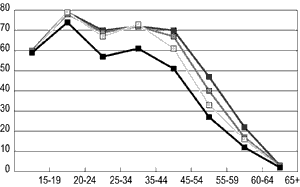
of paid employment. The graph below demonstrates that where once the
prime childbearing years were associated with a rapid decline in labour
market participation, today the decline is much smaller and for a shorter
period of time. Frequently, but not always, family responsibilities
are accommodated with part time and casual work. The employment rate
for all women of workforce age (15-64) increased from 47 per cent in
1980 to 61 per cent in 2000.[28] For women in the
main childbearing years (25-34), the employment rate increased from
50 per cent in 1980 to 66 per cent in 2000.[29]
Graph 2.1: Female
labour force participation by age group, Australia, 1985-2000
Source: ABS Labour
Force - Participation Rate - Australia (Cat no 6291.40.001), May
figures.
The growth in two
income families with dependants has been the largest contributor to
rising family living standards since the 1970s. In 2000, 63 per cent
of couple families with dependants had two incomes.[30]
The contribution
of women's personal income to total income for couples with children
increased from 25 per cent of total income in 1982 to 30 per cent in
1999-2000. [31]
2.4.3
Education and training opportunities
Not only are more
women employed in paid work across all ages, greater access to education
and training has meant the nature of the work they do has also changed.
Employment opportunities of women have also expanded, partly because
of their uptake of education and training. Women with a degree have
a full time employment-population ratio that is about two times larger
than women who left school at 15 years of age and subsequently have
not obtained a qualification. [32]
The rise in the
number of women and girls in education and training has occurred at
a time when the percentage of men and boys in education and training
has also risen, although the increase for women and girls has been more
startling, especially in vocational training. The rapid expansion in
labour-saving technology and the increasing demand for skilled labour
that has accompanied technological change, in conjunction with greater
emphasis on Australia's international competitiveness, have contributed
to this trend.
The Year 12 retention
rate for girls increased from 65.2 per cent in 1989 to 78.5 per cent
in 1999. [33] This increase in secondary schooling
numbers preceded a large increase in students attending universities
and other forms of higher education. In the ten years from 1989, the
number of people of workforce age attending an educational institution
rose by 28 per cent. [34]
Young people are
also increasingly in higher education at older ages. Overall, around
one in three people aged 20-24 is still engaged in training. [35] This is an increase of 39.2 per cent of those in this age group. They
may also be engaged in paid work, usually part time. [36]
There has also
been a dramatic increase in the participation of women in higher education.
In 1989 women made up 49 per cent of higher education students aged
20-24 and 47 per cent of those 25-44. [37] A decade
later these proportions had increased to 52 and 55 per cent respectively. [38]
The significant
investment of a woman's time and money in her education, in addition
to substantial Government investment and the expectation of a return
on that investment, underpins much of the change in social expectations
about women's work choices.
2.4.4
Changes in the nature of work
Changes in the
type of work
As in many other
countries, the levels and patterns of women's participation in paid
work in Australia have undergone substantial changes over the last 50
years. A much wider range of occupations have opened up to women as
a result of the introduction of anti-discrimination laws, changes in
social attitudes to the roles and rights of women in the paid workforce,
the removal from awards of conditions that discriminated against women
and equal opportunity policies. Changes in the labour market, in particular
the growth of the service industry, improvements in communication technologies
and increased mechanisation and computerisation, have also resulted
in changes in the kinds of paid work undertaken by women. [39] In the late 1980s and early 1990s, when these labour market changes
were most significant, there was an increase in the numbers of women
across most occupations. The most significant change was the number
of women in professional and para-professional occupations. By August
1992, 42.4 per cent of women were professionals and 46.7 per cent of
women were para-professionals. [40]
Despite these changes,
Australia continues to have one of the most highly gender segregated
labour forces in the industrialised world. [41] Women
continue to be concentrated in occupations traditionally dominated by
women, for example 91 per cent of the 187 300 nurses and 73 per cent
of the 301 100 school teachers in Australia today are female. [42]
Increased uncertainty
Families face rising
living costs and continue to expect that they can provide improved living
conditions for their children, yet family income today is less certain
than it has been for past generations. This reflects, in part, an increasing
preference by employers to hire workers on a casual or temporary contract
basis. Casual work, defined by the Australian Bureau of Statistics as
employment without leave entitlements, increased by 69 per cent overall
between 1988 and 1998. For men, the incidence of casual work increased
by 115 per cent, and for women, 43 per cent. [43] As at August 2001 workers without leave entitlements comprised 27 per
cent of all full time and part time employees. [44]
Some of this increased
casualisation reflects the high participation rates of young men and
women in post-secondary education and their desire for part time, not
full time work.
Overall, the number
of permanent full and part time employees has dropped from 79.8 per
cent of all employed persons to 62.2 per cent in the space of thirty
years (1971-2000). [45] The Australian Bureau of Statistics
estimates that only 54.6 per cent of female employees and 55.3 per cent
of male employees are now permanent. [46] For full
time permanent work this change has been most marked; the percentage
has declined from an estimated 76.4 per cent to 53.4 per cent of employed
persons. [47] This drop results not only from an increase
in the number of casual employees, but also from those self employed
and in restricted tenure jobs.
In addition to
the decline in permanency, a significant proportion of the workforce
is in a job for a relatively short period. Only between 10 per cent
and 26 per cent of employees in non-permanent forms of work have tenure
of more than two years, compared with 64 per cent of permanent employees. [48] Overall, in 1998 a total of 42 per cent of the
Australian workforce had been working for an employer for less than
two years. [49]
Job security
in Australia is rapidly declining. In 1989/90 when we first asked
the "is your job secure" question, the vast majority of
Australian workers reported having secure jobs: a total of 73% felt
very secure or fairly secure in their jobs. In the next few years
this dropped to 63% and by 1996/97 it had fallen further to 56%. [50]
In 2000, almost
one in four of those aged 25-34 had changed employer within the previous
12 months, compared with 10 per cent of 35-44 year olds and even fewer
in older age groups. [51] Female employees of child
bearing age also have shorter periods of continuous employment, with
45.9 per cent of those aged 20-24 and 27.9 per cent of those aged 25-34
having worked in the same job for less than one year. [52]
Historically, high
levels of unemployment have been associated with lower rates of family
formation and low levels of unemployment with higher rates. While the
improving macro-economic conditions of the past 12 years might suggest
we should now be witnessing higher rates of family formation, anecdotal
and statistical evidence that individual levels of employment uncertainty
have risen as the result of changed industrial conditions, mitigate
against this. [53]
The deregulation
of the labour market and the rise of enterprise bargaining has arguably
contributed to Australia's record of economic growth since the 1990s.
However, this deregulation appears to have contributed to a higher level
of employment uncertainty and has also had unintended social consequences
which are outlined below at 2.5.
2.4.5
Home ownership
With greater family
purchasing power there is likely to be some upward pressure on demand
for family formation goods such as houses and cars. But it is also true
that rising populations in urban areas and the Australian tradition
of low urban density have also contributed to the rising cost of housing
and the perception of the need for the second car. In real terms, construction
costs have been a secondary source of rising housing prices. The major
contributor to rising house prices has been the cost of land, reflecting
an increase in demand for housing per se rather than of luxurious or
more expensive houses. BIS Shrapnel data shows a 677 per cent increase
in the cost of land in Sydney over the period 1980-2002 but only an
increase of 241 per cent in construction costs. [54] Much of this increase is in rising unit costs of materials and labour.
Accompanying these
spectacular increases in land prices has been a concomitant decrease
in housing affordability for single income earners. Whereas in 1976
the average weekly mortgage repayment was 6.5 per cent of Average Weekly
Earnings, it is now 52 per cent. [55] For many families,
two incomes are now essential to support the purchase of a home.
The Home Loan Affordability
Indicator has decreased from 57.4 in March 1980 to 40.5 in December
2001 - representing a 29 per cent decrease in the affordability of housing
in Australia in the last 20 years. [56] In cities
such as Sydney the increase has been much more marked. The average loan
size for first home buyers in Australia has increased from $73 300 in
1992 to $124 800 in 2002. This is a 70 per cent increase in a decade.[57]
Housing affordability
is also closely related to interest rates. Housing affordability is
defined as the monthly mortgage repayments for a 25 year loan on 75
per cent of the median house price as a percentage of average total
full time earnings. There is no doubt that the high interest rates of
the 1980s gave impetus to two income families. The decline in interest
rates in the late 1990s appears to have assisted in driving up housing
prices, given the greater capacity of two income households to commit
to larger mortgages. [58]
The story of housing
affordability suggests that the two income family has become necessary
for owning a home. The risk now is that were interest rates to rise
again, families, already reliant on two incomes, would be further obliged
to extract the maximum income from both parents or bear mortgages worth
more than the value of the asset.
Access to housing
finance is more difficult and expensive for those without permanent
work, suggesting that for younger age groups, home ownership, with its
implications for family formation, is likely to be problematic.
It is not surprising
that among couples under the age of 35, without children, home ownership
fell eight per cent in the five years from 1994 to 1999, from 60 per
cent to 52 per cent. [59] Home purchase is generally
associated with the beginnings of family formation.
2.4.6
Social and cultural change
Introduction
Other factors have
contributed to the rise in the numbers of mothers in paid work. Economic,
technological and demographic change has been accompanied by cultural
and social shifts.
Social expectations
Foremost among
these is the expectation that women should be able to be in paid work
and to have children. The modern women's rights movement and the increasing
recognition of individual human rights by democratic Governments have
enhanced the trend for women to choose to be in paid work.
Since the passing
of the Sex Discrimination Act in 1984, Australia, like many other countries,
has positively promoted the rights of women, in particular their right
to be in paid work. The removal of the bar on married women working
in the public service in 1966, the ruling of the then Commonwealth Conciliation
and Arbitration Commission in 1969 that women should have equal pay
and the development of more gender-inclusive education programmes have
all played a part in increasing the access of women to paid work. [60]
The availability
of reliable contraception since the 1960s has facilitated this by enabling
women to manage their work and family formation roles.
The increased likelihood
of family breakdown may have encouraged more women to value self-reliance
through remaining attached to the workforce during their childbearing
years. The reform of Australia's divorce law was marked by the introduction
of the Family Law Act 1975 (Cth). Since then, Australia's divorce
rate has risen dramatically. In 1997 there were approximately 12 divorces
per 1 000 married couples each year. [61] Based on
1999 rates, almost one in two marriages will end in divorce. [62]
Today 19.6 per
cent of children are living with only one parent, usually their mother. [63] The expectation that, in these circumstances,
a mother will be her family's primary earner may be an additional factor
that could incline more young women to pursuing long term work force
participation. Although less than half (46 per cent) of sole parents
in Australia are in paid work, [64] the majority relying
on child support and welfare payments, this percentage is expected to
rise under recent Government policy changes. [65]
One of the most
significant features of the change in women's expectations over the
course of a generation has been the shift from a family centred to a
work and family centred approach to life planning, as Catherine Hakim's
preference theory demonstrates. [66] However, this
shift has not and could not be absolute. In practice there is a wide
combination of choices available to and taken up by women. Some women
have, for example, decided to become full time parents despite their
extensive education and training while others become full time workers
as well as mothers, despite the low skilled and low paid nature of their
work. In positing three groups of women: work centred, home centred
and adaptive women, Hakim's theory is itself a simplification of the
myriad of combinations available. The theory also assumes all women
have the same capacity to choose whereas for many, their combination
of work and family responsibilities will be a matter of necessity. Some
choices will simply not be available. Despite this, the theory's policy
implications are clear enough. Policies aimed at affecting the decisions
women make, including the decision to have children and the numbers
of children to have, will be of limited use if based on the assumption
that all women will respond in the same way to a policy instrument such
as a government benefit.
2.4.7
Work and family
There is also growing
recognition of the need to change the structures of work to recognise
both women's and men's family responsibilities. [67]
Concern was expressed
in every forum in HREOC's consultations that work and life balance was
becoming increasingly precarious for Australian families. In addition
to this general concern, there was, in particular, recognition that
the role of men in their families necessitated more support. This point
was raised in several consultations, including a consultation with women's
groups and community members in Perth.
Men want to have
contact with their children, bond with kids They want to take
a greater role in parenting. [68]
Support for the
greater involvement of men with their young families came not only from
women in the community but also from men, especially those in union
consultations. For example, in a consultation with union representatives
in Adelaide one participant stated that "
having both parents
at home [following childbirth] obviously supports the family, but in
reality men are not taking the leave". [69]
Concern was also
expressed about the long hours the fathers of young children worked
in an attempt to compensate the family for the mother's loss of income
during this stage. Long working hours and its effect on families recently
prompted the Australian Council of Trade Unions to run a test case on
reasonable working hours in the Australian Industrial Relations Commission. [70]
Women supported
the greater involvement of men in parenting because of the greater capacity
this provided for women to pursue their own work and family choices
but also because they considered this was best for children and their
fathers.
2.5
The consequences of change for work and family
2.5.1
Introduction
It is difficult
to attribute cause and effect between the various changes discussed
above, but together they have clearly contributed to significant changes
in family formation and working patterns for women. The main changes
are outlined below.
2.5.2
The need for two income families
The combination
of rising job uncertainty with declining housing affordability and a
rising cost of living has contributed to the increase in the number
of two income families. Spreading the risk of losing total family income
between a couple is effectively achieved by their both working, while
rising living costs also put pressure on families to have a second income
earner, especially in families whose primary source of income is a low
or medium income earner. Rural families, for example, have long been
familiar with the need to minimise the risk of income exposure. In rural
households, 80 per cent of off-farm income is earned by women. [71] In addition, couples in two income households are likely to be more
attractive to mortgage providers, as the risk of income reduction is
lessened.
The number of two
income families had risen from 50.2 per cent of all couple families
with dependent children in 1987 to 56.3 per cent by 1997. [72] By 2000, this proportion had risen to 63 per cent of couple families
with dependent children. [73]
2.5.3
Older parenting ages
The rising numbers
of young people, in particular of young women, in non-compulsory education
well into their twenties, suggests that young people today will be inclined
to commit to relationships and child rearing later than previous generations.
The desire of young women and young men to receive a return on the investment
they have made in their education and training is likely to further
defer this commitment. Young women's increased expectation of workforce
attachment and their growing career expectations often also compete
with a focus on family formation. In addition, growing job uncertainty
is associated with the deferral of partnering by both affecting the
capacity of young people to acquire a home and the understandable desire
of young people for certainty before committing to support another.
The median age
at which women in Australia bear their first child is now 30 years;
it is a figure which has risen relentlessly over the course of the past
generation. [74] The proportion of women aged 25-29
who had not had a child increased from 40 per cent in 1986 to 53 per
cent in 1996. [75] The parenting age for men is slightly
higher.
A fast growing
group of new mothers is those aged 35 and over. Women aged 35 years
and over giving birth to their first child, as a percentage of women
aged 35 and over giving birth, was 23.7 per cent in 1999, up from 12.7
per cent in 1991. [76]
The number of births
to women aged 30 years and over increased from one in four births in
1979 to almost one in every two births in 1999. [77] Peak fertility was among 24 year old women in 1964 and among 29 year
old women in 1994. [78]
For over 35 year
old mothers, overall fertility is likely to be lower than that of younger
women.
The ability to
conceive declines markedly from age 35 years onwards. The proportion
of assisted conception pregnancies to women aged 35 years and over in
Australia and New Zealand increased from 29 per cent of all assisted
conception pregnancies in 1990 to 41 per cent in 1997. [79]
2.5.4
Family size continues to drop
For women aged
30 and over, the mean number of children ever born declined from 2.5
children per woman in 1986 to 2.3 in 1996. [80] There
is a decline in this age group of the proportion of women having larger
families, with the number of women with four or more children down from
22 per cent in 1986 to 18 per cent in 1996. [81] The
proportion of single child families among all families with dependants
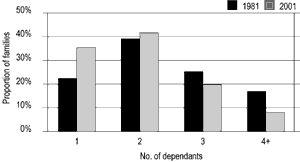
has risen from 22 per cent to 34 per cent in the 20 years from 1981
to 2001. [82] It has been this reduction in family
size, rather than an increase in childlessness, which has contributed
to declining fertility rates thus far. In future, significant increases
in childlessness will also contribute to falling fertility. Based on
estimates for 2000, 24 per cent of women currently in their reproductive
years will remain childless. [83]
Graph 2.2: Families
and dependent children
Philip Gammage
noted that:
[t]his is the
era of "the only, lonely child", increasingly born to a
mother of about 29 years of age, a mother often necessarily in mid
career. There are no support structures available from an extended
family. It does not exist. The past traditions and securities have
gone, probably for ever. Instead of regretting that loss, and sometimes
bowing to the cultural and sexual hegemony of the wishful male (especially,
it might seem, elderly, middle-class parliamentary ones) we should,
I think, be asserting the need for new models. [84]
Overall, Australia's
fertility rate has trended down over the last part of the twentieth
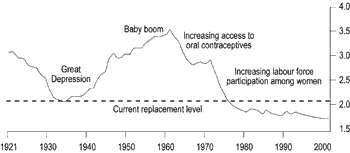
century. The Total Fertility Rate was 3.1 during the early 1920s, 2.1
in the 1930s (the Great Depression), 3.4 in 1962 (the Baby Boom), 2.9
in the early 1970s, 1.90 in 1980, 1.91 in 1990, 1.75 in 2000 and 1.73
in 2001. [85]
Graph 2.3: Total
Fertility Rate
Source: ABS
4102.0 Australian Social Trends 2002, p13.
Arguably, insufficient
support for working families (in the form of paid maternity leave, child
care subsidy, lack of access to retraining facilities after time out
of the workforce and lack of access to flexible working arrangements)
exacerbates the trend to smaller families at older ages. [86] This downward trend in fertility is also, in part, the result of increased
age at the time of first birth.
2.5.5
Women returning to work within a year of the birth of a child
Financial pressures
and the need for many women to maintain workforce attachment are likely
to contribute to the significant number of women with young infants
returning to work. This figure is likely to be interest rate sensitive
for some women, particularly where the major debt is the household mortgage.
The Finance Sector Union, in a survey of its members, reported that
nearly half of the 182 respondents indicated that they might have to
return to work earlier than they would like because of their financial
situation. [87] This was also reflected in a number
of the consultations. In a consultation held with women's groups and
community members in Brisbane, for example, it was stated that:
[f]inancially
you cannot afford not to go back. They say you have the choice to
stay at home or go back to work but there really is no choice at the
moment. It is a clear financial decision. [88]
More limited tenure
has also meant that not all women in the workforce are eligible for
the 12 month period of unpaid maternity leave available in Australia.
Women are not eligible for unpaid maternity leave unless they have been
with a single employer for at least 12 months. Twenty-eight per cent
of women workers aged 25-34 have worked in their main job for less than
12 months; for younger women this figure is higher. [89]
This may mean some
women take other forms of leave, generally short, in order to retain
their position. The declining number of permanent employees, especially
in younger age groups, suggests eligibility will continue to be problematic
for women while it is based on industrial requirements.
Other women return
to work earlier than they might choose because of the shortage of formal
childcare and the need to accept a place once offered or return to the
end of the waiting list. [90] The decision to return
to work is also likely to be affected by personal preferences.
Census figures
confirm that 36 per cent of women were in the labour force within a
year of the birth of a baby in 2001. [91] This is
a substantial increase from 1981, when 26 per cent of women with a child
under one were in the labour force. [92] As shown
in Table 2.1, a significant number of women with dependent children
are in the labour force. There has been a dramatic increase in the labour
force participation rate for women in couples with dependent children
over the past twenty years. For example, the proportion of women in
couples in the labour force women whose youngest child is aged under
one more than doubled between 1976 and 1996. The change in labour force
participation for sole parents is not as clear, with the 1996 labour
force participation rate for women whose youngest child is under one
being greater than it was in 1976, but less than in 1986.
Table 2.1: Labour
force participation rate of women with dependent children
|
.
|
Age
of youngest child |
1976
(%) |
1986 |
1996
(%) |
|
Couples
|
o
|
16.6
|
28.7
|
35.5
|
|
.
|
1-2
|
25.5
|
42.1
|
52.3
|
|
.
|
4-5
|
39.9
|
53.7
|
62.1
|
|
Sole
parents |
o
|
14.9
|
27.6
|
18.4
|
|
.
|
1-2
|
22.4
|
40.5
|
34.1
|
|
.
|
4-5
|
33.5
|
51.4
|
48.5
|
Source: ABS
4102.0 Australian Social Trends 2002, p13.
A 1998 Australian
Bureau of Statistics survey found that 69 per cent of female employees
with children under the age of six years who took a break from the workforce
(using paid and/or unpaid leave) or ceased working at the time of the
birth of their youngest child returned to work within a year of the
birth of this child. [93] This survey does not include
women not employed at the time of the survey and women who did not return
to work within six years of the birth. It does confirm that for women
with ongoing attachment to the workforce, returning to work within a
year is common.
2.6
Conclusion
Women in Australia
today are working in increasing numbers, undertaking more study, delaying
childbirth and having fewer children. Women with children increasingly
are also in paid work, often soon after the birth of a child, to reduce
the risk of there being no income earner due to unexpected unemployment,
and to assist in meeting the family's cost of living. They also work
because they have invested considerable time and investment in developing
workforce skills and because there is a greater expectation and need
among women for financial independence. Many women also derive considerable
enjoyment and a sense of identity from work.
Many families are
facing increasing time and financial pressures in a less certain environment.
The economic, social and cultural changes that Australia has experienced
within the space of a generation mean that now, more than ever before,
there is a need to support families and parents combining work and childrearing.
The majority of parents with dependent children are now in paid work. [94] Measures that support families therefore need
to reflect this change. A national paid maternity leave scheme becomes,
in these circumstances, an essential part of such support. HREOC urges
the federal Government to act now to support families, women, and babies
through the introduction of paid maternity leave.
3.
Adequacy of existing arrangements
3.1
Introduction
An important consideration
in assessing the need for a national paid maternity leave scheme is
the adequacy of existing government and business provisions designed
to support women and families at the time of childbirth.
The interim paper, Valuing Parenthood: Options for paid
maternity leave, [95] considered the existing
provisions to support women and families at the time of childbirth.
The interim paper extensively reviewed available data on unpaid and
paid maternity leave, and government assistance. The findings of that
paper were that while Australia's unpaid maternity leave arrangements
are comparable with those of other countries, including Australia's
trading partners, they still fail to provide adequate support for families
around childbirth as they do not provide financial support for mothers
wishing to absent themselves from work for some time immediately following
the birth of the baby. [96] Existing paid maternity
leave arrangements are limited, haphazard and fall significantly below
what could be considered a national system. [97] Similarly,
while the Government provides a range of family assistance and income
support payments to assist families, none of these meet the key objectives
of paid maternity leave. [98] These findings, and
particularly the gap in provisions to support women at the time of childbirth,
were one of the key starting points for HREOC's examination of the need
or otherwise for a national paid maternity leave scheme.
This Chapter provides
a critical overview of current financial support and maternity leave
arrangements in Australia, including the current system of unpaid maternity
leave, paid maternity leave and government benefits to families. This
information draws on the findings of the interim paper, together with
comments received in submissions and consultations, in order to demonstrate
the need for a national system of paid maternity leave.
3.2
Existing unpaid maternity leave arrangements
3.2.1
Introduction
Australia currently
provides a reasonably comprehensive system of unpaid leave. Permanent
full time and part time employees who have worked with their employer
for at least 12 continuous months have a minimum entitlement to 52 weeks
of unpaid parental leave following the birth or adoption of a child. [99]
Employees taking
unpaid parental leave have a right to return to the position they held
prior to taking leave, or to one nearest in status. [100] State legislation generally mirrors the federal provision. [101]
In May 2001, an
Australian Industrial Relations Commission decision granted access to
unpaid parental leave to casual employees covered by a federal award
and employed on a:
regular
and systematic basis for several periods of employment or on a regular
or systematic basis for an ongoing period of employment during a period
of at least 12 months, and [who have] a reasonable expectation of
on-going employment. [102]
This provision
will be inserted into federal awards on application by the award parties
on an award-by-award basis. Legislation in Queensland and New South
Wales also covers casual employees who have regular, continuous service
with one employer. [103]
3.2.2
Adequacy of current unpaid maternity leave arrangements
Australia's unpaid
maternity leave arrangements reflect international practices. However,
in consultations a perception emerged that Australia's unpaid maternity
leave standards are the world's best. This is not the case.
Sweden provides
a total of 18 months parental leave, of which 14 weeks is maternity
leave. Twelve of the 18 months is paid at 80 per cent of the parent's
prior earnings, three months paid at a flat rate, and the remaining
three months unpaid leave. [104]
Austria provides
a total of 27.7 months parental leave of which 16 weeks is maternity
leave paid at 100 per cent of the mother's prior earnings, and the remaining
two years is parental leave. Eighteen months of the parental leave is
paid at the unemployment benefit rate with the remaining six months
unpaid. [105]
Germany provides
a total of 39.2 months of parental leave of which 14 weeks is maternity
leave paid at a rate of 100 per cent of the mother's prior earnings,
with the remaining three years classified as parental leave. Two years
of this parental leave is paid at a flat rate, although it is income
tested, with the remaining year unpaid. [106]
Finland and Norway
both provide 36 months of parental leave, all of which is paid. [107]
Clearly, Australia's
12 months of unpaid maternity leave falls short of "world's best".
However, the provision of this unpaid leave is still an important support
for women in order to enable them to take a period of time out of paid
work, without losing the right to return to their previous position.
Consultations and
submissions suggested that a significant number of women are not able
to make full use of their unpaid leave entitlement.
There is little
information available on the duration of leave for those who do take
unpaid maternity leave. The information that is available suggests that
a significant proportion of women return to work prior to their child's
first birthday. A 1998 Australian Bureau of Statistics survey found
that 69 per cent of female employees with children under the age of
six years who took a break from the workforce (using paid and/or unpaid
leave) or ceased working at the time of the birth of their youngest
child returned to work within a year of the birth of this child. [108] However, any leave taken was not necessarily unpaid maternity leave.
A 1988 study by the Australian Institute of Family Studies found 65
per cent of women who were eligible for, and took, maternity leave [109] returned to work with the same employer within the 12 month statutory
period. [110] In 1996, 34 per cent of all women whose
youngest child was aged under one year were in the labour force. [111] In the case that women had only one child, and that child was aged under
one year, the labour force participation rate in 1996 was 39 per cent. [112] A recent study of 400 pregnant women attending
the Melbourne Royal Women's Hospital's pre-admission clinic found that
the mean expected period of unpaid maternity leave was 41.6 weeks. [113]
One of the reasons
that some women cannot access unpaid leave is the eligibility criteria
for this leave, that require a woman to have worked for 12 continuous
months with a single employer. The Australian Living Standards Study conducted in 1991-1992 found that three quarters of women in its full
time employee sample were eligible for unpaid parental leave, while
the number of eligible part time females was less than 40 per cent.
Part time employees' lack of eligibility was most likely due to the
high proportion of part time employees who worked on a casual basis.
Some 47 per cent of full time male employees in the sample indicated
that they were eligible for unpaid parental leave. [114]
Women who do not
have sufficient service with one employer and casual employees not covered
by a federal award or relevant State legislation will have no right
to unpaid maternity leave and may be forced to resign in order to give
birth to and care for their child. Women's workforce participation is
characterised by their part time and casual employment, making eligibility
for unpaid leave particularly difficult. The Australian Council of Trade
Unions pointed out that:
[n]early one-quarter
of women have worked less than 12 months in their main job, compared
to only 20.6% of men.
Younger women are most likely to have held their job for less than
1 year - 46% of 20-24 year olds have short tenure, 28% of women aged
25-34, and 19% of those aged 34-44. [115]
In addition, it
is clear that the lack of financial support during a period of unpaid
parental leave, and the need to forego an income from paid work for
this period mean that many families cannot afford for a woman to remain
out of paid work for 12 months.
Australia's legislated
right to unpaid maternity leave does not provide income replacement,
which can limit women's ability to access the leave. Some women must
return to work because they or their family are dependent on their income.
At times this means that a woman returns to work before she or her child
are ready. One woman, expecting a child, wrote that her individual circumstances
effectively forced her back to full time work.
My position is
exceptional as I am not only a shiftworker, but an unpartnered parent
with little support in the form of child care. I have grave concerns
for the future welfare of my child as I have no choice but
to return to full time shift work to maintain a home for my child.
Parenting payment and taking leave without pay is not an option as
this government supporting parent payment falls short of my minimum
mortgage payment. If I had the choice I would be taking at least 12
months leave to care for my child. [116]
Families in the
lowest income brackets, including many single parent families, will
be least likely to be able to access their full entitlement to unpaid
leave.
3.3
Existing paid maternity leave arrangements
3.3.1
Introduction
In the absence
of any legislated right to paid maternity leave, such leave may be provided
for in awards, agreements or individual workplace policies. [117] This section of the paper reviews current paid maternity leave arrangements.
It should be noted
that there are significant limitations with the available data on paid
maternity leave. The majority of available data sets only record whether
workplaces or agreements provide some form of paid maternity leave.
They do not provide information on the number of women who are actually
eligible for paid maternity leave. Eligibility criteria, such as the
need for 12 months service, mean that many women will not be eligible
for paid maternity leave, even though they may work in organisations
that provide for such leave. [118] Employees who
fall outside of these formal conditions, such as contract workers, will
not have access to paid maternity leave at all. Similarly, casual employees'
limited access to leave entitlements means that they will generally
not have access to paid maternity leave, even where they work in organisations
that offer this type of leave. This is highlighted by the Survey of
Employment Arrangements and Superannuation which found that only 0.4
per cent of casual employees had access to paid maternity leave. [119] Further, paid maternity leave may only be offered by an organisation
on a discretionary basis. This means that the figures outlined in this
Chapter are likely to significantly overstate the availability of paid
maternity leave.
The available data
do not record the number of women who take paid maternity leave. Even
though paid maternity leave may be available, this does not mean that
women actually use this leave. The take up rate of paid maternity leave
is a crucial factor in determining the effectiveness of workplace provision
of paid maternity leave. A range of factors, such as workplace culture
or fear of affecting career prospects, may mean that women are unwilling
to use an employer provided paid maternity leave entitlement.
3.3.2
Adequacy of existing paid maternity leave arrangements
The most recent
data on paid leave arrangements found that 38 per cent of female employees
reported that they were entitled to some form of paid maternity leave. [120] Therefore, approximately 62 per cent of women
in employment may not have access to any paid maternity leave. [121] When these women have children and by necessity take time away from
the workplace, they receive no compensation for the income they lose. [122] Others may return to the workforce from financial
necessity, leaving very young infants in care.
The 1995 Australian
Workplace Industrial Relations Survey (AWIRS) found that 34 per
cent of workplaces with more than 20 employees provided some form of
paid maternity leave, potentially covering 36 per cent of employees
working at workplaces with 20 or more employees. [123]
A nation-wide survey
in 2000-2001 by the Equal Opportunity for Women in the Workplace Agency
(EOWA) of firms with more than 100 employees found that 23 per cent
of employers offered some form of paid maternity leave to employees. [124] The EOWA data suggest some increase in the
provision of paid maternity leave amongst Australia's largest organisations,
from 15 per cent of organisations in 1997 [125] to
23 per cent in 2000-2001. However the number of firms with more than
100 employees offering paid maternity leave between 1998-1999 and 2000-2001
has remained stable at 23 per cent. [126]
All three of these
measures suggest that the majority of women in paid work do not have
access to paid maternity leave.
Available data
suggest that paid maternity leave is predominantly available in the
public sector and larger organisations. [127]
Paid maternity
leave also appears to be an entitlement predominantly of highly skilled
women in full time work rather than of women in more marginal employment,
with lower skills, who are in part time or casual work. Fifty-one per
cent of women in full time work, 21 per cent of women in part time work
and 0.4 per cent of women in casual employment report that they have
access to paid maternity leave. [128]
A recent survey
of 400 women attending the Royal Women's Hospital, Melbourne found a
high correlation between employee education levels and access to paid
maternity leave. Tertiary educated women made up less than 40 per cent
of the sample, yet two thirds of those with access to some form of paid
maternity leave had tertiary qualifications. No woman with primary level
education had access to paid maternity leave. [129]
Data also indicate
that there are significant variations between industries and occupations. [130]
An adjunct to the
availability of paid maternity leave is knowledge of that entitlement.
Of the female employees surveyed by the Australian Bureau of Statistics
in 2000, 18.1 per cent did not know whether or not they were entitled
to paid maternity leave. [131] More recent data indicate
that 22 per cent of randomly selected female employees were unaware
of their rights concerning access to paid and or unpaid maternity leave
compared to 29 per cent of female employees covered by Australian Workplace
Agreements (AWAs). [132] This suggests that female
employees employed under AWAs are less likely to know their unpaid maternity
leave entitlements than female employees generally. This is alarming
given that AWAs are negotiated agreements between employers and individual
employees. If such an employee is unaware of her unpaid maternity leave
entitlements she is unlikely to successfully negotiate paid maternity
leave with her employee.
The inequity of
the current system in terms of which employees are eligible for benefits
was highlighted in a number of submissions. The New South Wales Working
Women's Centre submitted that:
[t]he current
approach to paid maternity leave, based on enterprise bargaining,
company discretion and legislative cover for some public servants,
discriminates against those working women who are less skilled, less
educated and with less bargaining power in the workplace. [133]
3.3.3
Adequacy of paid maternity leave provisions in awards and agreements
A review of 100
federal awards with the highest coverage of workers, undertaken by the
then Commonwealth Department of Employment, Workplace Relations and
Small Business found that only six federal awards included provision
for paid parental leave. [134]
The Workplace Agreements
Database found that for the two-year period from 1 January 2000 to 31
December 2001 seven per cent of federal certified agreements made in
that period contained paid maternity leave provisions, a decrease of
three per cent from the 1998-1999 period. [135] Over
the same periods the percentage of federal certified agreements made
which contained paid paternity leave provisions increased from two per
cent to four per cent, while the percentage of certified agreements
made which contained paid family leave provisions remained static at
three per cent. [136]
Thirty-nine per
cent of all female employees covered by federal certified agreements
made in the 2000-2001 period potentially had access to an average of
seven weeks' paid maternity leave. [137] This compares
with 28 per cent of all female employees covered by federal certified
agreements made in the 1998-1999 period potentially having access to
an average of four weeks' paid maternity leave. [138]
The disparity between
the increase in the proportion of female employees covered by paid maternity
leave in federal certified agreements and the decrease in the incidence
of paid maternity leave provisions in federal certified agreements made
in the periods 1998-1999 and 2000-2001 suggests that paid maternity
leave provisions were included in a higher percentage of agreements
covering very large workforces made in 2000-2001 than in 1998-1999. [139] While the number of employees covered by paid
maternity leave provisions has increased, these figures still indicate
that the spread of paid maternity leave entitlements through certified
agreements may have stalled.
Based on analysis
of the first AWA provided by each employer, the Office of the Employer
Advocate found that between 1998 and 1999 17 per cent of employees have
paid maternity leave in their AWAs. [140] In analysis
conducted by the Australian Centre for Industrial Relations Research
and Training, less than one per cent of a random sample of AWAs operating
at the end of 2001 provided paid maternity leave. [141] The duration of the leave offered was either nine or 12 weeks. [142] This figure is even more negligible when it is considered that AWAs
are generally limited to particular industries and apply to more highly
skilled workers. At the end of 2001 the number of current AWAs was estimated
to be just under 130, 000 agreements, representing 1.7 per cent of the
wage and salary earner population in Australia. [143]
Information in
relation to State registered awards or agreements is available but not
comprehensive. [144]
An analysis of
both federal and State enterprise agreements showed that 7.48 per cent
of all federal agreements certified between 1997 and 2000 included a
paid maternity leave provision. In contrast, only 3.1 per cent of State
agreements listed in the Agreement Database and Monitor held by Australian
Centre for Industrial Relations Research and Training between 1992 and
2000 contained a paid maternity leave provision. [145]
The available statistics
show that paid maternity leave arrangements have not entered awards
and agreements in any great numbers and that enterprise bargaining has
not significantly increased women's access to paid maternity leave.
As stated in a recent article on paid maternity leave, "
enterprise bargaining is only delivering paid maternity leave to a small
proportion of Australian women".[146] The limited
impact of enterprise bargaining on women's access to paid maternity
leave was also supported by comments in submissions.
The Work + Family
Policy Research Group of the University of Sydney stated that their
research on the spread of paid maternity leave through enterprise bargaining
"
shows that progress has been minimal
" [147] Their submission concluded that:
[t]his data provides
evidence of the way in which employment and labour market-based mechanisms
distribute social and economic outcomes inequitably, thus affecting
the well-being of families and children. Those parents who can least
afford the income loss of unpaid leave at the time when family costs
and needs increase substantially on the birth of a child have least
access to a period of paid leave. [148]
Many submissions
were critical of the ability of enterprise bargaining to deliver a permanent
entitlement to paid leave.
Enterprise bargaining
has totally failed to provide adequate maternity leave conditions.
Paid maternity leave is a basic human right and it is an outrage to
be expected to have to ask for it and try and negotiate for it. [149]
Sectoral differences
in the duration of paid maternity leave are also quite stark. In the
industries that employ the most women, such as the accommodation, cafes
and restaurants sector and the retail and wholesale trade sectors, only
four per cent, two per cent and six per cent of agreements respectively
provide paid maternity leave. [150] One union provided
the following information to support its assertion that "
enterprise bargaining has failed women in manufacturing". [151]
Only 60 certified
agreements out of approximately 1 500 agreements (0.25 per cent) that
the AMWU [Australian Manufacturing Workers' Union] is a party to contain
a provision for paid maternity leave the level of entitlement
to paid maternity leave varies from between 3-6 weeks paid leave thus
revealing inequities in the system as the level of entitlement depends
on the bargaining strength of the workers.
In addition, bargaining factors such as the demographics of a workplace
including the ratio of men to women, the comparative age group of
the workforce, union representation at the workplace etc. can determine
whether the paid maternity leave claim is successful or not. [152]
The lack of bargaining
power of most women in the industrial relations setting was seen by
many as a reason that enterprise bargaining would not deliver paid maternity
leave. The Australian Services Union submitted that:
[w]omen workers
disproportionately occupy the lower-paid, precarious and deregulated
industries and jobs where they are more vulnerable to employment practices
that do not allow the flexibility required to properly balance their
work and family responsibilities.
[W]ithout legislative supports in place, including paid maternity
leave, the gap will continue to widen between those workers with bargaining
power and those without. [153]
One individual
submitted that:
[e]nterprise
agreements on their own are delivering very little to working women
in Australia. Enterprise bargaining is delivering benefits to only
a small proportion of Australian women. Even when available it is
concentrated in certain industries such as the public sector. Other
female dominated industries such as hospitality provide virtually
no paid maternity leave. [154]
The Australian
Nursing Federation was concerned that:
[a] continuation
of the current piecemeal approach will result in, at best, incremental
improvements for a minority of women who work in areas with the industrial
capacity to achieve positive outcomes through bargaining. [155]
The National Pay
Equity Coalition considered that enterprise bargaining would not deliver
paid maternity leave to the majority of women.
Many women are
in sectors of the economy where they are unlikely to be able to bargain
adequate entitlements. Enterprise bargaining has delivered a very
low incidence of agreements with paid maternity leave entitlements
(DEWRSB [Department of Employment, Workplace Relations and Small Business],
2000). Entitlements that have been secured through industrial bargaining
to date are well below international standards and are unlikely to
be improved in the short-term. Those workplaces that have negotiated
paid maternity leave are more likely to be located in industry sectors
with higher earnings. [156]
Enterprise bargaining
as a means of delivering paid maternity leave was also considered to
further entrench the workplace disadvantage of particular groups of
women. [157] This issue is taken up further at 7.4.
The enterprise
bargaining approach to delivering paid maternity leave for women workers
requires that workers covered by the agreement but unlikely to benefit
directly from paid maternity leave also need to be persuaded of the
efficacy of including a paid maternity leave entitlement in their agreements.
One union considered that:
[p]aid
maternity leave is not going to flow to women workers through workplace
level bargaining negotiations Our members have limited access
to enterprise bargaining and when they do, they are more inclined
to negotiate over more immediate priority issues - such as wages and
job security. Parties tend not to negotiate about events which may
or may not happen and agreements cannot be easily changed during their
lifetime In collective bargaining agreements, women have to
win support for paid maternity leave within their own workplaces and
convince those who will not directly benefit such as older women or
men or younger women of the value of the claim - as opposed to other
claims which might benefit the whole. [158]
Australian Centre
for Industrial Relations Research and Training Director Ron Callus has
noted the disadvantages of using certified agreements to introduce paid
maternity leave.
The problems
of relying on agreements to deliver, what in most countries are regarded
as basic workers rights, are apparent. The result is some workers
have access to paid leave while others remain disadvantaged. Economy-wide
minimum provisions and rights really require a macro approach, through
legislation or a test case that will ensure that there is some fairness
in women's ability to access paid maternity [leave] as a right not
simply as a "bonus" granted at the discretion of some organisations. [159]
The Australian
Chamber of Commerce and Industry has acknowledged that "[i]t is
clear that most workplaces are not currently choosing to include
paid maternity leave in their agreements". [160] However, ACCI contends that the number of workplace agreements that
include paid maternity leave has increased over time, that the available
data may "... underestimate the incidence of paid leave by agreement
in Australian workplaces" [161] and that paid
maternity leave may not be a bargaining priority for some employees. [162]
Without evidence,
it cannot be assumed that there are widespread demands for paid leave
though bargaining which are not being addressed by employers. There
are also other approaches available in agreement making to deal with
work and family issues, other than a simple focus on "paid maternity
leave" or maternity issues - such as working hours flexibility,
and training and re-training. [163]
Some commentators
have suggested that enterprise bargaining is a more appropriate means
of achieving paid maternity leave in contemporary Australian society
where work and family imperatives vary greatly and flexibility is highly
valued. [164] For example, the National Farmers'
Federation considered that "[t]he provision of paid maternity leave
should be a decision taken by the individual employer when considering
all issues affecting the business" [165] and
concluded that:
paid maternity
leave, as a workplace entitlement, should only be implemented by agreement
at an individual workplace through existing agreement-making mechanisms. [166]
However a national
scheme of paid maternity leave offered at a minimum level, does not
prohibit employers and employees from negotiating additional arrangements
to suit individual situations. A legislated right to paid maternity
leave does however provide basic support for all women in paid work
that cannot be removed by bargaining.
HREOC concludes
that current provisions for paid maternity leave in awards and agreements
are inadequate. The evidence indicates that agreement and award making
will not bring Australian women in employment a secure paid maternity
leave benefit. In addition, HREOC believes that the industrial processes
for negotiating benefits have inherent problems when it comes to securing
paid maternity leave. For example, negotiating an entitlement to paid
maternity leave as part of a workplace agreement generally requires
employees to trade off other benefits, including wages, to secure the
new entitlement. This means that female employees are in effect paying
for their own maternity leave entitlement by relinquishing other benefits.
Paid maternity leave is a basic right for women in paid employment and
should be secured as a right rather than negotiated as a tradeable benefit.
3.3.4
Adequacy of paid maternity leave provisions through company policies
Information about
the extent and operation of company policies providing for paid parental
leave is scant and represents a future area for research. However, research
has found that there is a great deal of variation in access to paid
parental leave entitlements via company policies not only between workplaces
but also within workplaces. [167] One study found
that, not surprisingly, employers were more likely to provide access
to paid parental leave policies to employees who are highly skilled
or in whom they have invested training or other resources. [168]
Company policies
are not public documents. There is, therefore, no direct way of ascertaining
their content and how they are implemented. As they are discretionary,
they can be changed at any time, can be applied to different employees
differently and do not necessarily involve any consultation or involvement
of employees. However, Australian evidence suggests that the best organisational
predictors of company provided paid maternity leave are organisational
size and structured management practices, [169] while
the best labour market predictors are education and occupational status. [170]
The uneven distribution
of company provided paid maternity leave both between and within companies
indicates that such a mechanism for providing paid maternity leave does
not deliver equity and generally does little for women employed in the
non-core business of the organisation, for example in supportive, administrative
roles. [171]
Moreover, the conditions
attached to paid maternity leave provided by company policy are often
onerous. For example, the Victorian Women Lawyers noted that:
[t]here is a
significant disparity in the maternity leave policies within law firms.
The majority of law firms do not offer any paid leave when
law firms have policies providing for paid maternity leave, there
are often quite onerous conditions attached to the entitlement. For
example, the woman must have worked for the law firm for a certain
period of time, the amount of payment will depend on the woman's length
of service with the firm ... [172]
3.3.5
Duration of paid maternity leave
Available data
suggest that there are very limited cases in Australia where women receive
the international standard of a minimum of 14 weeks paid maternity leave
and that in many cases available leave falls well short of this standard.
Analysis by the
former Commonwealth Department of Employment, Workplace Relations and
Small Business of federal agreements certified from January 1997 to
June 2001 found that the average duration of paid maternity leave over
this period was approximately six weeks, with the average in 2001 reaching
almost eight weeks. [173] Paid maternity leave provisions
in Certified Agreements ranged from one day to up to 18 weeks, with
the most frequent periods offered being two weeks (39 per cent), six
weeks (21 per cent) and 12 weeks (23 per cent). [174]
Research on the
availability of paid maternity leave in certified agreements has found
that the amount of paid leave varies significantly from two days to
18 weeks. The most frequent duration of paid maternity leave at the
federal level was two weeks and six weeks at the State level. The 14
weeks paid leave recommended by the International Labour Organization
is available in very few agreements. [175]
Currently operating
AWAs provide paid maternity leave of either nine weeks or 12 weeks. [176] However, it is important to note that women
with AWAs are likely to be more highly qualified than other women in
the workforce and therefore may have increased bargaining power. [177]
For 2000-2001,
Equal Opportunity for Women in the Workplace Agency found that, amongst
organisations with over 100 employees, 41 per cent of organisations
that provide some form of paid maternity leave provided five to six
weeks of leave, [178] while another 33 per cent of
these organisations provided nine to 12 weeks of paid maternity leave. [179]
As was the case
with availability of paid maternity leave, there was also variation
across industries in the average length of paid maternity leave offered.
Amongst federal certified agreements in 2001, the communication services
industry offered on average 12 weeks, finance and insurance offered
on average seven weeks, while retail trade and accommodation, cafes
and restaurants both offered an average of four weeks. [180]
In the public sector,
the length of paid leave varies considerably from four weeks in South
Australia to a maximum of 14 weeks in the Northern Territory. [181] Eligible federal public servants are entitled to 12 weeks.
Comprehensive statistics
on the duration of paid maternity leave provided for in State industrial
relations instruments or in individual company policies are not available.
3.3.6
Conclusion
It is clear from
the available data that the majority of women do not have access to
employer provided paid maternity leave. The most recent data suggest
that over 60 per cent of female employees do not have access to paid
maternity leave. [182]
While paid maternity
leave is provided through some awards, agreements and company policies,
none of these measures has delivered paid maternity leave for the majority
of women. Even where paid maternity leave is provided, it often falls
well short of the international standard of 14 weeks of paid leave.
In addition, the rate of increase of paid maternity leave provisions
mean that it is unlikely that the proportion of women in paid work receiving
employer funded paid maternity leave will significantly increase in
the foreseeable future.
It is also clear
that those women in more vulnerable employment and less able to bargain
for improved work standards are the most likely not to receive paid
maternity leave under the current system. Women who work in smaller
organisations, in particular those with small profit margins, or who
are in part time or casual work, or who have lower skills, are far less
likely to have access to employer funded paid maternity leave.
HREOC is strongly
of the view that a continuation of the current system of market and
enterprise bargaining for paid maternity leave will leave a significant
proportion of women vulnerable at the time of childbirth. In contrast,
a national scheme of paid maternity leave would ensure more evenly spread
access to paid maternity leave and assist in ensuring that women are
able to have a period of time to recover from childbirth and be with
their child without financial pressure to return to paid work.
3.4
Government payments to parents
3.4.1
Current government assistance
Introduction
The federal Government
provides a range of income support payments to families to assist with
the costs of raising children, including newborns. [183]
Government expenditure
in 2000-2001 on Maternity Allowance and Maternity Immunisation Allowance
was $218 million. [184] These payments both constitute
a payment to families to support young children. Government expenditure
in 2000-2001 on Family Tax Benefit Part A and Family Tax Benefit Part
B was $10.076 billion. [185] While Family Tax Benefit
provides financial assistance to families with young children, assistance
also extends to much older children. The Baby Bonus has only been available
since July 2001. Government spending on the Baby Bonus is projected
to reach $510 million in 2005-06. [186]
In light of the
significant government spending on family assistance payments it is
important to consider the extent to which these payments already meet
the objectives of paid maternity leave.
HREOC considers
that the key features of paid maternity leave are that it is a payment
made immediately prior to and following the birth of a child that provides
the opportunity for the woman to recuperate, provides time for the mother
and child to bond without the financial pressure leading to an early
return to paid work, and compensates the family for a loss of income
from paid work necessitated by the birth of a child. [187] In addition, the number of women who are able to access the payment
is important when considering whether any existing payment approximates
a national scheme of paid maternity leave. Existing government payments
are reviewed against these objectives in order to establish the extent
to which the Government can be considered to be currently delivering
appropriate support to women at the time of childbirth.
Maternity Allowance
The purpose of
Maternity Allowance is to help families with the extra costs associated
with the birth of a new baby. Maternity Allowance is paid as a non taxable
lump sum of $811.44 per baby, and is paid close to the time of birth. [188] This amount is equivalent to just over one
week of Average Weekly Earnings, [189] less than
two weeks of the Federal Minimum Wage [190] or four
weeks of unemployment benefits. [191] In order to
receive Maternity Allowance, the claimant must qualify for Family Tax
Benefit Part A within 13 weeks of the child being born. This means,
for a family with one child, that family income must be below $83 184
a year. [192]
Maternity Allowance
falls short of paid maternity leave in terms of the level of payment
that is made, and the fact that the payment is means tested. It is also
only paid after the birth of the child.
Maternity Immunisation
Allowance
Maternity Immunisation
Allowance is paid for children after the child reaches 18 months old
and either has been fully immunised, or is exempt from the immunisation
requirement. Claimants must have been paid Maternity Allowance for the
child or be eligible for Family Tax Benefit Part A when the child meets
the immunisation or exemption requirements. It is paid as a non-taxable
lump sum of $208. [193]
The Maternity Immunisation
Allowance falls short of paid maternity leave in terms of the level
of the payment, the timing of the payment and the fact that the payment
is means tested.
Family Tax Benefit
Part A
The purpose of
Family Tax Benefit Part A is to help families with the costs of raising
children. It is paid to families with children up to 21 years and young
people between 21 and 24 who are studying full time (and not receiving
Youth Allowance or a similar payment). Family Tax Benefit Part A is
means tested on the basis of family income, but does not have an assets
test. Families with one child who have an income below $30 806 a year
will receive the full rate of payment. The payment is then reduced on
the basis of earnings, and cuts out for a family with one child when
the family income reaches $83 184 a financial year.
The maximum rate
of Family Tax Benefit Part A for a family with a newborn baby is $126.70
per fortnight. [194] This amount is equivalent to
nine per cent of the Average Weekly Earnings, [195] 15 per cent of the Federal Minimum Wage [196] or
31 per cent of the weekly rate of unemployment benefits. [197]
Family Tax Benefit
Part A falls short of paid maternity leave in terms of the level of
payment that is made, and the fact that the payment is means tested.
It is also only paid after the birth of the child. Its benefit to the
family in the first year depends therefore on when in the tax year the
baby is born.
Family Tax Benefit
Part B
The purpose of
Family Tax Benefit Part B is to provide extra assistance to single income
families, including sole parents, especially families with a child aged
under five years. Family Tax Benefit Part B is paid to families with
children up to 16 years and children between 16 and 18 years who are
studying full time.
Family Tax Benefit
Part B is not income tested on the basis of family income. There are
no limits on the income that the primary income earner can earn. The
payment is income tested on the basis of the second income earner, who
must earn below $11 206 per year to be eligible for payment. [198] There is no assets test for Family Tax Benefit Part B. The maximum rate
of Family Tax Benefit Part B for a family with a newborn baby is $108.78
per fortnight. [199] This amount is equivalent to
eight per cent of Average Weekly Earnings, [200] 13 per cent of the Federal Minimum Wage [201] or
27 per cent of the rate of unemployment benefits. [202]
Family Tax Benefit
Part B falls short of paid maternity leave in terms of the level of
payment that is made, and the fact that the payment is means tested.
In addition, the targeting of this payment at single income families
effectively means that women cannot return to paid work and receive
this payment. It is also only paid following the birth of a child.
Baby Bonus
The purpose of
the Baby Bonus is to recognise "
the loss of income that
generally follows the arrival of a family's first child". [203]
The Baby Bonus
provides a tax refund in each of the first five years following the
birth of a family's first child. Payment is made at the end of each
financial year. The maximum payment available each year is $2,500. [204] The rate of payment is linked to the level of the woman's earnings before
the birth of the baby. The highest level of payment is available if
a woman does not return to work. The amount a woman receives reduces
if she returns to work following the birth of a child. For example,
she will receive half her possible payment if she earns half the amount
she earned prior to the birth. She will receive no payment if she earns
equal to or greater than her earnings prior to the birth. A minimum
payment of $500 is available for mothers whose taxable income is $25,000
per annum or less. [205]
The Baby Bonus
falls short of paid maternity leave in terms of the payment level, and
the timing of the payment which is spread over five years and is only
made at the end of each financial year. In addition, the Baby Bonus
is only made for a family's first child. This means that a family will
not receive the Baby Bonus for a second or subsequent child.
Parenting Payment
The purpose of
Parenting Payment is to assist people with children, particularly low
income families, by providing an independent income. Parenting Payment
is paid to the primary carer of a dependent child aged under 16 years.
Parenting Payment
is subject to an income and assets test. It is paid fortnightly at a
rate of up to $429.40 per fortnight for sole parents and $338.10 per
fortnight for partnered parents. [206]
Women who are on
unpaid maternity leave following the birth of a child may receive Parenting
Payment, provided that they meet the income and assets test.
HREOC considers
that the level of payment of Parenting Payment means that it falls short
of paid maternity leave. It is subject to an income and assets test,
which restricts the number of women who can access this payment. In
addition, it is only available following the birth of a child.
Child Care Benefit
Child Care Benefits
are a government rebate of up to $2.66 per hour for approved or registered
child care. [207] A minimum rate applies for families
over a certain income threshold. [208] All families
have access to 20 hours of child care benefit each week, while families
using child care for work, study or training purposes may claim a rebate
for up to 50 hours a week. [209]
Child Care Benefit
is a payment made specifically in relation to purchased child care.
The benefit can only be claimed for hours of child care that are actually
purchased. This is a very different purpose to paid maternity leave
and does not relate to income replacement.
Cumulative effect
of government payments
While no single
government payment equates to paid maternity leave, it is possible that
the cumulative effect of these payments is equivalent to paid maternity
leave.
As noted above,
HREOC considers that payments should be made at the time of the birth
if they are to be considered equivalent to paid maternity leave. As
such, the key payments which, together, may be equivalent to paid maternity
leave are the Maternity Allowance, Family Tax Benefit Part A, Family
Tax Benefit Part B and Parenting Payment.
The maximum amount
of cumulative government payments would apply to a woman who was a sole
parent and who was not in paid work. A woman in this situation would
receive maximum Family Tax Benefit Part A ($126.70 per fortnight), [210] maximum Family Tax Benefit Part B ($108.78 per fortnight), [211] the Maternity Allowance ($811.44 lump sum payment) [212] and the full rate of Parenting Payment Single ($429.40 per fortnight). [213] This means she would receive $5 465.60 in the
first 14 weeks of her baby's life. This is equivalent to $390.40 per
week for fourteen weeks. This rate is close to a weekly payment at the
rate of the Federal Minimum Wage ($431 per week). However, the woman
must be single and have no earnings from paid work in the financial
year of the baby's birth to receive this level of payment. She would
also need to meet the Parenting Payment assets test.
Any woman who has
earnings from paid work within the financial year of the baby's birth
(whether as a result of being in paid work prior to the birth of the
child or returning to work after the birth), who has a partner who is
in paid work, or who has assets greater than allowed under the assets
test will receive less than this amount.
For example, a
woman who earned more than $11 206 ($431 per fortnight) in the financial
year that her baby was born, and whose family income was greater than
$38 276 per annum may only receive the base rate of Family Tax Benefit
Part A ($40.74 per fortnight) [214] and the Maternity
Allowance ($811.44 lump sum payment). [215] This
means she would receive $1 381.80 in the first 14 weeks of her baby's
life. This is equivalent to $78.33 per week for fourteen weeks because
of the retrospective nature of means testing. This rate would apply
despite the possibility of a very significant drop in the family's income
during the first 14 weeks following childbirth. In these circumstances
it is foreseeable that a family may have had to accumulate significant
savings prior to the birth of the child, or face the alternative that
the woman will be under financial pressure to return to work as soon
as possible. HREOC is of the view that a payment of $100 per week would
not be a sufficient payment to ensure that women can have a guaranteed
period of time out of the workforce.
Conclusion
The Government
provides a range of family assistance and income support payments to
support the different circumstances of women and families with children.
The Government
has not claimed that any of these payments are equivalent to or meet
the objectives of paid maternity leave. However, there are clearly overlapping
aims between some of these payments and paid maternity leave. In particular,
the Government has claimed that one of the purposes of the Baby Bonus
is to replace the income a family loses when a woman takes time out
from paid work to care for a baby. This is similar to the income replacement
objective of paid maternity leave. Similarly, the Maternity Allowance
overlaps with the purposes of paid maternity leave to some extent in
that it is designed to support families with the additional expenses
incurred at the time of arrival of a baby.
The most important
fact in relation to existing government payments is that currently none
of these payments enable a woman to take a period of time out of paid
work immediately prior to and following the birth of a child. Under
the current system of government payments, some women are faced with
the options of saving over an extended period for a baby, returning
to work before they or their baby are physically ready or not having
a child because they cannot afford to forego their income from paid
work.
3.4.2
Community views on government payments
to parents
Many submissions
considered that existing government payments to families were financially
inadequate and restricted in coverage. The income thresholds for the
means testing applied to some government payments were felt to be set
inappropriately, while other government payments were not means tested
at all. [216] The Australian Council of Trade Unions,
for example, considered that:
[e]xisting government
support for families of newborn children is both inadequate and inequitable.The Maternity
and Immunization Allowances of $798.72 and $208.00, means tested,
are inadequate to compensate families for the costs associated with
childbirth.The Family Tax
Part B ($2752.00) was justified as support for families who choose
to care for their children at home, rather than in child care
However the Family Tax Benefit Part B does not perform this role,
in that it:
- is payable
to parents of children up to 18 years of age- discourages
dual income earning and the sharing of care responsibilities, and
penalises return to part time employment- is not means
tested, and thus is paid to some high-income families.How many families
with the mother in employment would be eligible for Family Tax Benefit
Part B in the child's first year, given the likelihood of some maternal
income in the period before the child's birth.The new Baby
Bonus is regressive and acts as a disincentive to employment. Payment
is made at the end of the financial year, not at the time of the birth.
This means it is not an immediate source of income replacement at
the time of birth. Payment has outstanding debt taken from it. Payment
in the first year reduced proportionally to the timing of the birth
over a whole year. [217]
The Shop, Distributive
and Allied Employees' Association asserted that:
current
government support payments to families are grossly inadequate. They
are inadequate in respect of the levels of payment, they do not deliver
adequate levels of support to many for whom they were designed, and
in some cases, they are fundamentally inequitable in their design.
None of them approximate paid maternity leave. [218]
The New South Wales
EEO Practitioners' Association wrote that:
[c]urrent payments
to assist women at the time of child-birth are financially inadequate
in terms of the level of payment and coverage. In particular we note
that the majority of existing supports are income tested and not accessible
by many women at higher levels of income. [219]
The Women's Economic
Think Tank considered that there was an imbalance in family assistance
payments available to single and dual income families.
One underpinning
concern driving support for paid maternity leave is to redress
in part the message given by the present imbalance in funding policies
that clearly provide more support to single income families as a category. [220]
Some submissions
distinguished the scope and purpose of existing payments from those
of a proposed paid maternity leave scheme, noting paid maternity leave's
short term focus on providing adequate financial support for women for
the period surrounding childbirth. Coles Myer wrote that:
[i]t is acknowledged
that the federal government currently provides a wide range of support
for families. However, the payments currently available appear to
be targeted more broadly than a paid maternity leave scheme would
be. In addition the payments are means tested restricting availability
to certain socio-economic groups.
A paid maternity leave scheme would ideally be structured in such
a way as to provide financial support at the time of the birth of
a child and the payment would be sufficient to provide a sense of
financial security to the mother for a reasonable period of time following
the birth to reduce the financial imperative to return to work prematurely. [221]
The Australian
Retailers Association considered that existing government payments "
do not address the situation of short term financial assistance to a
two income couple during that initial period following the birth of
a child". [222]
Many submissions,
including submissions from employers, employer groups, unions and women's
groups, argued that the existing government payments available to families
did not equate with, or even approximate, paid maternity leave. The
Australian Industry Group commented that "[a] range of family payments
are currently available to eligible persons, but none are genuine paid
maternity leave schemes". [223] Similarly, the
Australian Retailers Association noted that their organisation:
does not
consider that government support for families with newborn children
may be considered to approximate paid maternity leave.Payments currently
available appear to be targeted more broadly than a paid maternity
leave scheme would be. In addition the payments are means tested,
restricting availability. [224]
Coles Myer submitted
that it "
does not consider that government support for families
with newborn children may be considered to approximate paid maternity
leave". [225]
The Victorian Independent
Education Union noted limits in the ability of existing government payments
to meet the objectives of paid maternity leave, particularly focussing
on the Maternity Allowance.
Current government
support provided to families with newborn children cannot be considered
to approximate paid maternity leave. The means tested Maternity Allowance
is designed to offset costs associated with the birth and care
of a newborn baby. It does not assist a mother to take time off work
or provide financial security during the period after birth while
she recovers physically and psychologically, establishes feeding and
care for the infant. The Maternity Allowance does not protect the
mother's employment (thereby ensuring she has a position to return
to), nor does it protect or preserve other workplace entitlements
(long service leave, sick leave and the like). [226]
A number of submissions
raised a concern that existing government support for adoptive families
often does not acknowledge the additional costs, including government
imposed costs, associated with adoption, as opposed to biological births. [227] Government support also does not take account
of the particular costs of inter-country adoption, nor does it acknowledge
some of the realities of adopting an older child. For example, eligibility
for the Baby Bonus requires that the child is under five years of age. [228] Seventeen per cent of intercountry adoptees
in 2000-2001 were five years of age or older. [229] Eligibility for Maternity Allowance requires that the child is under
26 weeks of age at the time of placement with the family. [230] This issue is considered further in the discussion of the proposal for
a national scheme of paid maternity leave at 14.5.
3.4.3
The Baby Bonus
Many submissions
were particularly critical of the Government's recently introduced Baby
Bonus. For example, the Australian Education Union were concerned about
the timing of payment of the Baby Bonus.
[T]he maximum
of $2 500 available [via the Baby Bonus] is refunded from tax already
paid at the end of the financial year. The economic pressure experienced
by women occurs when the birth is imminent or has occurred not at
the end of the financial year. [231]
BPW Australia considered
that:
the baby
bonus [is] poorly targeted and unhelpful in supporting families to
combine work and family formation. Like other tax-break schemes it
unfairly offers more benefits to women on higher salaries, but still
not enough to make a difference. As such it is expensive, ineffective
and poorly directed and rather than encouraging women to have children,
discourages those that do have babies from returning to work even
part-time. [232]
A submission by
a union argued that the Baby Bonus acted as an incentive for women to
leave the workforce and become reliant on the welfare system.
[T]he current
Baby Bonus is an expensive and inequitable system that discourages
women from returning to work. The current Baby Bonus scheme provides
an incentive for leaving the workforce through the means of maximising
tax benefits based on the period out of work. Long term detachment
from the workforce results in a greater reliance on the welfare system
(Gregory 2002), a stifling of career progression, negative effects
on retirement incomes and shifting women from contributing to the
taxation system to be reliant on the welfare system. [233]
The Women's Economic
Think Tank considered that another weakness of the Baby Bonus is that
it is not available for the birth of a second child:
unless
the first child was born before the introduction of the payment
the mother is more likely at this stage to be working part time, and
is likely to be earning less. So no baby bonus or a reduced one makes
the choice to add a child a more difficult one financially. [234]
This issue is considered
further in the discussion of the proposal for a national paid maternity
leave scheme, at 21.3.2.
3.4.4
Calls for a review of government assistance
Several submissions
called upon the federal Government to review its current system of family
payments while considering the introduction of a paid maternity leave
scheme. The Australian Education Union considered that "
the existing family payment system needs a thorough review". [235] The National Farmers' Federation proposed that:
the Federal
Government should review existing social assistance measures to determine
whether there should be amendments to existing measures or the introduction
of new measures that may enhance the pursuit of the objectives in
respect to family and population policies. This approach would be
more efficient and equitable than pursuing the paid maternity leave
model. [236]
The Australian
Council of Trade Unions called for "
a review of the maternity
allowance, baby bonus and Family Tax Benefit payments, at least as they
relate to the first year of a child's life" to be conducted in
conjunction with the introduction of paid maternity leave. [237]
The Australian
Chamber of Commerce and Industry argued:
that the
Commonwealth should examine and consider restructuring existing government
funded maternity, parenting and family payments made via the Australian
social welfare system. [238]
That submission
also stated that:
[the Australian
Chamber of Commerce and Industry] would participate in a review of
existing Commonwealth social welfare funding for maternity, parenting
and families with a view to examining whether such payments should
be restructured into a national government funded maternity benefits
scheme. [239]
The Australian
Catholic Commission for Employment Relations argued that:
[i]ndependent
analysis and reappraisal of the effectiveness of current and proposed
family assistance payments and rebates needs to be undertaken before
there can be a final determination about the introduction of any form
of new assistance to families, either by way of paid maternity or
parental leave or universal family assistance. [240]
Some submissions
called for a more comprehensive review, including the interaction of
tax, government payments and working arrangements for families.
We call on the
federal government to initiate a national inquiry into current and
future arrangements, addressing the interrelationships of tax, social
security, employment conditions, superannuation, childcare and health
care funding throughout the life-cycle, especially as these intersections
are experienced by the worst-off women. A useful model is the Green
Paper process recently completed by the UK Government, although the
Australian inquiry needs to be even broader in view of the ad hoc
and piecemeal nature of existing provisions and their manifest inadequacy
for the needs of women and families in Australia today and in the
future. [241]
HREOC has not considered
government payments beyond the scope of their equivalence to and interaction
with a national paid maternity leave scheme. Given the concerns that
women expressed to HREOC about their ability to combine work and family
there may be merit in the Government undertaking a broader review of
family assistance payments.
Regardless of the
Government's decision on the possible review of family assistance, it
is clear from the consultations that paid maternity leave is a crucial
element of any package of support. Any review of family assistance should
not delay the introduction of paid maternity leave.
3.5
Conclusion
Unpaid maternity
leave arrangements exclude women who have not worked for their current
employer for more than a year, as well as certain groups of casuals.
In addition, since unpaid leave does not provide income replacement,
women may be forced to return to work before they or their babies are
ready.
Paid maternity
leave arrangements are limited and uneven in availability and duration.
Women who most need financial support are the least likely to have any
entitlement. Where paid maternity leave arrangements do exist, they
may have been traded off against another workplace benefit as part of
a negotiated agreement. Large numbers of women have no entitlement at
all to paid maternity leave.
All of the evidence
indicates that enterprise bargaining is not delivering paid maternity
leave to the vast majority of women in paid employment. HREOC considers
that the industrial track is an inherently inadequate means for women
to secure paid maternity leave in order to be with their child. In addition,
such leave is a basic need and should be guaranteed rather than negotiated.
HREOC has concluded
that government assistance to families with young children is inadequate
as an alternative to a legislated paid maternity leave scheme. Current
government assistance does not provide women in paid employment with
the financial support to guarantee an adequate break from employment
around childbirth.
HREOC recognises
the need for government assistance to support the different circumstances
of women, including those in paid work and those who are full time carers.
Paid maternity leave should not be seen as a replacement to existing
government support, but rather as a modification or addition that would
support the needs of a particular group of women. Paid maternity leave
is only one of a suite of measures that should be available to give
women real choice in how they care for their children and how they combine
work and family.
HREOC considers
that the existing government and business provisions to support women
and families at the time of childbirth do not equate to a national paid
maternity leave scheme. HREOC calls on the Government to introduce a
national system of paid maternity leave as a priority.
20.
Studies show that 39 per cent of women return to work after a maternity
break of less than six months and eight per cent return after a break
of less than six weeks: ABS 6254.0 Career Experience November 1998,
p23.
21. Maternity Protection Convention 1919 (No. 3).
22. Maternity Protection Convention (Revised)
1952 (No. 103).
23. Maternity Protection Convention 2000 (No. 183).
24. Department of Family and Community Services A
Short Genealogy of Income Support Payments Research FaCS Sheet Number
11 March 2002, p1.
25. UN Doc. A/49/38, para 379.
26. See note 1.
27. Centrelink A Guide to Commonwealth Government
Payments 20 September - 31 December 2002 www.centrelink.gov.au/internet/internet.nsf/publications/co029.htm,
p4. This is the rate that applies where the youngest child is under
5 years of age.
28. ABS 4102.0 Australian Social Trends 2001,
p134.
29. ABS 4102.0 Australian Social Trends 2001,
p135. Bob Gregory found that full time female workers, in the key age
group of 25-34, increased by 60 per cent between 1976 and 2000: R G
Gregory Can this be the Promised Land? Work and welfare for the modern
woman National Institute Public Lecture Parliament House Canberra
5 June 2002, figure 5.
30. ABS 4102.0 Australian Social Trends 2001 p135.
31. ABS 4102.0 Australian Social Trends 2001 p156.
32. R G Gregory Can this be the Promised Land? Work
and welfare for the modern woman National Institute Public Lecture
Parliament House Canberra, 5 June 2002, p8.
33. ABS 4102.0 Australian Social Trends 2000,
p82. Between 1985 and 1995 the retention of all students to Year 12
Secondary schooling rose from 46 per cent to 72 per cent: ABS 4102.0 Australian Social Trends 1996, p72. For girls, the Year 12 retention
rate increased dramatically and is now higher than the retention rate
of boys, 79.1 per cent and 68.1 per cent respectively: ABS 102.0 Australian
Social Trends 2002, p96.
34. ABS 4102.0 Australian Social Trends 2000,
p93.
35. ABS 4102.0 Australian Social Trends 2002,
p96.
36. Even amongst 25 to 34 year olds, there was a 63.5
per cent increase in attendance at post compulsory education institutions
between 1989 and 1999: ABS 4102.0 Australian Social Trends 2000,
p94.
37. ABS 4102.0 Australian Social Trends 2000,
p94.
38. ABS 4102.0 Australian Social Trends 2000,
p94. Similarly, in vocational education and training, in 1989 women
made up 37 per cent of participants aged 15-19 and 38 per cent of those
aged 20-24, but a decade later 38 per cent of 15-19 year olds and 47
per cent of those aged 20-24: ABS 4102.0 Australian Social Trends
2000, p95. The number of women undertaking apprenticeships and training
has more than quadrupled between 1995 and 2001, increasing from 24 500
to 114 400: Commonwealth Office of the Status of Women Women 2002 Commonwealth of Australia Canberra 2002, p6.
39. New South Wales Department for Women New South
Wales Government Action Plan for Women 2000-2002 Sydney 2001, p53.
40. ABS 6203.0 Labour Force August 1992 as cited
in ABS 6205.2 Women and Work 1992, p15.
41. ABS 4102.0 Australian Social Trends 1998,
p114 and House of Representatives Standing Committee on Legal and Constitutional
Affairs Half Way to Equal Parliament of Commonwealth of Australia
Canberra 1992, p31.
42. ABS 6203.0 Labour Force August 2002, p48.
43. ABS 6203.0 Labour Force July 1999, p4. Despite
the difference in the rates of increase of casually employed males and
females, females continued to represent a greater proportion of casual
employees over this period. In August 1998, for example, 54 per cent
of casual employees were female.
44. Note this survey is based on employee access to
entitlements in their main job: ABS 6310.0 Employee Earnings, Benefits
and Trade Union Membership August 2001, p33.
45. Mark Wooden "The changing labour market and
its impact on work and employment relations" in Ron Callus and
Russell Lansbury Working Futures: The changing nature of work and
employment relations in Australia Federation Press Sydney 2002,
p57.
46. ABS 6361.0 Employment Arrangements and Superannuation April to June 2000, p17,18.
47. Mark Wooden "The changing labour market and
its impact on work and employment relations" in Ron Callus and
Russell Lansbury Working Futures: The changing nature of work and
employment relations in Australia Federation Press Sydney 2002,
p57.
48. ABS 4102.0 Australian Social Trends 2000,
p116.
49. ABS 6359.0 Forms of Employment August 1998,
p10.
50. J Kelley, M Evans and P Dawkins "Job security
in the 1990s: How much is job security worth to employees?" (1998)1(1) Australian Social Monitor 1 at 2.
51. ABS 4102.0 Australian Social Trends 2001,
p130.
52. ABS 6361.0 Employment Arrangements and Superannuation April to June 2000, p18.
53. J Kelley, M Evans and P Dawkins "Job Security
in the 1990s: How much is job security worth to employees?" 19981(1) Australian Social Monitor 1 at 2.
54. Figures provided by BIS Shrapnel, using data from
BIS Shrapnel Building in Australia 1991-2005 Sydney 1991 and
the Real Estate Institute of New South Wales.
55. Zana Bytheway "In support of flexible work
practices" Jobwatching: The Official Publication of Job Watch
Inc., Newsletter October 2002, p1.
56. Real Estate Institute of Australia and AMP Banking Home Loan Affordability Indicator 2002.
57. ABS 4102.0 Australian Social Trends 2002,
p96.
58. Conversation with Robert Mellor, Director, BIS
Shrapnel, October 2002.
59. ABS 4102.0 Australian Social Trends 2001,
p177.
60. ABS 4102.0 Australian Social Trends 1998,
p118.
61. Department of Family and Community Services Australian
Families: Circumstances and trends, Research FaCS Sheet Number 6
September 2000, p3.
62. ABS 4102.0 Australian Social Trends 2001,
p57.
63. Refers to children under 15 years: ABS 4102.0 Australian Social Trends 2002, p30. Eighty-six per cent of sole
parent families with dependants had a female parent in June 2000: ABS
6224.0 Labour Force Status and Other Characteristics of Families June 2000, p7.
64. ABS 4102.0 Australian Social Trends 2002,
p30.
65. See the Australians Working Together package, detailed
at http://www.together.gov.au/.
66. Catherine Hakim, Work-Lifestyle Choices in the
Twenty-first Century: Preference theory Oxford University Press
Oxford 2000.
67. See 11.3 - 11.4 for further discussion.
68. Women's groups and community consultation, Perth,
20 June 2002.
69. Union consultation, Adelaide, 1 July 2002. This
issue was also raised at union consultation, Perth, 21 June 2002.
70. See 11.4.3 for further discussion.
71. Rural Industries Research and Development Corporation
and the Department of Primary Industries and Energy Missed Opportunities:
Harnessing the potential of Australian women in Agriculture Volume
1, Department of Primary Industries and Energy Canberra, 1998, p18.
72. Department of Family and Community Services Australian
Children: Circumstances and trends Research FaCS Sheet Number 7,
September 2000, p3.
73. ABS 4102.0 Australian Social Trends 2001,
p135.
74. ABS 3301.0 Births Australia 2001, p6.
75. ABS 4102.0 Australian Social Trends 2002,
p56.
76. ABS 4102.0 Australian Social Trends 2002,
p31.
77. ABS 4102.0 Australian Social Trends 2001,
p56.
78. ABS 4102.0 Australian Social Trends 1996,
p40.
79. ABS 4102.0 Australian Social Trends 2001,
pp57-58.
80. ABS 3301.0 Births 2000, p27.
81. ABS 3301.0 Births 2000, p27.
82. ABS Census 2001, unpublished data.
83. ABS 4102.0 Australian Social Trends 2002,
p37.
84. Philip Gammage, Submission 91, p2.
85. ABS 3301.0 Births 2001, pp44-45.
86. Peter MacDonald "Gender equity, social institutions
and the future of birth" (2000)17 Journal of Population Research,
1-16.
87. Finance Sector Union, Submission 161, p5.
88. Women's groups and community consultation, Brisbane,
24 May 2002. This issue was also raised at women's groups and community
consultation, Perth, 20 June 2002 and union consultation, Tasmania,
27 June 2002.
89. ABS 6361.0 Employment Arrangements and Superannuation April to June 2000, p18: 45.9 per cent of women with jobs aged 20-24
had worked in the same job for less than one year.
90. See also 11.6.
91. ABS Census 2001, unpublished data.
92. ABS Census 1981, unpublished data.
93. ABS 6254.0 Career Experience November 1998,
p23.
94. Sixty-three per cent of couple families with children
were two income families in 2000: ABS 4102.0 Australian Social Trends
2001, p135. Similarly, the majority of sole parents with dependent
children were in employment. Fifty-one per cent of sole parents with
dependent children were employed in 2000: ABS 4102.0 Australian Social
Trends 2001, p136.
95. Human Rights and Equal Opportunity Commission Valuing
Parenthood: Options for paid maternity leave, interim paper 2002 HREOC Sydney 2002.
96. Human Rights and Equal Opportunity Commission Valuing
Parenthood: Options for paid maternity leave, interim paper 2002 HREOC Sydney 2002, pp17-18; 88-92.
97. Human Rights and Equal Opportunity Commission Valuing
Parenthood: Options for paid maternity leave, interim paper 2002 HREOC Sydney 2002, pp18-23; 92-105.
98. Human Rights and Equal Opportunity Commission Valuing
Parenthood: Options for paid maternity leave, interim paper 2002 HREOC Sydney 2002, pp24-26; 106-112. See Part C for a discussion of
the objectives of paid maternity leave.
99. The Workplace Relations Act 1996 (Cth) limits
adoption leave to the adoption of children under the age of five.
100. Schedule 14 clause 12 Workplace Relations
Act 1996 (Cth). Except for a one week overlap, parents cannot
take leave simultaneously as it is designed for the primary care-giver.
101. Section 54(1) Industrial Relations Act 1996 (NSW); section 18(2) Industrial Relations Act 1999 (Qld);
schedule 5 clause 1 Industrial and Employee Relations Act 1994 (SA); in Tasmania the provisions of the federal Act apply; schedule
1A Workplace Relations Act 1996 (Cth) applies to Victorian workers;
section 33 Minimum Conditions of Employment Act 1993 (WA); section
5 Parental Leave (Private Sector Employees) Act 1992 (ACT); in
the Northern Territory the provisions of the federal Act will apply.
102. Re Parental Leave - Casual Employees Test
Case (2001) EOC 93-144, para 8.
103. Section 53 Industrial Relations Act 1996 (NSW); s16(a) Industrial Relations Act 1999 (Qld).
104. Sheila Kamerman "Parental leave policies:
An essential ingredient in early childhood education and care policies"
(2000) XIV (2) Social Policy Report 1 at 6, 11.
105. Sheila Kamerman "Parental leave policies:
An essential ingredient in early childhood education and care policies"
(2000) XIV (2) Social Policy Report 1 at 5, 10-11.
106. Sheila Kamerman "Parental leave policies:
An essential ingredient in early childhood education and care policies"
(2000) XIV (2) Social Policy Report 1 at 5, 11.
107. Sheila Kamerman "Parental leave policies:
An essential ingredient in early childhood education and care policies"
(2000) XIV (2) Social Policy Report 1 at 5-6.
108. ABS 6254.0 Career Experience November
1998, p23.
109. Maternity leave was defined in this study as
"time absent from work allowed by employers for an employee to
have a baby
" No differentiation was made between paid and
unpaid maternity leave: Australian Institute of Family Studies Maternity
Leave in Australia: Employee and employer experiences - Report of a
survey Commonwealth of Australia Melbourne 1988, pp15-16.
110. Australian Institute of Family Studies Maternity
Leave in Australia: Employee and employer experiences - Report of a
survey Commonwealth of Australia Melbourne 1988, p52.
111. ABS Census 1996, unpublished data.
112. ABS Census 1996, unpublished data.
113. Wendy Weeks Paid and Unpaid Maternity Leave
of Women After the Birth of their Baby: Preliminary findings on the
situation of 400 women attending the Royal Women's Hospital 2001-2002 Melbourne 2002 unpublished report, p13.
114. Helen Glezer and Ilene Wolcott Work and Family
Life: Achieving integration Australian Institute of Family Studies
Melbourne 1995, pp37-38. Note that this study was conducted only one
year after the Parental Leave Test Case Australian Industrial
Relations Commission Print J3596 26 July 1990. The number of men eligible
for parental leave would have increased in subsequent years. The test
case, brought on by an application by the Australian Council of Trade
Unions, saw the existing maternity leave clause in most awards replaced
with an amended clause providing parental leave: 12 months unpaid leave
to be shared by both parents including one week's paternity leave.
115. Australian Council of Trade Unions, Submission
208, p19. These statistics are from ABS 6361.0 Employment Arrangements
and Superannuation April - June 2000, p18. See also 2.4.4.
116. Verlaine Bell, Submission 19, p1.
117. Awards and agreements are industrial instruments
that regulate the employment relationship in terms of pay and conditions
of employment. Awards are legally binding documents that set out the
minimum entitlements of employees. Certified agreements are a form of
collective agreement made between an employer and a group of employees,
or a union acting as a representative of the employees. An Australian
Workplace Agreement (AWA) is an individual agreement made between an
employer and an employee. Individual company policies are discretionary
and non-binding policies offered by an employer within an individual
company or organisation.
118. See 2.4.4. and 3.2.2. above. Examples of conditions
attached to paid maternity leave entitlements include: at ANZ women
returning to work must work continuously for ten weeks before receiving
the other half of the six weeks paid maternity leave payment; at BankWest
in Western Australia, women receive six weeks' pay for maternity leave
after they return to work, and must work a further six months to retain
the payment. Cited in Centre for Applied Social Research, RMIT University,
Submission 234, p3.
119. ABS 6361.0 Survey of Employment Arrangements
and Superannuation April - June 2000 unpublished data.
120. ABS 6361.0 Survey of Employment Arrangements
and Superannuation April - June 2000 unpublished data. These data
were collected via a self-reported interview process and may not necessarily
indicate the actual proportion of women entitled to paid maternity leave.
121. ABS 6361.0 Survey of Employment Arrangements
and Superannuation April - June 2000 unpublished data.
122. As noted at 3.4 below, all women will potentially
have access to some welfare based payments at the time of the birth
of a child, which will offset lost income to a limited extent.
123. Alison Morehead et al Changes at Work: The
1995 Australian Workplace Industrial Relations Survey Longman Melbourne
1997, p451.
124. Equal Opportunity for Women in the Workplace
Agency 2002 unpublished data.
125. Commonwealth Department of Employment, Workplace
Relations and Small Business Work and Family State of Play 1998 Commonwealth of Australia Canberra 1998, p18.
126. Equal Opportunity for Women in the Workplace
Agency 2002 unpublished data.
127. The Equal Opportunity for Women in the Workplace
Agency survey found that companies with more than 1 000 employees were
more likely (38 per cent) to offer paid maternity leave than companies
with between 100-499 employees (20 per cent): Equal Opportunity for
Women in the Workplace Agency 2002 unpublished data. See also Human
Rights and Equal Opportunity Commission Valuing
Parenthood: Options for paid maternity leave, interim paper 2002 HREOC Sydney 2002, p20.
128. ABS 6361.0 Survey of Employment Arrangements
and Superannuation April - June 2000 unpublished data. See also
Human Rights and Equal Opportunity Commission Valuing
Parenthood: Options for paid maternity leave, interim paper 2002 HREOC Sydney 2002, p20-21. Also raised at union consultation, Melbourne,
9 July 2002.
129. Wendy Weeks Paid and Unpaid Maternity Leave
of Women After the Birth of their Baby: Preliminary findings on the
situation of 400 women attending the Royal Women's Hospital 2001-2002 Melbourne 2002 unpublished report, p15.
130. Equal Opportunity for Women in the Workplace
Agency 2002 unpublished data; ABS 6361.0 Survey of Employment Arrangements
and Superannuation April - June 2000 unpublished data. See also
Wendy Weeks Paid and Unpaid Maternity Leave of Women After the Birth
of their Baby: Preliminary findings on the situation of 400 women attending
the Royal Women's Hospital 2001-2002 Melbourne 2002 unpublished
report, which found that half of the women surveyed with access to paid
maternity leave were managers, professionals or associate professionals,
p14.
131. ABS 6361.0 Survey of Employment Arrangements
and Superannuation Canberra, 2000, unpublished data cited in Commonwealth
Department of Family and Community Services and Commonwealth Department
of Employment and Workplace Relations OECD Review of Family Friendly
Policies: The reconciliation of work and family life - Australia's background
report Commonwealth of Australia Canberra 2002, p47.
132. Office of the Employer Advocate Employee Attitude
Survey 2002 unpublished data.
133. New South Wales Working Women's Centre, Submission
225, p8.
134. Research provided by the then Commonwealth Department
of Employment, Workplace Relations and Small Business dated 7 November
2000.
135. Commonwealth Department of Employment and Workplace
Relations Agreement Making in Australia under the Workplace Relations
Act: 2000 and 2001 Commonwealth of Australia Canberra 2002, p81.
136. Commonwealth Department of Employment and Workplace
Relations Agreement Making in Australia under the Workplace Relations
Act: 2000 and 2001 Commonwealth of Australia Canberra 2002, p81.
137. It should be borne in mind that as at May 2000,
only 21.7 per cent of the Australian workforce had their pay set under
the provisions of federally registered collective agreements. Commonwealth
Department of Employment and Workplace Relations Agreement Making
in Australia under the Workplace Relations Act: 2000 and 2001 Commonwealth
of Australia Canberra 2002, pp1,140.
138. Commonwealth Department of Employment and Workplace
Relations Agreement Making in Australia under the Workplace Relations
Act: 2000 and 2001 Commonwealth of Australia Canberra 2002, p141.
139. Commonwealth Department of Employment and Workplace
Relations Agreement Making in Australia under the Workplace Relations
Act: 2000 and 2001 Commonwealth of Australia Canberra 2002, p73.
140. Commonwealth Department of Employment Workplace
Relations and Small Business and the Office of the Employment Advocate Agreement Making in Australia under the Workplace Relations Act: 1998
and 1999 Commonwealth of Australia Canberra 2000, p96.
141. Australian Centre for Industrial Relations Research
and Training Agreements Database and Monitor: Report 32 University
of Sydney March 2002, p8. According to the Office of Employment Advocate
the difference between this figure and the percentage of AWAs with paid
maternity leave may be explained by the different sampling methods used.
The Office of Employment Advocate analysis also gives greater weight
to larger employers. The Australian Centre for Industrial Relations
Research and Training sample is also significantly smaller than the
sample used by the Office of the Employment Advocate. Furthermore, in
the random sampling done by the Australian Centre for Industrial Relations
Research and Training, it is more likely that male AWAs would have been
included, as over half of AWA employees are male. There would be no
need for maternity leave in their AWAs.
142. Australian Centre for Industrial Relations Research
and Training Agreements Database and Monitor: Report 32 University
of Sydney March 2002, p8.
143. Commonwealth Department of Employment and Workplace
Relations Agreement Making in Australia under the Workplace Relations
Act: 2000 and 2001 Commonwealth of Australia Canberra 2002, p150.
144. M Baird, D Brennan and L Cutcher "A pregnant
pause: Paid maternity leave in Australia" (2002) 13 (1) Labour
and Industry 1 at 7.
145. M Baird, D Brennan and L Cutcher "A pregnant
pause: Paid maternity leave in Australia" (2002) 13 (1) Labour
and Industry 1 at 10. The Agreements Database and Monitor (ADAM) contains
data on approximately one third of all agreements registered in the
separate State jurisdictions between 1992 and 2000.
146. M Baird, D Brennan and L Cutcher "A pregnant
pause: Paid maternity leave in Australia" (2002) 13 (1) Labour
and Industry 1 at 13-14.
147. Work + Family Policy Research Group University
of Sydney, Submission 251, p3.
148. Work + Family Policy Research Group University
of Sydney, Submission 251, p4.
149. Karen Bijkersma, Submission 150, p2. Also raised
at community and women's groups consultation, Melbourne, 31 May 2002.
150. Commonwealth Department of Employment and Workplace
Relations Agreement Making in Australia under the Workplace Relations
Act: 2000 and 2001 Commonwealth of Australia Canberra 2002, p238.
151. Australian Manufacturing Workers' Union, Submission
237, p2.
152. Australian Manufacturing Workers' Union, Submission
237, pp7-8.
153. Australian Services Union MEU Private Sector
Victorian Branch, Submission 154 , p5.
154. Kimberley Meyer, Submission 105, p1.
155. Australian Nursing Federation, Submission 123,
p5.
156. National Pay Equity Coalition, Submission 224,
p34.
157. See also Ethnic Communities' Council of Victoria,
Submission 242, p5; Women's Economic Think Tank, Submission 256, p1;
Finance Sector Union, Submission 161, p4; Women's Electoral Lobby, Submission
248, p6; Union Research Centre on Organisation and Technology, Submission
254, p12.
158. Australian Liquor, Hospitality and Miscellaneous
Workers Union, Submission 153, p3.
159. Australian Centre for Industrial Relations Research
and Training "Little agreement on paid maternity leave" Media
Release 15 April 2002.
160. Australian Chamber of Commerce and Industry,
Submission 197, p14.
161. Australian Chamber of Commerce and Industry,
Submission 197, p14.
162. Australian Chamber of Commerce and Industry,
Submission 197, p30.
163. Australian Chamber of Commerce and Industry,
Submission 197, p14.
164. See, for example, Australian Chamber of Commerce
and Industry, Submission 197, pp ii,8,40, 41.
165. National Farmers' Federation, Submission 160,
p12.
166. National Farmers' Federation, Submission 160,
p15.
167. M Gray and J Tudball Family-Friendly Work
Practices: Differences within and between workplaces Research Report
No 7 Australian Institute of Family Studies Melbourne 2002 cited in
M Baird, D Brennan and L Cutcher "A pregnant pause: Paid maternity
leave in Australia" (2002) 13 (1) Labour and Industry 1
at 4.
168. M Gray and J Tudball Family-Friendly Work
Practices: Differences within and between workplaces Research Report
No 7 Australian Institute of Family Studies Melbourne 2002 cited in
M Baird, D Brennan and L Cutcher "A pregnant pause: Paid maternity
leave in Australia" (2002) 13 (1) Labour and Industry 1
at 4.
169. A Morehead et al Changes at Work: The 1995
Australian Industrial Relations Workplace Industrial Relations Survey Longman Melbourne 1997 cited in M Baird, D Brennan and L Cutcher "A
pregnant pause: Paid maternity leave in Australia" (2002) 13 (1) Labour and Industry 1 at 14.
170. G Whitehouse and D Zetland "Family friendly
policies: Distribution and implementation in Australian workplaces" Work and Family Seminar Papers Women's Equity Bureau Sydney 1999
cited in M Baird, D Brennan and L Cutcher "A pregnant pause: Paid
maternity leave in Australia" (2002) 13 (1) Labour and Industry 1 at 14.
171. M Baird, D Brennan and L Cutcher "A pregnant
pause: Paid maternity leave in Australia" (2002) 13 (1) Labour
and Industry 1 at 15.
172. Victorian Women Lawyers, Submission 137, p1.
173. Commonwealth Department of Employment and Workplace
Relations Workplace Agreements Database 3 April 2002 unpublished
data.
174. Commonwealth Department of Employment and Workplace
Relations Workplace Agreements Database 3 April 2002 unpublished
data.
175. M Baird, D Brennan and L Cutcher "A pregnant
pause: Paid maternity leave in Australia" (2002) 13 (1) Labour
and Industry 1 at 8.
176. Australian Centre for Industrial Relations Research
and Training Agreements Database and Monitor: Report 32 University
of Sydney March 2002, p8.
177. Commonwealth Department of Employment, Workplace
Relations and Small Business Work and Family State of Play 1998 Commonwealth of Australia Canberra 1998, 28. See also the discussion
on fairness for all employees at 7.4.
178. Equal Opportunity for Women in the Workplace
Agency 2002 unpublished data.
179. Equal Opportunity for Women in the Workplace
Agency 2002 unpublished data.
180. Commonwealth Department of Employment and Workplace
Relations Workplace Agreements Database dated 3 April 2002 unpublished
data.
181. "The Western Australian Government is still
in the process of introducing six weeks paid parental leave for its
own employees. This is available to either parent. Currently, only 58
per cent of the State's public sector employees have access to paid
parental leave. The remaining 42 per cent only have access to unpaid
leave. However, the Government has made a commitment to provide the
full six weeks paid parental leave to all employees within the next
two years, or as soon as funding is available": Western Australian
Government, Submission 245, p2. Tasmania introduced 12 weeks paid maternity
leave in March 2001 via the Tasmanian State Service Wages Agreement
2001. The entitlement has flowed on to other public sector occupations.
The Northern Territory announced on 21 October 2002 that it would extend
existing provisions of 12 weeks paid maternity leave for public sector
workers to 14 weeks as part of settlement in current enterprise bargaining
negotiations. See The Chief Minister of the Northern Territory "NT
Government sets national benchmark on maternity leave" Media
Release 21 October 2002.
182. ABS 6361.0 Survey of Employment Arrangements
and Superannuation April - June 2000 unpublished data.
183. This section is drawn from the Centrelink publications Centrelink Information: A Guide to Payment and Services 2001-2002 www.centrelink.gov.au/internet/internet.nsf/about_us/centrelink_info.htm;
Centrelink A Guide to Commonwealth Government Payments 20
September - 31 December 2002 www.centrelink.gov.au/internet/internet.nsf/publications/co029.htm;
Commonwealth Department of Family and Community Services Annual Report
2001-02 Commonwealth of Australia Canberra 2002; Commonwealth Department
of Family and Community Services Annual Report 2000-01 Commonwealth
of Australia Canberra 2001.
184. Commonwealth Department of Family and Community
Services Annual Report 2000-01 Commonwealth of Australia Canberra
2001, p42. Government spending on Maternity Allowance and Maternity
Immunisation Allowance was $217 million in 2001-02: Commonwealth Department
of Family and Community Services Annual Report 2001-02 Commonwealth
of Australia Canberra 2002, vol 2 p23.
185. In 2000-2001 spending on Family Tax Benefit Part
A and Family Tax Benefit Part B constituted $10.076 billion delivered
via the social security system: Commonwealth Department of Family and
Community Services Annual Report 2000-01 Commonwealth of Australia
Canberra 2001, p42; and $11 million delivered via the tax system: Treasury Tax Expenditure Statement 2001 Commonwealth of Australia Canberra
2001, p7. Note that the amount delivered via the tax system is an estimate
for spending in 2000-2001 as opposed to the social security figure which
is actual expenditure. Government expenditure on Family Tax Benefit
Part A and Family Tax Benefit Part B increased in 2001-2002 to $10.928
billion: Commonwealth Department of Family and Community Services Annual
Report 2001-02 Commonwealth of Australia Canberra 2002, vol 2 p23.
This more recent figure was not used in this comparison as the amount
delivered via the tax system for 2001-2002 was, at the time of publication
of this report, yet to be released.
186. Taxation Law Amendment (Baby Bonus) Bill 2002
Explanatory Memorandum, p3 (general outline and financial impact).
187. See discussion of the objectives of paid maternity
leave at Part C.
188. Centrelink A Guide to Commonwealth Government
Payments 20 September - 31 December 2002 www.centrelink.gov.au/internet/internet.nsf/publications/co029.htm,
p4.
189. Based on Average Weekly Earnings (all
employees total earnings) of $689.00. ABS 6302.0 Average Weekly Earnings May 2002, p4.
190. Based on the Federal Minimum Wage of $431 per
week.
191. Based on the "single aged 21 or over with
children" rate of Newstart Allowance of $405.40 per fortnight:
Centrelink A Guide to Commonwealth Government Payments 20 September
- 31 December 2002 www.centrelink.gov.au/internet/internet.nsf/publications/co029.htm,
p11.
192. Centrelink A Guide to Commonwealth Government
Payments 20 September - 31 December 2002 www.centrelink.gov.au/internet/internet.nsf/publications/co029.htm,
p3.
193. Centrelink A Guide to Commonwealth Government
Payments 20 September - 31 December 2002 www.centrelink.gov.au/internet/internet.nsf/publications/co029.htm,
p5.
194. Centrelink A Guide to Commonwealth Government
Payments 20 September - 31 December 2002 www.centrelink.gov.au/internet/internet.nsf/publications/co029.htm,
p2.
195. Based on Average Weekly Earnings (all employees
total earnings) of $689.00. ABS 6302.0 Average Weekly Earnings May
2002, p4.
196. Based on the Federal Minimum Wage of $431 per
week.
197. Based on the single with children rate of Newstart
Allowance of $405.40 per fortnight: Centrelink A Guide to Commonwealth
Government Payments 20 September - 31 December 2002 www.centrelink.gov.au/internet/internet.nsf/publications/co029.htm,
p11.
198. If the youngest child is between five and 18
years the second income earner must earn below $8 347 to be eligible
for payment: Centrelink A Guide to Commonwealth Government Payments
20 September - 31 December 2002 www.centrelink.gov.au/internet/internet.nsf/publications/co029.htm,
p4.
199. Centrelink A Guide to Commonwealth Government
Payments 20 September - 31 December 2002 www.centrelink.gov.au/internet/internet.nsf/publications/co029.htm,
p4.
200. Based on Average Weekly Earnings (all employees
total earnings) of $689.00. ABS 6302.0 Average Weekly Earnings May 2002, p4.
201. Based on the Federal Minimum Wage of $431 per
week.
202. Based on the single with children rate of Newstart
Allowance of $405.40 per fortnight: Centrelink A Guide to Commonwealth
Government Payments 20 September - 31 December 2002 www.centrelink.gov.au/internet/internet.nsf/publications/co029.htm,
p11.
203. Taxation Laws Amendment (Baby Bonus) Bill 2002
Explanatory Memorandum, para 1.2.
204. Taxation Laws Amendment (Baby Bonus) Bill 2002
Explanatory Memorandum, para 1.4.
205. Taxation Laws Amendment (Baby Bonus) Bill 2002
Explanatory Memorandum, para 1.4.
206. Centrelink A Guide to Commonwealth Government
Payments 20 September - 31 December 2002: www.centrelink.gov.au/internet/internet.nsf/publications/co029.htm,
p6.
207. For a non-school child: Centrelink A Guide
to Commonwealth Government Payments 20 September - 31 December 2002: www.centrelink.gov.au/internet/internet.nsf/publications/co029.htmm,
p5.
208. The minimum rate is $0.447 per hour for families
with incomes over $88 344 (one child); $95,808 (two children) and $10,
8847 (three children, plus $18 168 for each child after the third):
Centrelink A Guide to Commonwealth Government Payments 20 September
- 31 December 2002: www.centrelink.gov.au/internet/internet.nsf/publications/co029.htm,
p5.
209. Family Assistance Office Payment Choices for
Child Care Benefit www.familyassist.gov.au/Internet/FAO/FAO1.nsf/Payments/CCBPC.html3
July 2002, p2.
210. Centrelink A Guide to Commonwealth Government
Payments 20 September - 31 December 2002 www.centrelink.gov.au/internet/internet.nsf/publications/co029.htm,
p2.
211. Centrelink A Guide to Commonwealth Government
Payments 20 September - 31 December 2002 www.centrelink.gov.au/internet/internet.nsf/publications/co029.htm,
p4.
212. Centrelink A Guide to Commonwealth Government
Payments 20 September - 31 December 2002 www.centrelink.gov.au/internet/internet.nsf/publications/co029.htm,
p4.
213. Centrelink A Guide to Commonwealth Government
Payments 20 September - 31 December 2002 www.centrelink.gov.au/internet/internet.nsf/publications/co029.htm,
p6.
214. Centrelink A Guide to Commonwealth Government
Payments 20 September - 31 December 2002 www.centrelink.gov.au/internet/internet.nsf/publications/co029.htm,
p2.
215. Centrelink A Guide to Commonwealth Government
Payments 20 September - 31 December 2002 www.centrelink.gov.au/internet/internet.nsf/publications/co029.htm,
p4.
216. For further discussion on means testing see 15.6.
217. Australian Council of Trade Unions, Submission
208, pp31-32.
218. Shop, Distributive and Allied Employees' Association,
Submission 173, p11.
219. New South Wales EEO Practitioners' Association,
Submission 77, p3.
220. Women's Economic Think Tank, Submission 256,
p1.
221. Coles Myer Ltd, Submission 107, p.4
222. Australian Retailers Association, Submission
165, p10.
223. Australian Industry Group, Submission 121, p14.
224. Australian Retailers Association, Submission
165, p10.
225. Coles Myer Ltd, Submission 107, p4.
226. Victorian Independent Education Union, Submission
163, p2.
227. See 14.5.2, 14.5.3 and 14.5.4 for the costs associated
with adoption. Also raised at adoptive parents consultation, Sydney,
19 June 2002. See for example International Adoptive Parents Association,
Submission 145, p2; Susanna Lobez, Submission 47, p2; Tasmanian Branch
of the Australian Society for Intercountry Aid for Children, Submission
209, p2; Confidential, Submission 170, p1.
228. See Australian Taxation Office Are You Eligible
for the Baby Bonus? www.ato.gov.au/content.asp?doc=/content/forms/22339.htm&page=2#P51_3545.
229. Australian Institute of Health and Welfare Adoptions
Australia 2000-01 AIHW Canberra 2002, p4.
230. Centrelink A Guide to Commonwealth Government
Payments 20 September - 31 December 2002 www.centrelink.gov.au/internet/internet.nsf/publications/co029.htm,
p4.
231. Australian Education Union, Submission 122, p26.
232. BPW Australia, Submission 148, p7. The BPW Australia
analysis here is based on comments made by Peter MacDonald.
233. Community and Public Sector Union - State Public
Services Federation Group, Submission 230, p4.
234. Women's Economic Think Tank, Submission 256,
p2.
235. Australian Education Union, Submission 122, p26.
236. National Farmers' Federation, Submission 160,
p15.
237. Australian Council of Trade Unions, Submission
208, p4.
238. Australian Chamber of Commerce and Industry,
Submission 197, p53. See also Motor Trade Association of South Australia
Inc., Submission 142, p2.
239. Australian Chamber of Commerce and Industry,
Submission 197, piii.
240. Australian Catholic Commission for Employment
Relations, Submission 194, p3. See also Motor Trade Association of South
Australia Inc., Submission 142, p2.
241. National Pay Equity Coalition, Submission 224,
p10.

