
HREOC Website: Isma - Listen: National consultations on eliminating prejudice
against Arab and Muslim Australias
back to Consultations
Homepage
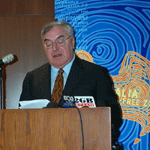 Launch
of Isma
21 March 2003.
Speech by Dr William Jonas,
Acting Race Discrimination Commissioner
I would like to begin
by acknowledging the Gadigal people of the Eora nation, the traditional
owners and custodians of the land where we meet today.
I would also like
to thank everyone for coming today to find out about our project and express
their good will towards it.
I would particularly
like to thank members of the Isma project reference group who have
come to support our project launch today. I am the convenor of the reference
group whose members our new community liaison officer, Ms Omeima Sukkarieh,
will introduce to you shortly.
Today we celebrate
the International Day for the Elimination of Racial Discrimination. In
Australia, this day is otherwise known as 'harmony day'.
Australia is
a relatively harmonious society. But it is important to recognise that
racism was, and continues to be, a serious problem in Australian society.
As the Acting Race
Discrimination Commissioner, it is my job to identify and denounce racial
discrimination where and when it occurs. It is also my role to conduct
research and develop programs that combat the prejudices that lead to
racial discrimination.
Recognising and denouncing
racism and the prejudice that leads to racism is especially crucial during
a time of war. War fosters a climate of fear and suspicion. This climate
is the perfect breeding ground for intolerance towards, discrimination
against and vilification of certain groups.
The war poses a real
threat to Australian Muslims and to Australians of Arab or Middle Eastern
background. This threat is neither imagined nor exaggerated.
In a moment, reference
group member Rawan Abdul-Nabi and Omeima Sukkarieh will speak about their
own personal experiences of discrimination. Their experiences are representative
of the kinds of information we have been hearing about informally over
the last 6 to 12 months from various community groups.
Since 11 September
2001, Arabic and Islamic community organisations have reported increased
levels of anti-Arab and anti-Muslim prejudice, discrimination and vilification.
Community leaders have told us that the reported incidents are really
just the tip of the iceberg. Fear and isolation have made many people
reluctant to come forward and speak out or complain. It is important that
we listen to the voices of these people.
We have heard from
some of them on our Commission's E-Race internet forum on anti-Muslim
prejudice. What these on-line voices are telling us is that the conflation
of Arab with Muslim has resulted in an especially virulent form of prejudice
and discrimination.
These on-line voices
also tell us that intolerance towards particular groups encourages discrimination
against other minorities - including Sikhs, Jews, Christian Arabs or non-Arab
Muslims. Attacking the very principle of respect for diversity has an
alarming ripple effect.
There are many other
sources of information which alert us to the fact that war will exacerbate
racial tensions.
In 1991, the Human
Rights Commission's Report of the National Inquiry into Racist Violence
in Australia described upsurges in violence towards Arab and Muslim
Australians during the Gulf War. But the Gulf War was simply the trigger
for violence - not the sole cause. The report pointed to deeper, long-term
underlying tensions as the root cause of discrimination and vilification.
We need to be mindful
of this in our current work. This war is likely to exacerbate racial tensions
- not cause them. One need only look at a recent survey on racist
attitudes in Australia by geographer Kevin Dunn to understand that the
level of anti-Muslim and anti-Arab prejudice was high among the general
Australian public even before the outbreak of war.
We understand that,
for people who face discrimination every day of their lives, this war
is just the latest crisis in long, protracted period of crises. Our goal
is to help develop strategies that address the underlying causes of discrimination
and vilification against Australian Arabs and Muslims. We are not just
trying to come up with a 'quick -fix' for tensions that flare up during
crisis flashpoints.
Our aims are ambitious.
Over the next six months we will consult with as wide a cross-section
as possible of Arab and Muslim community representatives, as well as with
other federal, state and territory government agencies and non-government
agencies across the nation.
Once we have consulted
extensively, we will report our findings and recommend future directions
for implementing strategies for change. I want to emphasise that the Isma
project is just the beginning of a longer term process of engagement for
HREOC.
The first step is
to listen. As the project name 'Isma' suggests, our goal is to
listen to what Australian Arabs and Muslims have to say about their
experiences of prejudice and discrimination. We also want to listen to
suggestions for developing and coordinating strategies between communities
and government agencies that will help to eliminate discrimination and
vilification against Arab and Muslim Australians.
We look forward to
working with you over the coming months and thank you for your interest
in our project.
I would like to now
introduce Ms Rawan Abdul-Nabi who is the youth representative on the Isma
reference group. Rawan will speak to us about her experiences of prejudice
and discrimination.
Thank you.

