
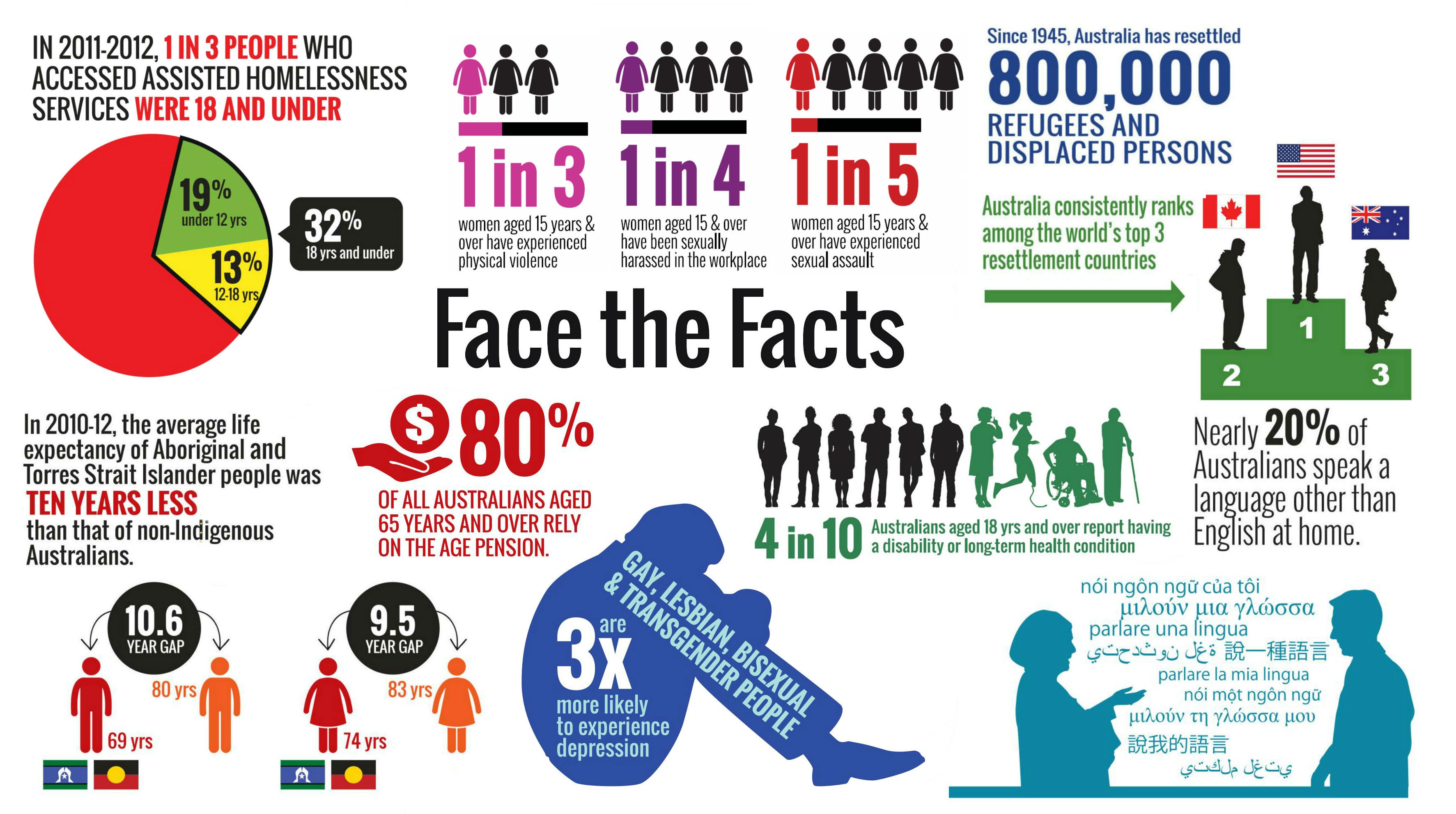
Face the Facts (2008)
Questions and Answers about Asylum Seekers and Refugees
- 3.1 Asylum seekers
- 3.2 Refugees
- 3.3 What is Australia’s policy on refugees?
- 3.4 How many refugees come to Australia?
- 3.5 Where do refugees come from?
- 3.6 What happens to asylum seekers in Australia?
- 3.7 Why are refugees allowed to stay in Australia?
- 3.8 What settlement services does Australia provide to refugees?
- 3.9 Past policies in Australia
- 3.10 What is immigration detention?
- Further reading
Download
-
Complete publication PDF [1.2 MB]
Compete publication Word [1 MB]
3.1 Asylum seekers
The terms asylum seeker and refugee are often confused. An asylum seeker is someone who says that he or she is a refugee but whose claim has not yet been assessed. A refugee is someone who has been assessed by a national government or an international agency (such as the Office of the High Commissioner for Refugees (UNHCR)) and meets the criteria set out under the Convention relating to the Status of Refugees 1951 (Refugee Convention).
Who are asylum seekers?
An asylum seeker is someone who has fled their own country and applies to the government of another country for protection as a refugee. As a signatory to the Refugee Convention, Australia must comply with its obligations and ensure that all those who make claims for protection while in Australia have their claims assessed in accordance with the Refugee Convention. A person is a refugee the moment he or she fulfils the criteria of this Convention. When Australia grants a refugee visa it does not establish but rather confirms their refugee status under international law.[119]
How many asylum seekers are there worldwide?
At the end of 2007 there were an estimated 740 000 individuals worldwide waiting on a decision regarding their asylum claim.[120]
Many asylum seekers make refugee applications in neighbouring countries, while some apply in countries further afield. As mainland Australia shares no land border with any other country and is far from most major conflicts, relatively few people seek asylum here compared to the United States and Europe. For example, in 2007 about 6303 people[121] sought asylum in Australia.[122] This compares with 50 700 applications in the United States, 45 600 in South Africa and 36 400 in Sweden.[123] In terms of the number of refugee visas granted, Ethiopia recognised the largest number of their asylum applicants as refugees (19 896), followed by the United States with 17 979, Malaysia with 14 156 and France with 12 928.[124]
3.2 Refugees
Who is a refugee?
The Refugee Convention and its 1967 Protocol are the bases of modern refugee protection. The Refugee Convention defines who is and who is not a refugee and sets out the basic rights which states should guarantee to refugees. Australia is one of 146 signatories to the Refugee Convention. According to the Convention, a refugee is someone who is outside their own country and cannot return due to a well-founded fear of persecution because of their:
- race
- religion
- nationality
- membership of a particular social group
or
- political opinion.[125]
A person becomes a refugee under international law once he or she crosses an international border and is assessed as meeting the definition of a refugee, either by a national government or an international agency such as the UNHCR.[126]
In popular use, the term refugee is often interpreted more broadly than its legal definition, to include all people who flee their homes seeking refuge from harm. There are many circumstances which could force someone to flee to safety, including war or civil strife, domestic violence, poverty and natural or man-made disasters. However, the Refugee Convention only recognises people as refugees if they are displaced from their home country because of persecution (or a well founded fear of persecution) on the basis of their race, religion, nationality and their membership of a particular social group or political opinion.
How many refugees are there worldwide?
At the end of 2007, there were roughly 11.4 million refugees around the world that were under the responsibility of the UNHCR.[127] This is the largest number of refugees seen in the past six years and continues the upward trend started in 2006.[128]
At the end of 2007, the Asia Pacific Region had 27.6% of the 11.4 million refugees under the mandate of UNHCR. The Middle East and North Africa region had 27.4%; the rest of Africa had 23.5%, followed by Europe 16.3% and the Americas 5.2%.[129]
In 2007, Pakistan hosted the largest number of refugees and people in refugee-like situations with over 2 million residing in that country, followed by Syria (over 1.8 million) Iran (approximately 964 000).[130] In 2007 the largest country of origin for refugees was Afghanistan (3.1 million), with Iraq as the next largest (2.3 million), followed by Colombia, Sudan, Somalia and then Burundi.[131]
Complete data of the age and gender makeup of the refugee population is not available. The data available showed that roughly half of the population of concern were female.[132] About 44% of the population of concern, for which data is available, were children under the age of 18 and about 10% were under the age of five.[133]
What are the responsibilities of the UNHCR?
The UNHCR was created by the United Nations General Assembly in 1950 and became operational in 1951. Its original (three year) mandate was to protect the interests of the remaining World War II refugees in the countries where they had sought asylum. However, the problem of displacement did not disappear after World War II and, in fact, became a persistent worldwide phenomenon.
The UNHCR leads and co-ordinates international action to protect refugees worldwide. Its primary purpose is to safeguard the rights and well-being of refugees. It aims to ensure that everyone can exercise the right to seek asylum and find safe refuge in another State, with the option to return home voluntarily (where possible), integrate locally in a host community or to resettle in a third country.
One of the key principles set out under the Refugee Convention is that refugees should not be returned to places where their lives or their freedom would be threatened. The UNHCR identify their preferred durable solutions for refugees as:
- the voluntary return to their country of origin in conditions of safety and dignity
- the local integration into a country of asylum if a safe return to the country of origin is not possible
- resettlement into a third country if neither of the first two options are suitable or possible.
For over 50 years, the agency has provided assistance to an estimated 50 million people. Today, the UNHCR operates in more than 110 countries and continues to help 32.9 million persons.
Who are environmental refugees?
People displaced due to environmental factors, including climate change, do not fit the international legal definition of ‘refugee’, which requires individuals already outside their country of origin to show that they have a well-founded fear of being persecuted (because of their race, religion, nationality political opinion or membership of a particular social group).[134]
Environmental refugees are classified as people who cannot sustain their livelihood and have to leave their ‘traditional habitats’ due to drought, soil erosion, desertification, deforestation, depletion of natural resources, climate change and other environmental problems. This also includes associated problems of population pressures and profound poverty.[135] Environmental refugees can include people who are internally displaced and therefore do not necessarily leave their country.
How do refugees differ from migrants?
Refugees are not in the same situation as migrants, although the definitions of the two groups are often confused. Migrants choose when to leave their country, where they go and when they return. Refugees flee their country for their own safety and cannot return unless the situation that forced them to leave improves. Migrants, however, may still be a vulnerable group who face many challenges while travelling to, and settling in, a new country. Refugees and migrants are fundamentally different and are treated differently under international law.
3.3 What is Australia’s policy on refugees?
Under its Humanitarian Program, Australia accepts a number of people from various regions. Each year the federal government sets a quota of places for people to come to Australia.
Through this program the Department of Immigration and Citizenship (DIAC) aims to:
- assist people in humanitarian need overseas for whom resettlement in another country is the only available option
- comply with Australia’s international obligations onshore under the Refugee Convention.
This program has two main parts: off-shore resettlement and on-shore protection.
Off-shore resettlement
The off-shore resettlement program is for refugees and other ‘humanitarian entrants’ who apply for a visa from outside Australia. There are two kinds of visas which can be granted under the off-shore resettlement program:
- Refugee Visas: for people outside their home country who satisfy the Refugee Convention definition of 'refugee' and who are in need of resettlement because they cannot return to their own country or stay where they are.[136]
- Special Humanitarian Program Visas: for people outside their home country who have experienced substantial discrimination amounting to a gross violation of human rights in their home country. A proposer, who is an Australian citizen, permanent resident, or eligible New Zealand citizen, or an organisation that is based in Australia, must support such an application for entry.[137]
Did you know?
A person can apply to Australia for a humanitarian visa while they are in another country or while they are in Australia.
On-shore protection
People can seek to be recognised as refugees once they are already in Australia by applying for a ‘Protection Visa’ (PV). To be granted a Protection Visa, asylum seekers must satisfy the Refugee Convention definition of ‘refugee’.[138]
Australia is only obliged to protect refugees if:
- the applicant has a well founded fear of persecution on grounds covered by the Convention
- the applicant has not committed war crimes or serious non-political crimes
- the applicant does not have effective protection in another country (eg. through citizenship or some other right to enter and remain safe in that country).[139]
Permanent Protection Visas (PPV): This visa is for people who arrive in Australia and are found to be refugees that Australia is obliged to protect. If granted, the Permanent Protection Visa allows the applicant to become a permanent resident of Australia and gives them the same rights as other permanent residents, including being able to apply for Australian Citizenship. Applicants who do not have a valid visa may receive a bridging visa upon lodging a PPV application which allows the applicant to remain lawfully in the community until the PPV application is finalised. Some bridging visas allow the applicant to work in Australia, while others do not have work rights attached.[140] Some PPV applicants are also eligible for financial assistance for basic food, accommodation and health care while their applications are being processed.[141]
3.4 How many refugees come to Australia?
Each year, the Australian Government makes a number of places available for use under the Humanitarian Program, including both off-shore and on-shore visas. The system is fairly flexible as places that are not used in the previous year can be carried forward and, if there is need, places in the following year can be used in the current year.[142] Up until 2004-05 the quota was set at around 12 000 visas per annum. This was increased to 13 000 in the 2004-05 program year and this higher quota has been maintained for the 2005-06, 2006-07 and 2007-08 program years.
The 2008-09 Humanitarian Program was increased to 13 500, with the additional 500 places set aside for Iraqi refugees in recognition of their critical resettlement needs.
In 2007-08 a total of 13 014 visas were granted under the Humanitarian Program.[143] In 2008-09, offshore visas of the Humanitarian Program are planned to be evenly split between three regional areas: Africa, Middle East and Asia will receive 33% each with 1% as contingency.[144]
Table 3.1 Humanitarian Program, visa grants by category, 2003-04 to 2007-08
Category |
2003-04 |
2004-05 |
2005-06 |
2006-07 |
2007-08 |
|---|---|---|---|---|---|
Refugee |
4134 |
5511 |
6022 |
6003 |
6004 |
Special Humanitarian |
8927^ |
6755+ |
6836 |
5275 |
5026 |
Onshore Protection |
788 |
895 |
1272 |
1701 |
1900 |
Temporary Humanitarian Concern |
2 |
17 |
14 |
38 |
84 |
Total |
13 851 |
13 178 |
14 144 |
13 017 |
13 014 |
^ This figure includes 1228 grants to the East Timorese
on-shore.
+ This figure includes 148 grants to East Timorese and
22 others on-shore.
Source: Department of Immigration and Citizenship, Australia’s Refugee and Humanitarian Programme, Fact Sheet 60. At http://www.immi.gov.au/media/fact-sheets/60refugee.htm, (viewed 15 September 2008).
3.5 Where do refugees come from?
In 2007-08, a total of 13 014 people were granted visas under the Humanitarian Program, including 10 799 off-shore and 2215 on-shore applicants.[145] The off-shore visas granted in 2007-08 were mainly targeted at three geographical areas: Middle East and South West Asia (35.4%), including Iraq and Afghanistan; Asia (33.7%), including Burma/Myanmar and Sri Lanka; and Africa (30.5%), including Sudan, Liberia and the Democratic Republic of the Congo.[146]
Table 3.2 Off-shore Resettlement Program, visas grants by region 1999-2000 to 2007-08
Region |
1999-2000 |
2000-01 |
2001-02 |
2002-03 |
2003-04 |
2004-05 |
2005-06 |
2006-07 |
2007-08 |
|---|---|---|---|---|---|---|---|---|---|
Middle East & SW Asia |
2208 |
2155 |
2743 |
4701* |
2867^ |
3174 |
4335 |
3126 |
3807 |
Africa |
1736 |
2032 |
2801 |
5616 |
8353 |
8486 |
7100 |
5695 |
3291 |
Asia |
113 |
316 |
189 |
181# |
221 |
415 |
1260 |
2315 |
3636 |
Europe |
3424 |
3462 |
2709 |
1158 |
354 |
20 |
55 |
50 |
59 |
Americas |
21 |
27 |
16 |
0 |
7 |
1 |
8 |
0 |
6 |
Total |
7502 |
7992 |
8458 |
11 656 |
11 802 |
12 096 |
12 758 |
11 186 |
10 799 |
* Includes 311 grants to mainly Afghan and Iraqis in the Offshore Processing
Centres in Papua New Guinea and Nauru.
# Includes 26 grants to out
of region cases.
^ Includes 90 grants to mainly Afghanis and
Iraqis in the Offshore Processing Centres in Papua New Guinea and Nauru.
Source: Department of Immigration and Citizenship, Australia’s Refugee and Humanitarian Programme, Fact Sheet 60. At http://www.immi.gov.au/media/fact-sheets/60refugee.htm, (viewed 15 September 2008)
3.6 What happens to asylum seekers in Australia?
Asylum seekers in Australia are treated differently according to whether they entered Australia as 'authorised' or 'unauthorised' arrivals.
'Authorised' arrivals enter Australia with a valid visa (such as a tourist or student visa). Authorised arrivals can apply for a Permanent Protection Visa (PPV). An applicant for a PPV who meets the relevant eligibility requirements will be granted a bridging visa while their protection claims are being assessed. Whether they are granted permission to work depends on their immigration status at the time of making their PPV application as well as the operation of other criteria. Some PPV applicants are also eligible to receive financial help from the Government if they cannot meet their basic needs for food, accommodation and health care. Authorised arrivals who are not found to be refugees according to Australian migration law may be detained until they are removed from the country.
'Unauthorised' arrivals enter Australia without a valid visa, by boat or by air. In July 2008 the federal government announced that Australia will only detain unauthorised arrivals for identity, health and security checks. Once they have passed these checks, they may be issued with a bridging visa so that they can live in the community while their refugee applications are being decided. Unauthorised arrivals who are found not to be refugees under Australian migration law may be removed from the country.
Who decides refugee applications in Australia?
Once in Australia, an asylum seeker applies for refugee status to DIAC. When an application is made an officer from DIAC, acting as a delegate of the Minister for Immigration and Citizenship, decides if the applicant engages Australia's obligations under the Refugee Convention. This is done by assessing individual claims against the definition of a refugee set out in the Refugee Convention and domestic legislation. A decision on all initial refugee applications should be made within three months[147] of the application being lodged.[148] The applicant must also meet certain health and character requirements in order to be granted a visa.[149] If the application is successful, the applicant is granted a Permanent Protection Visa.
If an application by a person in Australia is refused, that person can seek a review of the decision from an independent tribunal. They can either apply to the Refugee Review Tribunal (RRT) or the Administrative Appeals Tribunal (AAT) depending on the basis for refusal[150]. These appeals must also be processed within three months of them being lodged.[151]
Did you know?
A decision should be made within three months on all initial refugee applications made by asylum seekers being held in immigration detention in Australia.
The AAT provides independent merits review of:
- a visa refusal decision based on section 501 character grounds, or
- a protection visa refusal decision based on Article 1F or Article 33(2) of the Refugee Convention (see section 3.7).
The AAT hearing is based on an adversarial framework similar to that of a court proceeding where each party is able to present his or her case.
The RRT is an independent body established under the Migration Act 1958 (Cth) to review protection visa applications. The RRT considers individual circumstances and claims in each case, and make a fresh objective assessment of the merits of the case. The RRT will take into account any new developments or claims which may have emerged since the case was last examined. The tribunal hearing, unlike a court or the AAT, is informal and non-adversarial.
Applicants rejected by the RRT (and who have no other legal reason to be in Australia) have 28 days to depart Australia. If they stay beyond this 28-day period, they may be removed from Australia.[152]
The Minister has a non-compellable power to intervene after an unfavourable RRT or AAT decision relating to a protection visa to substitute a more favourable decision to the applicant if the Minister believes it is in the public interest.[153] Applicants may also seek judicial review of an unfavourable RRT or AAT decision in limited circumstances.
What happens to people who do not meet the definition of refugee but are in need of protection?
There are some people who are found not to be refugees by Australia’s refugee status determination system, but who otherwise may face significant human rights abuses if returned to their countries. For example, they may not meet one of the grounds for persecution under the Refugee Convention, but might face torture or death on return.
Australia has obligations under the International Covenant on Civil and Political Rights, the Convention against Torture and Other Cruel, Inhuman or Degrading Treatment and Punishment and the Convention on the Rights of the Child not to return people who risk these significant human rights violations. Similarly, Australia has international obligations not to return a person if they are stateless (no state considers them to be a national of their country).
Some countries provide a formal system of ‘complementary’ or ‘subsidiary’ protection’ for these people.[154] However, in Australia currently the only avenue of protection is to apply to the Minister for Immigration and Citizenship to exercise his/her personal discretion under section 417 of the Migration Act 1958 (Cth).
3.7 Why are refugees allowed to stay in Australia?
Every country that has adopted the Refugee Convention, including Australia, makes a commitment to protect the rights of refugees. The crucial part of this commitment is never to return a refugee to a country where he or she has reason to fear persecution.
Article 33 of the Refugee Convention is titled ‘Prohibition of expulsion or return (‘refoulement’)’ and says:
1. No Contracting State shall expel or return ("refouler") a refugee in any manner whatsoever to the frontiers of territories where his life or freedom would be threatened on account of his race, religion, nationality, membership of a particular social group or political opinion.
2. The benefit of the present provision may not, however, be claimed by a refugee whom there are reasonable grounds for regarding as a danger to the security of the country in which he is, or who, having been convicted by a final judgment of a particularly serious crime, constitutes a danger to the community of that country.[155]
As a signatory to the Refugee Convention, Australia is obliged to provide protection to those people, regardless of whether they entered Australia lawfully or unlawfully. This means that Australia must give authorised and unauthorised arrivals the chance to prove whether or not they are refugees before removing them from the country. Australian law requires that people who have not succeeded in their claim for refugee protection and who have no lawful basis to remain in Australia, be removed from Australia as soon as practicable.
3.8 What settlement services does Australia provide to refugees?
Humanitarian entrants like migrants have access to the Adult Migrant Education Program (AMEP). There are also some programs administered by DIAC specifically for refugees and other humanitarian entrants.
The Australian Cultural Orientation Program (ACOP): is available to all refugee and special humanitarian entrants over five years of age and is delivered offshore to provide an overview of Australia, including: government, geography and climate, cultural adjustment, travel to Australia, settling in, health care, education, finding a job, money management, housing, transport, Australian laws and the role of police.
The Integrated Humanitarian Settlement Strategy (IHSS): provides initial settlement assistance for humanitarian entrants for up to 12 months after arrival, including: information and orientation assistance, assistance in finding accommodation, a package of goods, assistance to access services and become a part of the local community and short-term torture and trauma counselling. Some asylum seekers that are granted an Onshore Protection Visa have limited eligibility to IHSS services.
The Settlement Grants Program (SGP): provides organisations with funding to provide settlement support to eligible migrants and humanitarian entrants, for up to five years after arrival. It aims to deliver services which help new arrivals to become self reliant and participate equitably in Australian society as soon as possible after arrival.
Other programs include:
- increased assistance with rental, utilities and transport costs in the first month after arrival
- Complex Case Support (CCS) services which deliver specialised and intensive case management to recently arrived humanitarian entrants where pre-migration experiences, such as severe torture and trauma, serious medical conditions and/ or crisis events after arrival in Australia, present significant barriers to successful settlement
- an additional one-off income support payment for humanitarian entrants on-arrival (through Centrelink).
3.9 Past policies in Australia
What was the ‘Tampa’ issue?
In August 2001, the Norwegian cargo ship MV Tampa rescued 433 mostly Afghani and Iraqi asylum seekers from a sinking boat in the Indian Ocean. The Howard Government refused permission for the Tampa to enter Australian waters and allow its passengers to get off on nearby Christmas Island, an Australian Territory. Despite the government's warning, the Tampa entered Australian waters and the ship was boarded by Australian Special Air Services (SAS) troops. The passengers were transferred from the Tampa to an Australian Navy ship and taken to Nauru. The government of Nauru agreed to house the asylum seekers in return for economic aid from Australia.
The Howard Government's refusal to allow asylum seekers on the Tampa to land on Australian territory was later challenged in the Federal Court, which upheld the right of the government to act as it did.[156] The Tampa incident was a major catalyst for debate in Australia regarding unauthorised boat arrivals and for the implementation of the ‘Pacific Solution’.
What was the ‘Pacific Solution’?
The 'Pacific Solution' or 'Pacific Strategy' aimed to prevent unauthorised boat arrivals from reaching the Australian mainland and making refugee applications. The Howard Government developed this strategy in September 2001 in response to the 'Tampa’ issue. It involved removing or 'excising' certain parts of Australian territory through amendments to the Migration Act, including Ashmore Reef and Cartier Island, Christmas Island and Cocos (Keeling) Islands, from Australia's 'migration zone'. This means people landing in these places could not access the Australian refugee determination system. Instead, they were transferred to a 'declared country', such as the Pacific Island nation of Nauru or Manus Province in Papua New Guinea, while their applications were being assessed.
In March 2008 the Rudd Government ended the Pacific Solution and the last remaining asylum seekers on Nauru were settled in Australia. Although asylum seekers are no longer detained in Papua New Guinea or Nauru, the legislation which excises certain parts of Australia remains. Unauthorised arrivals in these places, for example Christmas Island, cannot apply for a visa unless authorised by the Minister for Immigration and Citizenship. Their claims for protection are not subject to the same processes and review mechanisms as asylum seekers who arrive on mainland Australia. At the date of publication, the Rudd Government had also announced some measures to improve their access to legal assistance and review.
What were Temporary Protection Visas (TPV’s)
Temporary Protection Visas were introduced by the Howard Government to deter unauthorised arrivals. Under the policy, all unauthorised arrivals who applied for asylum and who were found to be refugees were granted three year TPV’s only. In contrast, asylum seekers who applied for protection while on a valid visa in Australia were granted Permanent Protection Visas (PPV’s). In addition to their temporary nature, TPV’s also restricted the rights of TPV holders to family reunion and their right of return if they left Australia.
On 9 August 2008 Temporary Protection Visas (TPVs) were officially abolished. All initial applicants for a protection visa who are found to be a refugee now receive a Permanent Protection Visa. A number of Temporary Humanitarian Visas (THVs) were also abolished in August 2008. These visas included the Subclass 451 – Secondary Movement Relocation (Temporary) and Subclass 447 – Secondary Movement Offshore Entry (Temporary) visas. Former TPV and THV holders who were still in Australia as of 9 August 2008 have access to a permanent visa arrangement with the same benefits and entitlements of the PPV.
Visit http://www.aph.gov.au/library/pubs/online/Refugees_contents.htm for more information about the history of refugee policy in Australia.
3.10 What is immigration detention?
Under the previous immigration detention policy, 'unlawful non-citizens' had to be detained until they were granted a visa (pursuant to a refugee claim or some other category) or were removed from the country. An 'unlawful non-citizen' is a person without a valid visa in Australia. People become 'unlawful non-citizens' if:
- they enter Australia without a valid visa (i.e. if they are 'unauthorised arrivals')
- they enter Australia with a valid visa but then stay past the visa's expiry date (i.e. they 'overstay' their visa)
- they break the conditions of their visa (for example, by working when the visa does not allow it)
or
- if their visa has been cancelled.[157]
The law requiring immigration detention for 'unlawful non-citizens' was introduced in 1992 and was then expanded in 1994.[158]
As at the 12 September 2008, there were a total of 274 people in detention:
What was the Palmer Report?
The Palmer Report was a result of an Inquiry held in July 2005, to determine how an Australian resident, Cornelia Rau, came to be held for 10 months in immigration detention, and an Australian citizen, Vivian Alvarez, came to be deported to the Philippines.
The report highlighted problems concerning the provision of mental health services to detainees, as well as identifying structural problems within DIAC.
Source: M Palmer, Inquiry into the Circumstances of the Detention of Cornelia Rau, 2005. At http://www.immi.gov.au/media/publications/pdf/palmer-report.pdfImmigration.
147 were detained because they overstayed their visa
- 67 were detained because their visa was cancelled
- six were unauthorised boat arrivals
- 40 were unauthorised air arrivals
- three were illegal foreign fishers
- 11 were detained for other reasons e.g. ship deserters and stowaways.[159]
Of the 274 people in immigration detention, 46 of these are in the process of seeking asylum in Australia.[160]
In July 2008, the Minister for Immigration and Citizenship announced changes to the mandatory immigration detention system.[161] The Minister indicated that immigration detention centres will only be used as a last resort and for the shortest possible period of time. Unauthorised arrivals will be detained only until they have passed identity, health and security checks.
Children in immigration detention
Between 1 July 1999 and 30 June 2003, 2184 children arrived in Australia without a valid visa and sought asylum – all these children were held in immigration detention while their refugee status was being determined.
Between 2001-04, the Australian Human Rights Commission conducted a National Inquiry into Children in Immigration Detention to investigate the human rights of children in immigration detention. The report on the Inquiry is entitled A last resort? Visit http://www.humanrights.gov.au/human_rights/children_detention_report/index.html to read the report.
National Inquiry into Children in Immigration Detention
From November 2001 to April 2004, the Commission conducted a National Inquiry into Children in Immigration Detention to investigate whether Australia's detention laws complied with international law. The report of the Inquiry into Children in Immigration Detention, A last resort? was tabled in Federal Parliament in May 2004.[162]
The Inquiry found that:
- Australia's immigration detention policy is inconsistent with the Convention on the Rights of the Child (1989).[163] In particular, Australia's mandatory immigration detention system failed to ensure a child's right to be detained as a measure of last resort and for the shortest appropriate period of time
- children in immigration detention for long periods of time are at high risk of serious mental harm
- long-term detention undermines a child's ability to enjoy a variety of other important rights.
Visit http://www.humanrights.gov.au/human_rights/children_detention_report/report/index.htm to read A last resort? The National Inquiry into Children in Immigration Detention.
Recent developments for children and families in detention
Since the tabling of A last resort?, the Migration Act was amended by the Migration Amendment (Detention Arrangements) Act 2005 (Cth). Those amendments:
- affirm the principle that children shall only be detained as a last resort, however, this principle is not directly enforceable
- confer upon the Minister a new power (which is non-compellable and non-reviewable) to grant a visa to a person in immigration detention where the Minister is satisfied that it is in the public interest to do so
- confer upon the Minister the power to specify alternative arrangements for a person in immigration detention, which will enable the Minister to allow families with children to reside in the community in a specified place (again this power is non-compellable and non-reviewable)
- confer upon the Commonwealth Ombudsman the function of reviewing the cases of people who have been in immigration detention for more than two years. While the Ombudsman is further empowered to make recommendations regarding such people (including as to the appropriateness of their ongoing detention) such recommendations will not be binding upon the Minister.
Since 29 July 2005, there have been no children held in Australian Immigration Detention Centres. However, technically children are still held in ‘detention’, as most children and their families without visas are detained in ‘community detention’ and Immigration Residential Housing at the discretion of the Minister.
How many people are detained?
The number of people who are detained in immigration detention each year varies greatly. In the last 10 years the number has ranged from approximately 2700 people in 1997-98 to over 8500 people in 2004-05.[164] There were 5485 people detained at some time during the 2006-07 period. The maximum number of people detained on any one day in this period was 847.[165]
Figure 3.4 Total number of people held in immigration detention between 1997-98 and 2006-07

Source: Department of Immigration and Citizenship, Immigration Detention, Fact Sheet 82. At http://www.immi.gov.au/media/fact-sheets/82detention.htm (viewed 12 January 2008).Department of Immigration and Citizenship, Annual Report 2006-07, (2007). At http://www.immi.gov.au/about/reports/annual/2006-07/html/outcome1/output1_3_5.htm (viewed 12 January 2008).
Where are people detained?
- Immigration Detention Centres (IDCs): mainly used to detain people whose visas have been cancelled, who have breached their visa conditions or who have overstayed their visa, and people refused entry at Australia's international airports. These are secure facilities.
- Immigration Residential Housing (IRH): enables people in immigration detention to live in family-style accommodation.
- Immigration Transit Accommodation (ITA): This is temporary accommodation for people who are spending a short time in detention before they are returned home or transferred to other facilities. Only people considered to be a low security risk are housed in these facilities.[166]
- Community Detention: In this situation people can be detained in the community as authorised by the Minister under ‘residence determinations’. People in community detention are able to live in the community at a specified address and, subject to certain conditions, can participate in community life without being accompanied or restricted. Community detention allows families with children, unaccompanied minors or people with special needs to live in the community where their needs can be better addressed, while still being available to DIAC for immigration processing purposes.
Table 3.5 Numbers of Persons in Immigration Detention as at 12 September 2008
Facility |
Men |
Women |
Children |
Total |
|---|---|---|---|---|
Villawood IDC |
126 |
12 |
0 |
138 |
Northern IDC |
3 |
0 |
0 |
3 |
Maribyrnong IDC |
41 |
6 |
0 |
47 |
Perth IDC |
4 |
0 |
0 |
4 |
Christmas Island IRPC |
0 |
0 |
0 |
0 |
Total in Immigration Detention Centres |
174 |
18 |
0 |
192 |
Sydney Immigration Residential Housing |
13 |
3 |
2 |
18 |
Perth Immigration Residential Housing |
4 |
2 |
0 |
6 |
Brisbane Immigration Transit Accommodation |
6 |
0 |
0 |
6 |
Melbourne Immigration Transit Accommodation |
3 |
0 |
0 |
3 |
Total in IRH and ITA |
26 |
5 |
2 |
33 |
Community Detentioni |
23 |
9 |
12 |
44 |
Alternative Temporary Detention in the Communityii |
2 |
1 |
0 |
3 |
Restricted on Board Vessels in Portiii |
2 |
0 |
0 |
2 |
Total in Community and Alternative Detention |
25 |
10 |
12 |
47 |
Total (All Locations) |
227 |
33 |
14 |
274 |
- Community Detention does not require the person to be accompanied by a designated person.
- Includes detention in the community with a designated person in private houses/ correctional facilities /watch houses/ hotels/ apartments/ foster care/ hospitals.
- The requirement for ships’ crew who visit Australian ports without an appropriate visa to remain on their vessel while it is in their port (under section 249 of the Migration Act 1958) has been enforced for each of these people.
Source: Department of Immigration and Citizenship, Immigration Detention Statistics Summary, 2008. At http://www.immi.gov.au/managing-australias-borders/detention/_pdf/immigration-detention-statistics-20080912.pdf (viewed 24 September 2008).
Immigration facilities at Port Hedland are also maintained as contingency facilities on a needs basis but are not currently in use.[167]
Where do people in detention come from?
The main nationalities of detainees held in detention in 2000-01 were Afghan, Iraqi, Iranian and Palestinian. The main nationalities of those held in 2001-02 were Afghan, Iraqi, Malay and Sri Lankan. Between 2002-03 and 2005-06, the main nationality of detainees was Indonesian, followed by Chinese, Malay and Korean.[168]
Further reading[169]
General
M Crock & B Saul, Future Seekers: Refugees and the Law in Australia, Federation Press, Sydney, (2002).
M Crock, Immigration and Refugee Law in Australia, Federation Press, Sydney, (1998).
N T Bao & D Cahill, 'The Vietnamese' in James Jupp (ed), The Australian People: Encyclopedia of the Nation, Its People and their Origins, Centre for Immigration and Multicultural Studies, Canberra, (2001).
Department of Immigration and Citizenship, Border Control, Fact Sheet 70. At: http://www.immi.gov.au/media/fact-sheets/70border.htm.
Department of Immigration and Citizenship, Refugee and Humanitarian Issues - Australia's Response, Canberra, (2005), Commonwealth of Australia, at: http://www.immi.gov.au/refugee/_pdf/refhumiss-fullv2.pdf.
Human Rights Commissioner, Those who've come across the seas: Detention of unauthorised arrivals, Human Rights and Equal Opportunity Commission, Sydney, (1998), at: http://www.humanrights.gov.au/Human_Rights/immigration/seas.html.
D Marr & M Wilkinson, Dark Victory, Allen & Unwin, Sydney, (2003).
L Hawthorne (ed), Refugee: the Vietnamese experience, Oxford University Press, Melbourne, (1982).
W Maley et al. (eds), Refugees and the Myth of the Borderless World, Research School of Pacific and Asian Studies, Australian National University, Canberra, (2002).
P Mares, Borderline: Australia's treatment of refugees and asylum seekers, UNSW Press, Sydney, (2001).
D McMaster, Asylum Seekers: Australia's Response to Refugees, Melbourne University Press, Melbourne, (2001).
Oxfam Community Aid Abroad, Adrift in the Pacific: the Implications of Australia's Pacific Refugee Solution, Oxfam, Melbourne, (2002).
S Pickering, 'The Hard Press of Asylum', Forced Migration Review, Issue 8, 8 August (2000).
T Rod & R Brunton, Who Gets to Stay? Refugees, Asylum Seekers and 'Unauthorised Arrivals in Australia, Institute of Public Affairs, Melbourne, (2002).
Senate Standing Committee on Foreign Affairs and Defence, Australia and the refugee problem: the plight and circumstance of Vietnamese and other refugees, Commonwealth Parliament, Canberra, (1976).
UNHCR, Refugees by Numbers, 2006 Edition, at: http://www.unhcr.org/cgi-bin/texis/vtx/basics/opendoc.htm?tbl=BASICS&id=3b028097c.
B York, Australia and Refugees, 1901-2002: Annotated Chronology Based on Official Sources: Summary, Department of the Parliamentary Library, (2003).
Asylum seekers
Department of Immigration and Citizenship, Border Control, Fact Sheet 70. At: http://www.immi.gov.au/media/fact-sheets/70border.htm.
UNHCR, 2006 Global Trends: Refugees, Asylum Seekers, Returnees, Internally Displaced Persons and Stateless Persons, (2007), at: http://www.unhcr.org/statistics/STATISTICS/4676a71d4.pdf.
Refugee Council of Australia, Top 10 Nationalities of Boat Arrivals at: http://www.refugeecouncil.org.au/html/facts_and_stats/stats.html#stat9.
Refugees
UNHCR, 2006 Global Trends: Refugees, Asylum Seekers, Returnees, Internally Displaced Persons and Stateless Persons, (2007), at: http://www.unhcr.org/statistics/STATISTICS/4676a71d4.pdf.
The United Nations University in New York, Environmental refugees: the forgotten migrants, (2007), at: http://www.ony.unu.edu/16May2007.html.
N Myers Environmental refugees: a growing phenomenon of the 21st century, Philosophical Transactions of the Royal Society of Biological Sciences, 357(1420), (2002).
Australian Law Reform Commission, 'Violence and Women's Refugee Status', Chapter 11 in Equality before the Law: Justice for Women, Commonwealth of Australia, (1994).
European Council on Refugees and Exiles, Position on the Interpretation of Article 1 of the Refugee Convention, (2000), at: http://www.ecre.org/resources/policy_papers/704.
B Hovey, Working Paper No. 37, New Issues in Refugee Research, Statistically correct asylum data: prospects and limitations', Evaluation and Policy Analysis Unit, UNHCR, Geneva, (2001), at: http://www.csnis.lk/Statistically_correct_asylum_data__prospects_and_limitations-7-325-V.html.
UN High Commission for Refugees, 'Who is a Refugee?' at: http://www.unicef.org.nz/school-room/refugees/who-is-a-refugee.html.
What is Australia's policy on refugees?
Department of Immigration and Citizenship, Australia’s Refugee and Humanitarian Programme, Fact Sheet 60. At http://www.immi.gov.au/media/fact-sheets/60refugee.htm.
Department of Immigration and Citizenship, Seeking Asylum within Australia, Fact Sheet 61. At http://www.immi.gov.au/media/fact-sheets/61asylum.htm.
Department of Immigration and Citizenship Fact Sheet 65. New Humanitarian Visa System, (2007), by: http://www.immi.gov.au/media/face-sheets/65humanitarian.htm.
Department of Immigration and Citizenship, Refugee and Humanitarian Issues - Australia's Response, (2005). at: http://www.immi.gov.au/media/publications/pdf/refhumiss-fullv2.pdf.
How many refugees come to Australia?
The Department of Immigration and Citizenship, Australia's Refugee and Humanitarian Program, Fact Sheet 60. At: www.immi.gov.au/media/face-sheets/60refugee.htm.
T Do, 'Statistics: Refugees and Australia's contribution', in William Maley et al (eds), Refugees and the Myth of the Borderless World, Research School of Pacific and Asian Studies, Australian National University, (2002).
UNHCR 2006 Global Trends: Refugees, Asylum Seekers, Returnees, Internally Displaced Persons and Stateless Persons, (2007), at: http://www.unhcr.org/statistics/STATISTICS/4676a71d4.pdf.
What happens to asylum seekers in Australia?
Department of Immigration and Citizenship, Seeking Asylum within Australia, Commonwealth of Australia, at: http://www.immi.gov.au/media/fact-sheets/61asylum.htm.
Department of Immigration and Citizenship, Assistance for Asylum Seekers in Australia, Fact Sheet 62. At: http://www.immi.gov.au/media/fact-sheets/62assistance.htm.
Department of Immigration and Citizenship, People Smuggling, Fact Sheet 73. At: http://www.immi.gov.au/media/fact-sheets/73smuggling.htm#d.
Why are asylum seekers allowed to stay in Australia?
Department of Immigration and Citizenship, Refugee and Humanitarian Issues - Australia's Response, Commonwealth of Australia, at: http://www.immi.gov.au/media/publications/pdf/refhumiss-fullv2.pdf.
European Council on Refugee and Exiles, Position on the interpretation of Article 1 of the Refugee Convention, (2000), at: http://www.ecre.org/resources/policy_papers/704.
Executive Committee of the United Nations High Commissioner for Refugees, Notes on International Protection, at: http://www.unhcr.org/doclist/excom/3b54444912.html.
L Barnett, New Issues in Refugee Research, Evaluation and Policy Analysis Unit, UNHCR, at: http://www.unhcr.org/doclist/research/3b8a11284.html.
What settlement services does Australia provide refugees and asylum seekers?
Amnesty International Australia, Factsheet 05 - Temporary Protection Visas, 2008, at: http://www.amnesty.org.au/refugees/comments/temporary_protection_visas/.
L Curran, Forgotten People - Asylum in Australia, Catholic Commission for Justice, Development and Peace, Occasional Paper No. 10, (2001).
Department of Immigration and Citizenship, Fact Sheet 66 - Integrated Humanitarian Settlement Strategy, Commonwealth of Australia, at: http://www.immi.gov.au/media/fact-sheets/66ihss.htm.
Department of Immigration and Citizenship, Refugee and Humanitarian Issues - Australia's Response, Commonwealth of Australia, at: http://www.immi.gov.au/media/publica tions/pdf/refhumiss-fullv2.pdf.
Human Rights and Equal Opportunity Commission, Submissions to the National Inquiry into Children in Immigration Detention, (2002), at: http://www.hreoc.gov.au/HUMAN_RIGHTS/children_detention/submissions/index.html.
Refugee Council of Australia, Position Paper on Temporary Protection Visas, (2000).
Past Policies in Australia
Department of Immigration and Citizenship, New Humanitarian Visa System, Fact Sheet 65. At: http://www.immi.gov.au/media/face-sheets/65humanitarian.htm.
Department of Immigration and Citizenship, Border Control, Fact Sheet 70. At: http://www.immi.gov.au/media/fact-sheets/70border.htm.
Department of Immigration and Citizenship, Australia’s Excised Offshore Places, Fact Sheet 81. At: http://www.immi.gov.au/media/fact-sheets/81excised.htm.
G Fry, 'The Pacific solution?', in William Maley et al (eds), Refugees and the Myth of the Borderless World, Research School of Pacific and Asian Studies, Australian National University, (2002).
Human Rights Watch, 'Not for Export': Why the International Community Should Reject Australia's Refugee Policies, (2002), at: http://www.hrw.org/press/2002/09/ausbrf0926.htm.
D McMaster, Asylum Seekers: Australia's Response to Refugees, Melbourne University Press, Melbourne, (2001).
What is immigration detention
Department of Immigration and Citizenship Fact Sheet 81. Australia’s Excised Offshore Places, Commonwealth of Australia, at: http://www.immi.gov.au/media/fact-sheets/81excised.htm.
Department of Immigration and Citizenship Fact Sheet 82. Immigration Detention, Commonwealth of Australia, at: http://www.immi.gov.au/media/fact-sheets/82detention.htm.
Human Rights Commissioner, Those who've come across the seas: detention of unauthorised arrivals, Human Rights and Equal Opportunity Commission (1998), at: http://www.humanrights.gov.au/Human_Rights/immigration/seas.html.
Human Rights and Equal Opportunity Commission, A Report on Visits to Immigration Detention Centres, (2001), at: http://www.humanrights.gov.au/Human_Rights/immigration/idc2001.html.
M McCallin, 'The Psychological Wellbeing of Refugee Children: Research', Practice and Policy Issues, International Catholic Child Bureau, Geneva, (1993).
D Silove & Z Steel, 'The Mental Health and Wellbeing of On-shore Asylum Seekers in Australia', Psychiatry Research and Teaching Unit, University of NSW, (1998).
A Sultan, A & K O'Sullivan, 'Psychological Disturbances in asylum seekers held in long term detention: a participant-observer account', Medical Journal of Australia, Vol. 175, (2001).
Footnotes
[119] United Nations High Commissioner for Refugees, 2007 Global Trends: Refugees, Asylum Seekers, Returnees, Internally Displaced Persons and Stateless Persons, UNHCR, (2008), p. 13. At http://www.unhcr.org/statistics/STATISTICS/4852366f2.pdf, (viewed 11 September 2008).
[120] United Nations High Commissioner for Refugees, 2007 Global Trends: Refugees, Asylum Seekers, Returnees, Internally Displaced Persons and Stateless Persons, UNHCR, (2008), p. 17. At http://www.unhcr.org/statistics/STATISTICS/4852366f2.pdf, (viewed 11 September 2008).
[121] United Nations High Commissioner for Refugees, ‘Table 9, Annexes’ 2007 Global Trends, (2008) at http://www.unhcr.org/statistics/2007Global-Trends.zip, (viewed 12 September 2008).
[122] This excludes persons who, since September 2001, arrived at Australia’s excised migration zones or were being processed in Papua New Guinea or Nauru.
[123] United Nations High Commissioner for Refugees, 2007 Global Trends: Refugees, Asylum Seekers, Returnees, Internally Displaced Persons and Stateless Persons, UNHCR, (2008), p. 14. At http://www.unhcr.org/statistics/STATISTICS/4852366f2.pdf, (viewed 11 September 2008).
[124] United Nations High Commissioner for Refugees, ‘Table 9, Annexes’ 2007 Global Trends, (2008). At http://www.unhcr.org/statistics/2007Global-Trends.zip, (viewed 12 September 2008).
[125] United Nations High Commissioner for Refugees, Convention and Protocol Relating to the Status of Refugees, United Nations, (1967), p. 16. At http://www.unhcr.org/protect/PROTECTION/3b66c2aa10.pdf, (viewed 12 September 2008).
[126] Visit www.unhcr.org for more information.
[127] United Nations High Commissioner for Refugees, 2007 Global Trends: Refugees, Asylum Seekers, Returnees, Internally Displaced Persons and Stateless Persons, UNHCR, (2008), p. 2. At http://www.unhcr.org/statistics/STATISTICS/4852366f2.pdf, (viewed 11 September 2008). [128] United Nations High Commissioner for Refugees, 2007 Global Trends: Refugees, Asylum Seekers, Returnees, Internally Displaced Persons and Stateless Persons, UNHCR, (2008), p. 5. At http://www.unhcr.org/statistics/STATISTICS/4852366f2.pdf, (viewed 11 September 2008).
[129] United Nations High Commissioner for Refugees, ‘Table 1, Annexes’ 2007 Global Trends, (2008). At http://www.unhcr.org/statistics/2007Global-Trends.zip, (viewed 12 September 2008).
[130] United Nations High Commissioner for Refugees, 2007 Global Trends: Refugees, Asylum Seekers, Returnees, Internally Displaced Persons and Stateless Persons, UNHCR, (2008), p. 8. At http://www.unhcr.org/statistics/STATISTICS/4852366f2.pdf, (viewed 11 September 2008).
[131] United Nations High Commissioner for Refugees, 2007 Global Trends: Refugees, Asylum Seekers, Returnees, Internally Displaced Persons and Stateless Persons, UNHCR, (2008), p. 8. At http://www.unhcr.org/statistics/STATISTICS/4852366f2.pdf, (viewed 11 September 2008).
[132] United Nations High Commissioner for Refugees, 2007 Global Trends: Refugees, Asylum Seekers, Returnees, Internally Displaced Persons and Stateless Persons, UNHCR, (2008), p. 12. At http://www.unhcr.org/statistics/STATISTICS/4852366f2.pdf, (viewed 11 September 2008).
[133] United Nations High Commissioner for Refugees, 2007 Global Trends: Refugees, Asylum Seekers, Returnees, Internally Displaced Persons and Stateless Persons, UNHCR, (2008), p. 12. At http://www.unhcr.org/statistics/STATISTICS/4852366f2.pdf, (viewed 11 September 2008).
[134] J McAdam., Climate Change ‘Refugees’ and International Law, NSW Bar Association, 24 October 2007, p. 1-2.
[135] N Myers, Environmental refugees: a growing phenomenon of the 21st century, Philosophical Transactions of the Royal Society of London B, 357(1420),(2002), p. 609.
[136] Department of Immigration and Citizenship, Australia’s Refugee and Humanitarian Programme, Fact Sheet 60. At http://www.immi.gov.au/media/fact-sheets/60refugee.htm, (viewed 15 September 2008).
[137] Department of Immigration and Citizenship, Australia’s Refugee and Humanitarian Programme, Fact Sheet 60. At http://www.immi.gov.au/media/fact-sheets/60refugee.htm, (viewed 15 September 2008).
[138] Department of Immigration and Citizenship, Seeking Asylum within Australia, Fact Sheet 61. At http://www.immi.gov.au/media/fact-sheets/61asylum.htm (viewed 15 September 2008).
[139] Department of Immigration and Citizenship, Seeking Asylum within Australia, Fact Sheet 61. At http://www.immi.gov.au/media/fact-sheets/61asylum.htm (viewed 15 September 2008).
[140] Department of Immigration and Citizenship, Seeking Asylum within Australia, Fact Sheet 61. At http://www.immi.gov.au/media/fact-sheets/61asylum.htm, (viewed 15 September 2008).
[141] Department of Immigration and Citizenship, Assistance for Asylum Seekers in Australia, Fact Sheet 62. At http://www.immi.gov.au/media/fact-sheets/62assistance.htm, (viewed 15 September 2008).
[142] Department of Immigration and Citizenship, Australia’s Refugee and Humanitarian Programme, Fact Sheet 60. At http://www.immi.gov.au/media/fact-sheets/60refugee.htm, (viewed 15 September 2008).
[143] Department of Immigration and Citizenship, Australia’s Refugee and Humanitarian Programme, Fact Sheet 60. At http://www.immi.gov.au/media/fact-sheets/60refugee.htm, (viewed 15 September 2008).
[144] Department of Immigration and Citizenship, Australia’s Refugee and Humanitarian Programme, Fact Sheet 60. At http://www.immi.gov.au/media/fact-sheets/60refugee.htm, (viewed 15 September 2008).
[145] Department of Immigration and Citizenship, Australia’s Refugee and Humanitarian Programme, Fact Sheet 60. At http://www.immi.gov.au/media/fact-sheets/60refugee.htm, (viewed 15 September 2008).
[146] Department of Immigration and Citizenship, Australia’s Refugee and Humanitarian Programme, Fact Sheet 60. At http://www.immi.gov.au/media/fact-sheets/60refugee.htm, (viewed 15 September 2008).
[147] Department of Immigration and Citizenship, Seeking Asylum within Australia, Fact Sheet 61. At http://www.immi.gov.au/media/fact-sheets/61asylum.htm, (viewed 15 September 2008).
[148] This limit was placed on processing time by the Prime Minister in 2005 to ensure that Australia met it’s obligations under the Refugee Convention.
[149] Department of Immigration and Citizenship, Seeking Asylum within Australia, Fact Sheet 61. At http://www.immi.gov.au/media/fact-sheets/61asylum.htm, (viewed 15 September 2008).
[150] Department of Immigration and Citizenship, Seeking Asylum within Australia, Fact Sheet 61. At http://www.immi.gov.au/media/fact-sheets/61asylum.htm, (viewed 15 September 2008).
[151] Department of Immigration and Citizenship, Seeking Asylum within Australia, Fact Sheet 61. At http://www.immi.gov.au/media/fact-sheets/61asylum.htm, (viewed 15 September 2008).
[152] Department of Immigration and Citizenship, Seeking Asylum within Australia, Fact Sheet 61. At http://www.immi.gov.au/media/fact-sheets/61asylum.htm, (viewed 15 September 2008).
[153] Department of Immigration and Citizenship, Seeking Asylum within Australia, Fact Sheet 61. At http://www.immi.gov.au/media/fact-sheets/61asylum.htm, (viewed 15 September 2008).
[154] For example, Canada, the USA and the European Union.
[155] United Nations High Commissioner for Refugees, Convention and Protocol Relating to the Status of Refugees, (2007), p. 32. At http://www.unhcr.org/protect/PROTECTION/3b66c2aa10.pdf, (viewed 12 September 2008).
[156] Ruddock v Vadarlis (2001) 110 FCR 491.
[157] Department of Immigration and Citizenship, Immigration Detention, Fact Sheet 82. At http://www.immi.gov.au/media/fact-sheets/82detention.htm (viewed 12 January 2008).
[158] Department of Immigration and Citizenship, Immigration Detention, Fact Sheet 82. At http://www.immi.gov.au/media/fact-sheets/82detention.htm (viewed 12 January 2008).
[159] Department of Immigration and Citizenship, Immigration Detention Statistics Summary, 2008. At http://www.immi.gov.au/managing-australias-borders/detention/_pdf/immigration-detention-statistics-20080912.pdf (viewed 24 September 2008).
[160] Department of Immigration and Citizenship, Immigration Detention Statistics Summary, 2008. At http://www.immi.gov.au/managing-australias-borders/detention/_pdf/immigration-detention-statistics-20080912.pdf (viewed 24 September 2008).
[161] Minister for Immigration and Citizenship, ‘Labor unveils new risk-based detention policy’, (Media Release, 29 July 2008). At http://www.minister.immi.gov.au/media/media-releases/2008/ce08072.htm (viewed 24 September 2008).
[162] Human Rights and Equal Opportunity Commission, A last resort? National Inquiry into Children in Immigration Detention, (2004). At http://www.humanrights.gov.au/human_rights/children_detention_report/index.html (viewed 19 September 2008).[163] Convention on the Rights of the Child, 1989. At http://www2.ohchr.org/english/law/crc.htm (viewed 19 September 2008).
[164] Department of Immigration and Citizenship, Annual Report 2006-07, (2007). At http://www.immi.gov.au/about/reports/annual/2005-06/DIMA_AR/performance/Outcome_1_5.html (viewed 19 September 2008).
[165] Department of Immigration and Citizenship, Annual Report 2006-07, (2007). At http://www.immi.gov.au/about/reports/annual/2006-07/html/outcome1/output1_3_5.htm (viewed12 January 2008).
[166] Department of Immigration and Citizenship, About Immigration Detention Facilities, http://www.immi.gov.au/managing-australias-borders/detention/facilities/about/immigration-detention-facilities.htm (viewed 19 September 2008).
[167] Department of Immigration and Citizenship, Future, Upgraded and Contingency Facilities, http://www.immi.gov.au/managing-australias-borders/detention/facilities/about/future-facilities.htm (viewed 19 September 2008).
[168] Department of Immigration and Citizenship, Immigration Detention, Fact Sheet 82. At http://www.immi.gov.au/media/fact-sheets/82detention.htm (viewed 12 January 2008).
[169] Palmer, M., Inquiry into the Circumstances of the Immigration Detention of Cornelia Rau (The Palmer Report), The Department of Immigration and Citizenship, 2005. At http://www.immi.gov.au/media/publications/pdf/palmer-report.pdf (viewed 20 January 2008).


