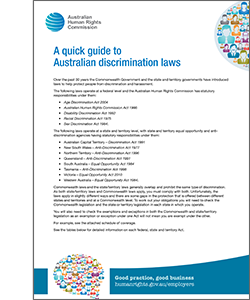
Click
on the links to read the full-text of the laws that apply in your workplace:Note: This summary is intended as a guide only. You should contact the Commission, your state or territory anti-discrimination agency or a qualified lawyer if you required advice on a specific matter.
Click on the links below for information on the following federal and state anti-discrimination laws:
Age; protects both younger and older Australians.
Employment; education; access to premises; provision of goods, services and facilities; renting or buying a house or flat; administration of Commonwealth laws and programs; and requests for information.
The Act does not apply to a number of areas including Commonwealth laws that govern taxation, social security (including pensions), migration and citizenship; superannuation; state laws; certain health programmes; youth wages; direct compliance with workplace agreements and awards; charities, and religious and voluntary bodies.
Complaints must be in writing. It is then assessed and if within jurisdiction is investigated. The complaint is then reviewed to see if it should be terminated or if it is suitable for conciliation. If the complaint cannot be conciliated, it will be terminated by the President of HREOC. A complainant may then take the matter to the Federal Court of Australia or the Federal Magistrates Court for determination within 28 days of the complaint being terminated.
Back to index of federal anti-discrimination laws
Physical, intellectual, psychiatric, sensory, neurological or learning disabilities; physical disfigurement; disorders, illness or diseases that affect thought processes, perceptions of reality, emotions or judgement, or results in disturbed behaviours; presence in body of organisms causing disease or illness (eg HIV virus).
Employment; education; access to premises; accommodation; buying or selling land; activities of clubs; sport; administration of Commonwealth laws and programs; provision of goods; and services and facilities.
Complaints must be in writing. It is then assessed and if within jurisdiction is investigated. The complaint is then reviewed to see if it should be terminated or if it is suitable for conciliation. If the complaint cannot be conciliated, it will be terminated by the President of HREOC. A complainant may then take the matter to the Federal Court of Australia or the Federal Magistrates Court for determination within 28 days of the complaint being terminated.
Back to index of federal anti-discrimination laws
Breaches of human rights by any Commonwealth body or agency and discrimination in employment on the basis of race, colour, sex, religion, political opinion, national extraction, social origin, age, medical record, criminal record, marital status, impairment, disability, nationality, sexual preference, trade union activity.
Commonwealth body or agency; employment and occupation.
Complaint must be in writing. It is then assessed and if within jurisdiction is investigated. If complaint is not declined, conciliation is attempted. If it cannot be conciliated, the Commission prepares a report to the federal Attorney-General who then tables the report in Parliament.
Back to index of federal anti-discrimination laws
Race, colour, descent or national or ethnic origin.
Racial hatred
Employment; provision of goods and services; right to join trade unions; access to places and facilities; land, housing and other accommodation.
Complaints must be in writing. It is then assessed and if within jurisdiction is investigated. The complaint is then reviewed to see if it should be terminated or if it is suitable for conciliation. If the complaint cannot be conciliated, it will be terminated by the President of HREOC. A complainant may then take the matter to the Federal Court of Australia or the Federal Magistrates Court for determination within 28 days of the complaint being terminated.
Back to index of federal anti-discrimination laws
Sex, marital status, pregnancy, family responsibility (dismissal only).
Sexual harassment
Employment; partnerships; qualifying bodies; registered organisations; employment agencies, education; goods, services and facilities; accommodation; land; clubs; awards; superannuation and enterprise agreements.
Complaints must be in writing. It is then assessed and if within jurisdiction is investigated. The complaint is then reviewed to see if it should be terminated or if it is suitable for conciliation. If the complaint cannot be conciliated, it will be terminated by the President of HREOC. A complainant may then take the matter to the Federal Court of Australia or the Federal Magistrates Court for determination within 28 days of the complaint being terminated.
Back to index of federal anti-discrimination laws
Sex, sexual harassment, sexuality, transsexuality, age, profession, trade, occupation or calling, relationship status, status as a parent or carer, pregnancy, race, racial vilification, religious or political conviction, impairment, membership or non-membership of association of employers or employees, breastfeeding, spent convictions, disability, religious practice in employment, having had one of the enumerated attributes in the past, or association with person with an above attribute.
Work; employment agencies; education; access to premises; goods, services or facilities; accommodation; clubs; qualifying bodies; professional or trade organisations; requests etc for information.
Complaint must be in writing to the Discrimination Commissioner. It is then investigated and conciliation may be attempted. If unsuccessful, the matter can be referred to the Discrimination Tribunal for public hearing and legally enforceable determination.
Back to index of state anti-discrimination laws
Race, (including colour, nationality and national or ethnic origin), sex (including pregnancy), marital status, disability, homosexuality, age (compulsory retirement only), transgender, carer's responsibility.
Sexual harassment; vilification on the basis of race, homosexuality, transgender and HIV/AIDS status.
Employment; partnerships; trade unions; qualifying bodies; employment agencies; education; access to places and vehicles; provision of goods and services; accommodation; registered clubs.
Complaint must be in writing to the NSW Anti-Discrimination Board. It is then assessed and if within jurisdiction is investigated and conciliation may be attempted. If unsuccessful, it may be referred to Equal Opportunity Tribunal for hearing and legally enforceable determination.
Back to index of state anti-discrimination laws
Race, sex, sexuality, age, marital status, pregnancy, parenthood, breastfeeding, impairment, trade union or employer association activity, religious belief or activity, irrelevant criminal record, political opinion, affiliation or activity, irrelevant medical record, or association with person with an above attribute.
Sexual harassment
Education; work; accommodation; goods and services; facilities; clubs; insurance and superannuation.
Complaint in writing to the Anti-Discrimination Commissioner. It is then assessed and if within jurisdiction is investigated and conciliation may be attempted. If unsuccessful, the Commissioner may hold a hearing and make a legally enforceable determination.
Back to index of state anti-discrimination laws
Sex, relationship status, pregnancy, parental status, breast feeding (goods and services only), race, age, physical impairment, religion, political belief or activity, trade union activity, lawful sexual activity, gender identity, sexuality, family responsibilities, or association with a person who has any of these attributes.
Sexual harassment
Work and work related; education; goods and services; superannuation and insurance; disposal of land; accommodation; club membership; administration of state laws and programs; local government; existing partnership and in pre-partnership.
Complaint must be in writing to Anti Discrimination Commission. It is then assessed and if within jurisdiction is investigated and conciliation may be attempted. If unsuccessful, the matter may be referred to the Anti-Discrimination Tribunal for hearing and legally enforceable determination.
Back to index of state anti-discrimination laws
Sex, sexuality, martial status, pregnancy, race, age, physical and intellectual impairment (but does not include mental illness).
Sexual harassment
Employment; partnerships; clubs and associations; qualifying bodies; education; provision of goods and services; accommodation; sale of land; advertising (including employment agencies); conferral of qualifications; superannuation.
Complaint must be in writing to the Equal Opportunity Commissioner. It is then assessed and if within jurisdiction is investigated and conciliation attempted. If unsuccessful, the matter is referred to the Equal Opportunity Tribunal for hearing and legally enforceable determination.
Back to index of state anti-discrimination laws
Age, breastfeeding, disability, family responsibilities, gender, industrial activity, irrelevant criminal record, irrelevant medical record, lawful sexual activity, marital status, relationship status, parental status, political activity, political belief or affiliation, pregnancy, race, religious activity, religious beliefs or affiliation, sexual orientation, association with a person who has, or is believed to have any of these attributes.
Sexual harassment; inciting hatred on the basis of race, disability, sexual orientation or religion.
Employment (paid and unpaid); education and training; provision of facilities, goods and services; accommodation; membership and activities of clubs; and in relation to some grounds, administration of any law of state; and awards, enterprise agreements and industrial agreements.
Complaint must be in writing. It is then assessed and if within jurisdiction is investigated and conciliation attempted. If unsuccessful, the complaint may be referred to the Anti-Discrimination Tribunal for hearing and legally enforceable determination.
Back to index of state anti-discrimination laws
Sex, sexual orientation, gender identity, pregnancy, breastfeeding, marital status, status as a carer, age, race (including colour, nationality, ethnic or national origin), parental status, physical features, childless or a de facto spouse, lawful religious or political belief or activity, impairment (including physical impairment, mental illness, mental retardation), industrial activity, lawful sexual activity, or personal association with persons having any of the above attributes.
Sexual harassment
Employment; partnerships; firms; professional and other organisations; qualifying bodies; employment agencies; education; provision of goods and services; accommodation (including alteration of accommodation); clubs or community service organisations; municipal or shire councils.
Complaint must be in writing to Commissioner for Equal Opportunity. It is then assessed and if within jurisdiction is investigated and conciliation attempted. If unsuccessful, the matter is referred to the Victorian Civil and Administrative Tribunal for hearing and legally enforceable determination.
Back to index of state anti-discrimination laws
Sex, sexual orientation, marital status, pregnancy, race, religious or political conviction, age, racial harassment, impairment, family responsibility or family status, gender history.
Sexual harassment; racial harassment.
Employment; partnerships; professional or trade organisations; qualifying bodies; employment agencies; applicants and employees and commission agents; application forms; advertisements; education; access to places and vehicles; provision of good services and facilities; accommodation; clubs; land.
Complaint must be in writing to the Commissioner for Equal Opportunity. It is then assessed and if within jurisdiction is investigated and conciliation attempted. If unsuccessful, the matter is referred to the Equal Opportunity Tribunal for hearing and legally enforceable determination .
Back to index of state anti-discrimination laws