
Commission WEBSITE: Healthy Community Projects
The State of Rural Health
Many country towns
are witnessing cutbacks and are finding it difficult to attract health
professionals. This is troubling considering that the health of rural
and remote Australians continues to be significantly worse than their
urban counterparts
The health of populations
living in rural and remote areas of Australia is worse than of those living
in capital cities and other metropolitan areas. Mortality and illness
levels increase as the distance from metropolitan centres increases. Relatively
poor access to health services, lower socioeconomic status and employment
levels, exposure to comparatively harsher environments and occupational
hazards contribute to and may explain most of these inequalities. Also,
a large proportion of the population in the more remote parts of Australia
are Aboriginal and Torres Strait Islander peoples, who generally have
poorer health status (Australian Institute of Health and Welfare, Australia's
Health 2000, 2000, page 223).
here to visit the Australian Institute of Health and Welfare (AIHW).
Mortality
Death rates from
all causes are higher in rural and remote areas than in capital cities
(AIHW, Health in Rural and Remote Australia, 1998, page 14). Rural Australians
are more likely to suffer from coronary heart disease, asthma and diabetes
among other diseases. Deaths of males in road accidents are 100% higher
in remote areas than in capital cities (Proceedings of the National
Rural Public Health Forum 12-15 October 1997, page 1). Suicide rates
are especially high for young rural males. For males 15 to 24 years, the
rural suicide rate is more than double the metropolitan rate (Proceedings
of the National Rural Public Health Forum 12-15 October 1997, page 3).
Indigenous Health
Although Aboriginal
and Torres Strait Islander people constitute about 2.1% of the total Australian
population, they make up 1% of the capital city population and 20% of
the population in remote areas (Australian Institute of Health and Welfare,
Australia's Health 2000, page 224). For Aboriginal Australians:
- Life expectancy is 20 years less than for non-Aboriginal Australians
- Aboriginal boys
born today have only a 45% chance of living to age 65 (85% for non-Aboriginal
boys); Aboriginal girls have a 54% chance of living to age 65 (89%
for non-Aboriginal girls)
- Over the last
forty years, the Aboriginal infant mortality rate has declined (though
it is still over three times the national average)
- Over the same
period, adult mortality in the Aboriginal population has increased
to Bush Talks from Central Australian Aboriginal Congress, Alice Springs,
NT).
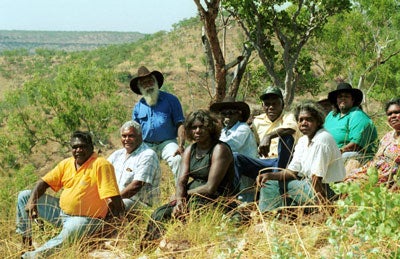
Image:
Gathering of Elders at Timber Creek
Health Services
The number of health
care professionals in an area is an important factor influencing the health
status of country Australians. Although over the course of 1998-99 there
was increasing recognition of the problem of diminishing health services
in rural areas, essential health services are still lacking in many areas.
Availability of general
practitioners (GPs) in rural areas is well below that of the cities. In
1998, small rural centres averaged 93 GPs per 100,000 population; other
rural areas had 77 and remote areas 68. All country areas were well below
capital cities, which averaged 122 GPs per 100,000; other metropolitan
areas and large rural centres averaged 107 and 110 respectively.(Australian
Institute of Health and Welfare, Medical Labour Force, 1998)
There is limited
access to a range of other health care professionals including specialists
and allied health workers. In addition, the supply of pharmacists is substantially
lower in many rural and remote areas (Australian Institute of Health
and Welfare, Health in Rural and Remote Australia, page 86).
Action by Governments
There have been some
encouraging signs of governments' commitment to ensuring adequate health
services in regional Australia. While most health funding comes from the
Commonwealth, most programs are initiated and implemented by State and
Territory health departments. For a full appreciation of recent and current
activities in each State and Territory it is necessary to research each
jurisdiction separately. Click here for a list of relevant websites. (Document
I)
In October 1999 the
Commonwealth government convened the Regional
Australia Summit, bringing together key people from government and
non-government sectors with interests and responsibilities in regional
development. In the 2000 Federal Budget, the Commonwealth made some significant
financial commitments to expanding a number of health services in regional,
rural and remote Australia. Examples include a four-year financial commitment
to increasing the availability of allied health professionals and nurses
in multi-professional teams in rural and regional areas. However, it will
take a sustained, integrated and inclusive strategy to solve the significant
health disparities between many rural and remote communities and their
urban counterparts.

