
8. Safety of Children in Immigration Detention
A last resort?
National Inquiry into Children in Immigration Detention
8. Safety of Children in Immigration Detention
Recognizing that the child, for the full and harmonious development of his or her personality, should grow up in a family environment, in an atmosphere of happiness, love and understanding ...
Convention on the Rights of the Child, Preamble
The Commonwealth, through the Department of Immigration and Multicultural and Indigenous Affairs (the Department or DIMIA), has a responsibility to ensure the safety and security of all people in immigration detention, with a special responsibility for children due to their vulnerability.
The Inquiry received evidence that the safety of children in detention was threatened by exposure to riots, demonstrations, acts of self-harm and assaults that occurred within detention centres. Furthermore, sometimes the measures designed to address these security concerns compromised the physical and psychological well-being of children. The use of tear gas and water cannons were obvious examples of measures taken in the name of safety and security but which had the effect of making children feel unsafe and frightened. These are not threats to which children in the community are likely to be exposed.
This chapter focuses on the heightened risk of physical and mental harm to children when they are held in immigration detention centres and evaluates the effectiveness of the measures taken to protect children within that context. It also considers whether the safety of children can ever be fully protected within the constraints of the detention centre environment.
The psychological impact of detention is developed further in Chapter 9 on Mental Health. The following questions are addressed in this chapter:
8.1 What are children's rights regarding safety in immigration detention?
8.2 What policies were in place to ensure the safety of children in detention?
8.3 What exposure have children had to riots, violence and self-harm in detention centres?
8.4 What exposure have children had to 'security' measures used in detention centres?
8.5 What exposure have children had to direct physical assault in detention centres?
At the end of the chapter there is a summary of the Inquiry's findings and a case study which describes a six-year-old Iraqi boy's exposure to violence at Woomera and Villawood.
8.1 What are children's rights regarding safety in immigration detention?
- States Parties shall take all appropriate legislative, administrative, social and educational measures to protect the child from all forms of physical or mental violence, injury or abuse, neglect or negligent treatment, maltreatment or exploitation, including sexual abuse, while in the care of parent(s), legal guardian(s) or any other person who has the care of the child.
- Such protective measures should, as appropriate, include effectiveprocedures for the establishment of social programmes to provide necessary support for the child and for those who have the care of the child, as well as for other forms of prevention and for identification, reporting, referral, investigation, treatment and follow-up of instances of child maltreatment described heretofore, and, as appropriate, for judicial involvement.
Convention on the Rights of the Child, article 19
The Convention on the Rights of the Child (CRC) takes the obligation to protect children from all forms of mental and physical violence extremely seriously. It sets a high threshold for compliance by requiring Australia to take 'all appropriate legislative, administrative, social and educational measures' to ensure that children are protected from all types of violence, abuse or neglect caused by a child's parent or any other person who is caring for the child. In the detention environment this means that the Department and Australasian Correctional Management Pty Limited (ACM) must take positive steps to ensure that children are protected from physical or mental violence, abuse or neglect in detention, irrespective of its source.
Article 3(2) requires Australia to ensure that all children who are in detention centres receive 'such protection and care as is necessary for his or her well-being, taking into account the rights and duties of his or her parents'. Furthermore, article 3(3) provides that:
States Parties shall ensure that the institutions, services and facilities responsible for the care or protection of children shall conform with the standards established by competent authorities, particularly in the areas of safety, health, in the number and suitability of their staff, as well as competent supervision.
This means that the Department has the obligation to ensure that there are standards in place so as to provide, to the maximum extent possible, an environment where children can feel safe and are protected from exposure to any violence.
Since asylum seekers and refugees are often fleeing situations of violence, they may be especially vulnerable, particularly in a psychological sense, to the impact of violence in detention. Article 19 must therefore be read with articles 6(2), 22(1) and 39 of the CRC which together require that appropriate measures be taken to ensure that refugee and asylum-seeking children grow up in an environment which fosters, to the maximum extent possible, development and rehabilitation from past trauma. Thus the requirement to protect children from violence extends beyond preventing direct abuse.
Further, in recognition of the special vulnerabilities of women and girls to violence, the Convention on the Elimination of All Forms of Discrimination Against Women (CEDAW) obliges Australia to pursue positive measures to eliminate all forms of violence against women and girls, including physical, mental or sexual harm and suffering, threats of such acts, coercion and other deprivations of liberty.(1)
The CRC also requires that detainee children are treated with humanity and respect for the inherent dignity of the child:
Every child deprived of liberty shall be treated with humanity and respect for the inherent dignity of the human person, and in a manner which takes into account the needs of persons of his or her age. In particular, every child deprived of liberty shall be separated from adults unless it is considered in the child's best interest not to do so.
Convention on the Rights of the Child, article 37(c)
Although Australia has made a reservation to the requirement that children in any detention facility (including prisons) must be separated from adults, the Minister for Immigration and Multicultural and Indigenous Affairs (the Minister) has recognised the importance of separating families in immigration detention from other adults (see section 8.5.1 below).(2) Separation of women and child detainees from men is also a practice recommended by the United Nations High Commissioner for Refugees Guidelines on Detention which provide that 'where women asylum seekers are detained they should be accommodated separately from male asylum seekers, unless these are close family relatives,'(3) and where children are detained they should be separate from adults except where they are in a family group.(4)
The United Nations Rules for the Protection of Juveniles Deprived of their Liberty (the JDL Rules) provide some guidance as to how children might be protected from violence within a detention environment. The JDL Rules acknowledge an inherent conflict between maintaining a secure detention facility while also creating an environment within which children feel safe and can develop and grow. For example, the JDL Rules recommend that any surveillance during sleeping hours should be aimed at protecting children and should be 'unobtrusive'.(5) The use of force and other 'control methods' regarding children should only be used in exceptional circumstances, under the order of the director of the facility and subject to higher review.(6)
The JDL Rules also provide that the conditions of detention should 'ensure their protection from harmful influences and risk situations'.(7) All staff in the detention facility 'should respect and protect the human dignity and fundamental human rights of all juveniles'. In particular:
All personnel should ensure the full protection of the physical and mental health of juveniles, including protection from physical, sexual and emotional abuse and exploitation, and should take immediate action to secure medical attention whenever required.(8)
Article 3(1) of the CRC requires Australia to ensure that the best interests of the child are a primary consideration in all actions concerning children, including those that might impact on a child's physical or psychological safety. When article 19(1) is read with article 3(1) it is clear that it is inadequate to simply consider how children can best be protected within a detention centre (although such consideration is clearly vital). A consideration of the best interests of the child necessarily includes an assessment of whether a child's safety can ever be properly protected within a detention environment. If not, appropriate legislative or administrative measures should be taken.
8.2 What policies were in place to ensure the safety of children in detention?
8.2.1 Department policy regarding safety and security
The Department acknowledges the obligation to protect children from harm while they are in immigration detention:
The Department and Services Provider make every effort to prevent undesirable or harmful actions occurring in immigration detention facilities, and to ensure that children are not exposed to them.(9)
Throughout the period of the Inquiry, the primary mechanism through which the Department established standards governing safety and security in detention, was the Immigration Detention Standards (IDS). The IDS imposed contractual obligations on ACM.
(a) Immigration Detention Standards on security
The IDS require that '[d]etainees, staff and visitors are safe and feel secure in the facility',(10)and that '[t]he security of buildings, contents and people within the facility is safeguarded'.(11)
The IDS also require that detainees be prevented from accessing any implement that could be used as a weapon.(12) These standards apply equally to children and adults. Staff are required to:
monitor tensions within detention facilities and take action to manage behaviour to forestall the development of disturbances or personal disputes between detainees. If these occur, they are dealt with swiftly and fairly to restore security to all in the facility.(13)
The standards also set out the means of discipline which are permissible within the facilities. They state that:
Prolonged solitary confinement for security reasons, punishment by placement in a dark cell, reduction of diet, sensory deprivation and all cruel, inhumane or degrading punishments are not used.(14)
While prolonged solitary confinement is not allowed, short term isolation appears to be contemplated as the standards state that if a detainee is placed in 'solitary confinement for security reasons, a qualified medical officer visits daily and ensures that the continued separation is not having a deleterious effect on physical or mental health'.(15) While there is no specific prohibition on solitary confinement of children, both the Department and ACM deny that children were confined for punishment reasons (see below section 8.4.6).
The IDS contain requirements governing the use of force, which may only be used as 'a last resort', and instruments of restraint (like handcuffs), the use of which is limited.(16)
All of these standards apply equally to adults and children; however, the IDS also state that 'detainees are responsible for the safety and care of their child/children living in detention'.(17)
Neither the IDS (nor the Handbook - see below) contain specific statements regarding special measures to ensure the safety and security of children, nor do they specify whether or not solitary confinement and other behaviour management strategies can be employed with children. The Department states that the broad application of the IDS and State child protection laws, taken in the context of the primary responsibility of parents to protect their children, adequately safeguards the interests of children.(18) This chapter explores whether or not that is the case in practice.
(b) Department Managers' Handbook
The Department has also created a handbook to guide Departmental Managers of detention facilities (the Handbook). The Handbook elaborates on the IDS and reflects corresponding provisions of the Migration Act 1958 (Cth) (Migration Act). The Handbook states that:
As officers under the Migration Act, DIMIA staff are also empowered to use reasonable force in certain circumstances but it is expected that the need for this in [detention centres] would be rare given the Services Provider's role and responsibilities.
In the immigration detention context, the Migration Act and Regulations provide the power to use reasonable force to:
- take a person into immigration detention;
- keep a person in immigration detention;
- cause a person to be kept in immigration detention. This includes preventing a detainee from escaping from detention;
- conduct a search of a detainee;
- identify a detainee; and
- provide non-consensual medical treatment to a detainee in a detention centre in specific circumstances.(19)
Department Managers have the final say on the use of force:
It is the DIMIA Manager's responsibility to monitor any use of force undertaken by the Services Provider to ensure consistency with the Migration Act and the IDS.(20)
The Handbook also states that:
Instruments of restraint and chemical agents, including flexi-cuffs and tear gas, are forms of force and must be used only in accordance with the principles relating to the use of reasonable force. They must never be applied as a punishment.(21)
The Handbook also outlines the search powers within immigration detention facilities.
(c) Monitoring of security practices
As discussed in Chapter 5 on Mechanisms to Protect Human Rights, one of the primary mechanisms by which the Department monitors safety and security of detainees is through the provision of incident reports, which are required by the IDS. Briefly, the IDS require that:
Any incident or occurrence which threatens or disrupts security and good order, or the health, safety or welfare of detainees is reported fully, in writing, to the DIMIA Facility Manager immediately and in writing within 24 hours.(22)
Chapter 5 describes the incident reporting system and discusses some of its weaknesses, including problems with the quality and timeliness of reporting by ACM.
8.2.2 ACM policy regarding safety and security
ACM has developed a range of policies to implement the security and safety requirements of the IDS, one of which is specific to the protection of children. The Child Protection Policy, first introduced at Woomera in February 2001, sets out the procedures to be followed when it is believed that:
- the child has or is likely to suffer physical or psychological injury; or
- the child's physical or psychological development is in jeopardy.(23)
The general child protection policy for all centres, introduced in August 2001, states that:
All ACM staff will comply with the Children's Protection Act of the State or Territory in which the Centre is located. Children and young people have the right to be emotionally and physically safe at all times.
The policy specifies that ACM staff must notify the relevant State child protection agency of any suspected child abuse(24) and that assaults involving children must be reported to both police and the relevant State children protection agency.(25) ACM policies also require that State agencies be notified in the event that a child goes on hunger strike.(26)
While the Child Protection Policy is the only security policy that focuses on children, there are some others that incorporate special measures for child detainees. For example:
- 'Pat searching' of children is restricted to 'the most exceptional circumstances, and based on sound reasoning'.(27) If a child is searched in this way, another person must be present at all times.
- Detainees under the age of 10 must not be strip searched, and a Magistrate's order is required before a strip search is conducted of a 'minor who is at least 10 but under 18 years of age'.(28)
-
ACM must 'not use handcuffs to restrain females, children or intellectually disabled unless special circumstances exist' when escorting a detainee to a place outside the detention centre (such as to the Refugee Review Tribunal, court, hospital, airport, prison or police cells).(29)
However, the majority of ACM's security policies do not specifically differentiate between the treatment of adults and children. Some of the areas covered by those policies include:
- Use of tear gas which 'should only be used as a last resort in circumstances where there is a real threat to life and limb'.(30) Clear warnings must be given to detainees prior to the use of tear gas, and clear instructions to those not wanting to participate any further in 'unlawful behaviour'.
- Emergency management.(31)
- Searches of detainees' rooms.(32)
- Detainee head counts, which require staff to 'physically sight the detainee. If the detainee is covered with bedding staff must pull back the sheet/blanket so the detainee can be identified'.(33)
- Behaviour management through isolation or transfer of a detainee who breaches the detainee code of conduct.(34)
- 'Management separation' which allows for the separation of detainees.(35)
- The use of force and restraints (other than for external escorts).(36)
- Management of detainees who are at risk of self-harm or abuse. This policy sets out the operation of the High Risk Assessment Team (HRAT) - an observation system.(37) The policy contains a list of risk indicators, and signs to observe in determining whether a detainee is at risk of self-harm.(38) The HRAT process is also used to keep a watch on detainees who are vulnerable to abuse.
There is no policy on the use of water cannons.
ACM states that these policies represent best practice and 'transcend the differentiation between adult and child':
ACM policies on riots and security do not make special provision for children because they do not need to. These policies aim to protect all detainees regardless of age or sex, from acts of violence from other detainees and address any measures that may be necessary to prevent the escalation of incidents.(39)
ACM also stated that while its policies regarding riots and security do not make special provision for children, they do incorporate 'fundamental principles of (a) preservation of life and property ... and (b) proportionality'.(40)
While the Inquiry acknowledges that the security policies covered children in principle, in the Inquiry's view, there should have been specific instructions to take special measures to protect children during violent disturbances. This is discussed further in sections 8.3 and 8.4.
8.2.3 State child protection agencies
All Australian States and Territories have child protection legislation and authorities charged with implementing that legislation.(41) Broadly speaking, child protection authorities deal with the protection of children from abuse and neglect. For example, in the community, a child protection authority may be called in to remove a child from a dangerous situation at home in the event of suspected assault or neglectful treatment at the hand of a child's carer.
The Department recognises that State child protection authorities have special expertise in child welfare and relies on them for advice on how to manage and protect children in detention.(42) In the detention context, conditions of neglect which may require the intervention of a child welfare agency can include the conditions in the detention centre itself. Chapter 9 on Mental Health addresses the role of State authorities in responding to the impact of that environment generally.
The detention environment also places children at heightened risk of becoming the victims of, or exposed to, specific acts of violence. The following sections focus on the role of child protection authorities in protecting children from specific instances of abuse or neglect.
Whether or not the State authority can properly fulfil their protection role depends on three factors:
- appropriate reporting procedures
- access to detention facilities to investigate any notifications
- the power to implement its recommendations.
This chapter primarily discusses the South Australian child protection authority. In South Australia, the Department of Human Services (DHS) is responsible for child protection and child welfare. Family and Youth Services (FAYS) is the section of DHS that manages these responsibilities.
In Western Australia the Department for Community Development (DCD) is responsible for child protection.
(a) Reporting of child abuse to child protection agencies
Effective interaction between the Department, ACM and State child protection agencies starts with appropriate reporting procedures. In NSW, SA and Victoria, State parliaments have enacted mandatory reporting obligations for incidents of suspected child abuse or mistreatment for various classes of professionals.(43) In Western Australia, there are no such mandatory reporting provisions, but any person may report their concerns to the Department of Community Development.(44)
The February 2001 Flood Report investigated the incidence of and procedures for dealing with child abuse in immigration detention between 1 December 1999 and 30 November 2000. The Flood Report expressed concern about ACM's delay in developing a policy that clearly set out the reporting responsibilities of staff under State child protection laws:
The new Child Protection Policy [for Woomera] is a thorough yet very overdue document which clearly outlines the responsibilities of staff under the Child Protection Act (SA). I remain unsatisfied that this policy has still not been implemented and that similar documents have not been developed for the other centres and I recommend that ACM address this issue immediately. The sexual assault policy also does not adequately address issues such as the needs of victims of sexual assault after they have been examined and returned to the centre.(45)
The Woomera Department Manager's report for the January 2001 quarter also indicated a lack of clarity in reporting procedures:
I was amazed by an allegation of child abuse, which was supposedly advised to me on a day I was testifying in Court in Adelaide. It was not notified to [the State child protection authority] in a timely manner ....A strong message is needed that this issue is a legal requirement and [DIMIA] nationally views it in the strongest possible terms.(46)
Furthermore, DHS expressed concern that, prior to early 2001 when negotiations began regarding a Memorandum of Understanding (MOU) with the Department on the issue of reporting, ACM staff believed that they were restricted from reporting child abuse and neglect because of confidentiality clauses in their employment contracts:
Staff employed at detention centres are required to sign a contract of employment that includes a confidentiality clause. Prior to the drafting of the South Australian MOU with DIMIA there was some tension in determining whether staff employed understood their obligations to make notifications under State law. Mandated notifier training is now [as at May 2002] provided to all staff at the detention centre and this has provided greater clarity about roles and responsibilities in relation to child protection notification.(47)
Submissions from the Alliance of Professionals Concerned about the Health of Asylum Seekers and their Children, and Australian Lawyers for Human Rights, also raised this conflict.(48) However, two doctors on short term contracts at Woomera gave evidence that they had not been asked to sign any confidentiality agreement and that it would not have changed the way they administered health care in any (49) case.
Another source of confusion may have been that, prior to the introduction of the Woomera Child Protection Policy in February 2001, staff were under the impression that they had to report their concerns to ACM management rather than to the child protection authorities directly.(50) For example, a former ACM nurse who worked on three six week contracts between August 2000 and February 2001 at Woomera testified that:
During my first two contracts with ACM, medical staff were instructed that they were not allowed to report child protection concerns directly to FAYS, but that we should report to management who would then notify FAYS. This requirement was detailed in the ACM policy manual. This policy was changed in early 2001 following the expression of concern from medical staff. Medical staff were then allowed to notify FAYS, and subsequently notify the ACM centre manager that they had done so.
In January 2001 I notified ACM management of an alleged instance of sexual assault of an unaccompanied minor. This incident was investigated by the South Australian police and FAYS were notified by ACM staff.(51)
The introduction of the Child Protection Policy for Woomera in February 2001, and the general protection policy in August 2001, appear to have gone a long way toward clarifying the reporting procedures.(52) While the Flood Report expressed concern about the level of training accompanying these policies it appears that there were substantial improvements in the level of reporting over 2001.(53) For example, the South Australian child protection authority stated that as at May 2002:
[T]he mandate of notification responsibilities of staff at Woomera has become commonplace. All the arguments that we came across in 2000 are now null and void and it is now part of ACM policy and they have altered their contracts [and had] stuff around the confidentiality clause changed to make it very clear and as I understand there's actually repercussions for ACM staff for not notifying.(54)
A former ACM Activities Officer who worked at Woomera from May 2000 to January 2002 also stated that:
Staff were made aware of the mandatory reporting requirement in relation to suspicion of child abuse or neglect. I was not aware of any matters that should have been reported to FAYS that were not reported.(55)
The Inquiry welcomes the improvements in the reporting procedures and practice regarding child abuse notification. However, given the presence of children in immigration detention since at least 1992, the Inquiry is concerned that a matter of such obvious importance was not specifically anticipated by the Department at a much earlier stage.
(b) Access to detention centres to investigate notifications
State child protection staff do not appear to have encountered problems in accessing detention centres to investigate child protection notifications. The Department explains that the Commonwealth Places (Application of Laws) Act 1970 empowers State authorities to enter immigration detention facilities to investigate specific allegations of child abuse. Therefore the only discussion between the State authorities and the Department would have related to arrangements as to a suitable time.(56)
DHS and DCD confirm that they have been granted access to detention facilities to conduct child abuse investigations and any necessary follow-up visits.(57) However, DCD also stated that it was made clear to them that access is in the control of the Department:
We have not had an instance in relation to child maltreatment where we have had any problems with access into the detention centre at this point. But we are always very clear, and it is always made very clear and we are very aware as well, that it is not something that we have a right of open access to. It has to be on the basis of getting permission from DIMIA.(58)
(c) Responsibility and powers of State child protection agencies in detention centres
While State child protection authorities have the power to enter a detention centre to investigate a child abuse notification, they have no power to enforce their recommendations as the Department retains ultimate authority in detention centres.
The nature of Australia's federal legal system is that Commonwealth legislation will prevail over State legislation.(59) In the context of child protection in immigration detention centres this means that the Migration Act, which requires that children remain in detention, will prevail over State child protection legislation which otherwise grants power to child protection authorities to recommend that a child be removed from detention. The Flood Report noted this problem in February 2001 and recommended that:
a Memorandum of Understanding (MOU) between [the Department] and each of the state authorities be established to clarify the roles and responsibilities of each party in cases where the state authorities make strong recommendations that a child be removed from a centre.(60)
In December 2001, the Department entered a Memorandum of Understanding relating to Child Protection Notifications and Child Welfare Issues (the 2001 MOU) with DHS which aims to:
Ensure appropriate notification and referral of all cases of possible child abuse or neglect which occur at places of immigration detention in South Australia.(61)
The 2001 MOU emphasised that although DHS has the responsibility to investigate child abuse allegations it has no authority to implement those recommendations of its own accord:
DHS has a legal responsibility to investigate child protection concerns for children in immigration detention in South Australia. However, any interventions undertaken to secure the care and protection of detainees must be actioned by DIMIA. DIMIA will consider carefully DHS recommendations to ensure that the best interests of the child are protected.(62)
The Department has also observed that neither State courts nor State government officials have any jurisdiction to order the release of a child from immigration detention:
A State government or court cannot order the release of a child detainee from immigration detention pursuant to State child welfare legislation. Any State child welfare legislation which purported to authorise a State Minister or official, or a court, to order the release of a child, would be inconsistent with the provisions of the Migration Act 1958 (Migration Act) which clearly require the keeping in immigration detention of all unlawful non-citizens, including children.(63)
DHS outlines the following powers of the South Australian Children's Protection Act, which would normally be used to protect children in the community, but 'are directly inconsistent with the detention requirements of the Migration Act and therefore cannot be applied':
- The power of the [South Australian] Minister to enter into a voluntary custody agreement with the guardians of the child;
- The power to remove a child from a place ...;
- The authority of the Youth Court to grant custody of a child to the [SA] Minister ...;
- The authority of the Youth Court to direct a person who resides with a child to cease or refrain from residing in the same premises as the child ...;
- The ability of an employee of the [DHS] to take a child to such persons or places as the Chief Executive Officer may authorise ...;
- Orders the Youth Court may make granting Custody or Guardianship of the child to the [SA] Minister on a long term basis and associated ancillary orders.(64)
Negotiations of MOUs with Western Australia, Victoria and New South Wales agencies are still underway; however, it appears that those agreements will work with similar limitations. The Western Australian Government has already expressed concern about its lack of authority to implement recommendations:
The Western Australian Government welcomes the progress being made on the MOU relating to child protection. It is concerned, however, about the discrepancy between DCD's statutory responsibility for child protection and its lack of authority within detention centres.(65)
Some of the practical difficulties that arise as a result of the unenforceability of the State child protection authority recommendations for removal of children are illustrated in the case study at the end of this chapter. This issue is discussed in further detail in Chapter 9 on Mental Health.
8.2.4 Federal and State police
The Australian Federal Police Act 1979 (Cth) provides that investigations of criminal matters on Commonwealth land are a matter of agreement between the State and Federal Commissioners of Police.(66) A February 2001 report commissioned by the Department regarding the breakouts in Woomera, Port Hedland and Curtin detention facilities in mid 2000, commented on the need to clarify the 'jurisdiction, responsibilities, roles, resource capabilities and protocols' regarding each of the relevant authorities, including State police.(67) The February 2001 Flood Report also urged the Department to enter memoranda of understanding that:
clearly and unambiguously articulate[s] the role of the state police in any incidents at Commonwealth detention facilities which may require police involvement.(68)
To the Inquiry's knowledge no such agreement has been reached with any State police authority. However, staff from DHS note that in South Australia it is the role of the State police to investigate abuse by anyone other than the family and it is the role of the Federal Police to investigate any allegations against ACM or Department staff.(69)
8.3 What exposure have children had to riots, violence and self-harm in detention centres?
Immigration detention centres have been the site of a number of major disturbances including demonstrations, hunger strikes, attempted and actual self-harm, riots and fires. It is clear to the Inquiry that the detention of children within this environment has meant that they have been exposed to a level of violence and distress that is unlikely to have occurred in the community.
In early 2003 a psychiatric study regarding children detained in a remote centre noted the impact on children of the exposure to violence:
All families described traumatic experiences in detention, such as witnessing riots, detainees fighting each other, fire breakouts, detainees self-harming, and witnessing suicide attempts. It should be noted that the researchers could not verify independently allegations made by asylum seekers particularly those directed at detention officers. ... The children particularly reported being distressed by witnessing the frequent acts of self-harm and suicide by other detainees. All of the children witnessed the same act of self-harm by an adult detainee who repeatedly mutilated himself with a razor in the main compound of the detention centre. Children also described having witnessed detainees who had slashed their wrists, jumped from buildings, resulting in broken legs, and detainees attempting to strangle or hang themselves with electric cords. At times, children witnessed their parents suicide attempts, or saw their parents hit with batons by officers. A number also witnessed their friends and siblings harm themselves. ... A number of families reported enforced periods of separation from each other during detention (7 families), often when a parent was taken to solitary confinement either as punishment or in response to self-harm attempts.(70)
The submission from the Conference of Leaders of Religious Institutes includes a discussion with mothers who describe how frightening it was for children at Maribyrnong to be near a riot:
There was a riot of sorts and several men damaged equipment such as computers, televisions and other furniture. This happened at night and was accompanied by a great deal of noise ... The mothers [told] me later, how afraid the children and they had been, as they were locked up [in] their own area just next to the area where it was all happening (in the same building). They were powerless to reassure the children that they were safe as they really were very afraid themselves, not knowing what was really happening, whether the place would be burned down, if the violence would escalate and overflow into their area.(71)
Dr Annie Sparrow, who was employed at Woomera for four weeks, two of which were in January 2002, described the surrounding violence as follows:
children are exposed to the acts of violence, as it were, that occur between the guards and the detainees or by the adult detainees or even the children, of self-mutilation or self-harm or violent behaviour when the adults would climb on to a building and threaten to throw themselves off or actually injure themself on wire ... And again, that is not conducive to any child's mental health where ever they are.(72)
Some of the self-harm incidents that children witnessed were quite dramatic. For example, children have seen their male relatives throwing themselves on razor wire, causing multiple lacerations to their bodies. A former ACM staff member described an incident where one group of children witnessed self-harm by another group of children:
I was in a room at [Woomera detention centre] with about 30 or 40 children watching a video when a group of about 10-15 unaccompanied minors formed in a group outside. They had taken their shirts off and proceeded to slash their chests with razor blades. They were all covered in blood. A number of the children saw this and some went outside to where this was taking place.(73)
One of the disturbing consequences of being exposed to violent behaviour is that children are drawn into it - themselves participating in acts of self-harm and violence, thereby seriously risking their safety and well-being and compromising their psychological health. Such behaviour has included children sewing their own lips together.
8.3.1 Chronology of riots and other major disturbances
The Department's incident trend analysis gives some indication of the prevalence of major incidents (an incident that 'seriously affects the good order and security of the detention centre') in detention centres.(74)For example, between July and December 2001 there were 688 major incidents involving 1149 detainees across all detention centres.(75) Of those incidents, 321 were alleged, actual or attempted assaults (19 of which involved children, 9 of which involved alleged detainee assaults on staff), 174 were self-harm incidents (25 of which involved children) and about 30 per cent involved 'contraband, damage to property, disturbances, escapes and protests'.(76) Seventy-four per cent of all the major incidents in that period occurred in the Curtin, Port Hedland and Woomera centres, where the largest number of children have been detained for the longest periods of time.
From January to June 2002, there were 760 major incidents involving 3030 detainees across all detention centres.(77) There were 116 alleged, attempted or actual assaults (16 of which involved children, 13 of which involved alleged detainee assaults on staff), 248 self-harm incidents (25 of which involved children) and 52 per cent of incidents involved 'contraband, damage to property, disturbances, escapes and protests'.(78) Almost 80 per cent of all incidents occurred in Curtin, Port Hedland and Woomera.
The following table, sourced primarily from media reports, sets out a rough chronology of the major disturbances in the three most problematic centres between July 1999 and December 2002.
Some of the disturbances listed below were over fairly quickly, for instance riots rarely lasted more than a day. Others, like protests and hunger strikes, could last weeks. Some disturbances involved all compounds in the centre and others were restricted to one or two compounds. The approximate numbers of detainees involved in the incidents are included where the media or other sources have reported them.(79)
The chronology is intended to give some sense of the environment in which the majority of children in immigration detention were living, rather than to provide a comprehensive description of each and every occurrence in the detention centres.
Chronology of major disturbances |
|||
| Date | Woomera | Curtin | Port Hedland |
|---|---|---|---|
| July 1999 | [Not open] | [Not open] | Riot and escapes. |
| Aug 1999 | [Not open] | [Not open] | Protests. |
| Mar 2000 | Demonstrations. | ||
| June 2000 | Two days of protests. Approx 480 detainees walk into town. | ||
| Aug 2000 | Three days of riots and fires. Tear gas and water cannons used. 60-80 detainees involved | ||
| Nov 2000 | Hunger strike by more than 30 detainees. Some forcibly fed in hospital. | ||
| Jan 2001 | Riot involving approx 300 detainees. | Riot involving approx 180 detainees, hunger strike. | |
| Mar 2001 | Riot. | ||
| April 2001 | Riots and fires, tear gas used, approx 200 detainees involved. | ||
| May 2001 | Riot. | Riot, hunger strike, tear gas used. | |
| June 2001 | Riot and confrontation between ACM and approx 150 detainees. Injuries on both sides. Water cannon used. | Riot. | |
| Aug 2001 | Riot, fires, tear gas, self-harm. Centre on riot alert for more than a week. | ||
| Sept 2001 | Protest outside. Water cannons and tear gas used on detainees inside. | ||
| Nov 2001 | Riot and extensive fires. Approx 250 detainees involved. | ||
| Dec 2001 | Three separate riots, each with fires. Tear gas and water cannons used. | ||
| Jan 2002 | Hunger strikes, lip-sewing, including seven children. | Hunger strikes, lip-sewing. | Hunger strikes, lip-sewing. |
| Mar-Apr 2002 | Riots over the Easter period. Approx 50 escapes including mother and three children. | Riots and fires. Approx 150 detainees involved. Tear gas used. Family compound created after these riots. | Riot involving approx 150 detainees. |
| June 2002 | Hunger strikes, including 13 children. Escapes, including three children. | ||
| July 2002 | Riots and fires. | ||
| Dec 2002 | Extensive fires. | [Not open] | One fire. |
The following sections describe just a few of these events.
8.3.2 Major disturbances at Woomera
Woomera opened in November 1999. Woomera has been the site of more riots and unrest than any other centre, as the above chronology shows. While the number of physical injuries sustained by children during these disturbances was few, the psychological impact they left on children was substantial.
In such a relatively small environment, children are inevitably exposed to whatever crises, riots or violence occur. One father said of children at Woomera: 'they know everything - who cut themselves, who try to hang themselves'.(80)
The two major disturbances about which the Inquiry has the most evidence are those that occurred in January and April 2002. However, when the Inquiry spoke to families in January 2002, it became clear that other events, such as the fires in November 2001 and December 2001, had a negative impact on the children who had witnessed them. There were 359 and 322 children detained in Woomera in November and December 2001 respectively.(81)
For example, an 11-year-old child told an ACM psychologist in December 2001 that he had cut his arms and legs with a razor blade because he was tired and because he had been in the centre a year and all his friends had left.(82)
Another family told the Inquiry that they were housed in a donga (demountable sleeping quarters) beside one of the buildings that was burned in November 2001. During the fires, the children, two young girls, had to remove their belongings from the room because they thought that they would be destroyed by fire. Detainees, including children were left inside the compounds with the fire while it burned. The two girls stood outside their donga and watched nearby buildings burn. The parents said that the girls still asked about the fire and one shook with fright at night time.
One of the girls saw the hunger strikers and witnessed a man jumping onto razor wire. She saw his bloodied body afterwards. The girl's parents say that she asks about this man all the time and that their children ask them 'why don't they eat?' and 'why is this happening?' They have no answers for them.(83)
(a) Woomera - January 2002
In January 2002, when there were 281 children detained at Woomera,(84) there was a major hunger strike and protest, which included lip-sewing, involving a large number of detainees. Seven children were involved in the lip-sewing. Many other children were living amongst and observing the ongoing protests.
(i) Hunger strike
The hunger strikes began in response to the Department halting the processing of visa applications by Afghan asylum seekers.
The ACM Manager reported that Woomera had been relatively calm until 11 January 2002, when the Refugee Review Tribunal reportedly refused to grant a visa to an Afghan applicant on the grounds that the Taliban was no longer in power in Afghanistan. While there were a few incidents in the following days, the hunger strike proper began on 16 January 2002.
When Inquiry officers visited Woomera between 25 and 29 January 2002, they observed:
- hunger strikers, including a man being removed by stretcher from the Main Compound;
- people with lips sewn together;
- the aftermath of a man jumping onto razor wire;
- demonstrations (people climbing onto the top of dongas and calling out for freedom, people dragging mattresses and bedding into the compounds);
- an extremely distressed woman screaming hysterically for an extended period, apparently after a dispute with an ACM officer;
- actual and threatened self-harm; and
- smashing of windows.
All of these events took place in full view of children, apart from the smashing of windows, which they may have heard.
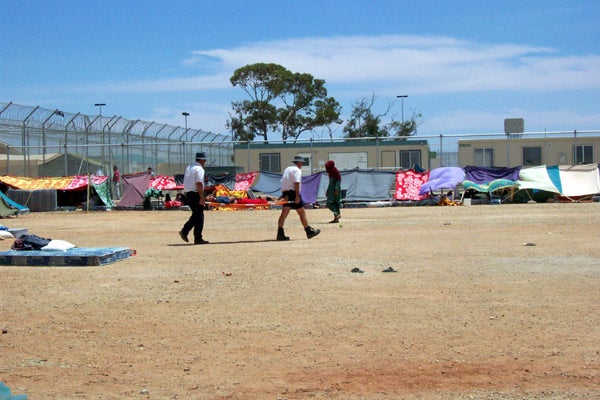
Hunger strike at Woomera, January 2002.
The Inquiry observed generally that the centre had an atmosphere of despair that affected every aspect of life. It was an atmosphere into which children were inevitably drawn.
At the time of the Inquiry's visit, there were hunger strikers in all of the compounds, with most based in the Main Compound. Hunger strikers had removed the bedding from their dongas and were lying on mattresses around internal perimeter fences of the compounds, using blankets fastened to fences as a form of shelter. In the Main Compound, women who were hunger striking congregated under a set of children's play equipment. The hunger strikers were being monitored by health staff to identify when medical attention was necessary.
Children were moving freely around the hunger strikers, even playing alongside them. A staff member employed at Woomera for 12 months at the time recalls:
I found the mass hunger strike extremely disturbing, people dragged their mattresses out into the open, and some people had stitched lips. I called it 'The Field of Mattresses', because put simply that is what it was. Bodies littered the ground in all compounds, I remember feeling the strangeness of the situation one day as I was making my way to the medical centre, just inches away from my feet through the wire, people lay lifeless on mattresses in the searing desert heat. Management had lost control of the centre.
It was a few days into the 'Field of Mattresses' about 10.00am when I entered the main compound [of Woomera detention centre] with a colleague ... to open a recreation building. We decided to check on a group of about 20 women who had joined the hunger strike, and had based themselves in the playground. What we found was an appalling tragedy.
A group of at least a dozen women, predominantly Afghanis, some Iranians and Iraqi women. This in itself was unusual as the groups do not often mix, this indicated to me the seriousness of the situation, and was a clear show of unity and support for each other.
The playground floor was littered with mattresses, some women laying, others sitting, some children bouncing on mattresses. I recognised most of the children as long term minors. [My colleague] and I asked each mother and child if the children were drinking and eating. The mothers and children confirmed the children were eating. A young woman I attended had a crawling baby with her; the baby appeared confused and dishevelled and tried to get the mother's attention by crawling all over her. I looked directly into the mother's face and noticed she was disoriented and appeared confused. When questioned she nodded she had not been eating, I asked her twice if she was feeding her baby she nodded yes and held her breast, indicating she had been breast feeding the child which other women present confirmed. The young mother's eyes were blank, unfocussed and held no life.(85)
ACM reports show that on 20 January 2002, there were 37 children on hunger strike.(86) Fifteen unaccompanied children had commenced the hunger strike the day before.(87) By 22 January, the total number had decreased to 31 children(88) and eight unaccompanied children (possibly some of the other children as well) were on a 'partial' hunger strike:
Detention manager reported that even though all UAM's are reported to be on hunger strike, they are drinking eight cups of water each per day with sugar in it.(89)
Two unaccompanied children swallowed shampoo and disinfectant respectively during this time.(90) FAYS were updated on the progress of these children on a daily basis.(91) Medical incident reports confirm that children of concern were being checked.
There have been suggestions that parents encouraged their children to go on hunger strike. Detainees interviewed at Woomera responded as follows:
I totally disagree because this is not fact. This man [a hunger striker], his children if not eat he will get angry with them. ... This is very misunderstood because the outside Australian public say they make children [do it] but this is really unfair to guys like that. When the woman, children and the father and mother is very depressed and these children themselves are still the same, they are not happy to eat and those people who stitch their lips - this is the boys' decision, believe me that's the boys'. As you see yesterday they started to remove the stitch.(92)
The claim [that children are being coerced into hunger striking and lip-stitching] is totally baseless. ... We are human beings, we don't use our children. We are ready to sacrifice ourselves for the sake of our children.(93)
The Department highlighted a case where a father refused to allow his hunger-striking son to be taken to the medical centre. However, this objection was short lived and the detainee delegates worked with ACM staff to make sure that all children could be treated.(94)
The Department also highlights that families who were not on hunger strike were given an opportunity to move to another compound and several took up that offer.(95)ACM, on the other hand, highlights that 'design limitations' make it very difficult to shelter children from being exposed to such activity, given that 'behaviour of this type was not predicted at the time the facility was designed'.(96)
Nevertheless, ACM detention staff tried to move the unaccompanied children from the compound where the primary hunger strike was taking place 'and put them all together so that they could all look after each other'.(97) Unfortunately, as set out above, this does not appear to have prevented unaccompanied children from participating in the hunger strike. However, two unaccompanied siblings were taken out of the centre altogether, to the Woomera Housing Project. They had expressed some fear of being attacked by residents unless they stopped eating.(98)
The Inquiry accepts that there are practical difficulties in sheltering children from the protests conducted by other detainees within the closed environment. This highlights the risks of keeping children in immigration detention.
(ii) Lip-sewing
Seven boys went beyond hunger striking and participated in the protests by sewing up their lips. Three were twelve-years-old (one of whom was an unaccompanied child), two were 14-years-old, one 15-years-old and another 16-years-old.(99) Four of the children had been detained for 12 months at the time they sewed their lips, and three for 6 months.
When ACM staff discovered that the children had sewn their lips together they were placed on two-hourly observations and offered food, water and medical attention.(100)Staff also notified FAYS, the South Australian Police and Glenside Psychiatric Hospital.
All children had their stitches removed within a day of putting them in, either at Woomera Hospital or the on-site medical centre. The records indicate two of the children stitched their lips a second time, and a third child may also have done so. All the children who sewed their lips were also participating in the hunger strike, even though in some cases it was possible to eat with the stitches in.
The mother of two of the boys who sewed their lips was also on hunger strike. The eldest son stitched his mouth twice, slashed the word 'freedom' down one arm and slashed his other arm and torso. This family was closely observed throughout the hunger strike.(101) One staff member in particular recounts her observations and efforts:
As I moved around the group I came to [the mother], an Afghani woman well known to myself and several of my colleagues. I had worked extensively with her five children aged 14 years to 5 years. I had filed numerous reports and referrals on the family, particularly the oldest child. ...
I was not surprised to see [the mother] joining the protest as she and her children had at that stage, been held in detention for over 12 months. I was alarmed at [her] condition. She lay on a mattress too weak to sit up; I knelt beside her, the other women told me she had not eaten for days. [Her] lips were stitched from corner to corner (this is a sight I will never forget), her eyes also held no life. I placed my hand on hers and cried, when I looked up all present were crying including [my colleague]. ...
I returned to the office to collect some recreation items for [the oldest son, in hospital] and left immediately for the Woomera hospital. As I crossed the Administration compound to exit the centre, I looked into the main compound and noticed [the mother] being physically supported by her [younger son] making their way back towards their room. It was [a] pitiful sight, the boy's head was hung low bearing the weight of his mother, who was barely able to move one foot in front of the other.
At the hospital a nurse who had been caring for [the boy] spoke to me for about ten minutes. She informed me [that the brothers] had both presented earlier in the week with stitched lips and had been brought to the hospital to have the stitches removed. She also told me that [the younger boy] was extremely distressed by the situation.
When I saw [the older boy] he was visibly happy to see me. He smiled, he was clean and well groomed. He told me he liked the hospital and it was better than the camp. [He] was very happy with his brother's 'Salaam' message. I gave the boy the pencils, paper and picture books I had brought for him, then we talked about his artistic talent and how he could use the picture books to copy some drawings.
[His] happiness at my visit was in stark contrast to what I saw, his lips were unstitched but he had slash marks on both his outer forearms, the scars from his previous slashing not long healed. The word freedom had been cut
into the length of one of his inner forearms, when I questioned him about this he just shrugged his shoulders and said nothing and became quiet.(102)
The Inquiry investigated allegations that adults were involved in the sewing of children's lips. Former staff, including doctors, psychologists, nurses and recreation officers, were questioned at hearings,(103) as were child protection authorities and current detention staff at Woomera. All were of the view that there was no evidence to support the suggestion that adults were involved in sewing children's lips. For example, the Department's Manager at Woomera told the Inquiry that there was no evidence that parents had sewed their children's lips, and that the children had admitted that they did it themselves. The ACM Health Services Coordinator also said that the children had acted independently.
During the Inquiry's public hearing, a senior Departmental officer said, 'it is my understanding that we were subsequently advised that there was no evidence either to confirm or deny' that parents were involved in sewing the lips of their children.(104)
A refugee mother who had been detained at Woomera in January 2002 told the Inquiry:
No, the families didn't encourage the children to do that, but only the children did that by themselves. They used to gather and shout, 'Freedom!' and still our children, up until now at home, they will still call, 'Freedom! Freedom!'(105)
A FAYS report of 24 January 2002 notes several children stating that they sewed their lips themselves.(106) They stressed, however, that Woomera was a coercive environment for all people detained there and that children were vulnerable because of this environment. Moreover, children may have been copying the behaviour of the adults around them. FAYS also noted their concern that where the parents were 'becoming decidedly weaker they are unable to protect and supervise their children'.(107)
The ACM psychologist at Woomera from October 2000 to December 2001, Harold Bilboe, made similar observations with respect to lip-sewing incidents that had occurred on a previous occasion:
Amongst the self-harm that occurred while I was at [Woomera], there was lip stitching amongst adolescents. There was no evidence of which I was aware to suggest the involvement of parents or adults in the stitching of children's lips. The only time I heard of these allegations of the involvement of adults in stitching the lips of children was from the Minister for Immigration.(108)
Another psychologist who worked in Woomera at this time told the Inquiry that she believed that a child may have had assistance in sewing his lips, but that the child's mother would have been unlikely to have provided this assistance herself:
I don't think she would do it to him but I think he would have had help because it is such a difficult thing to do and I think if any child - I mean, he is so emboldened now that he would want it done ... I'm sure he would have been assisted but he would have asked or demanded it to be done to him, that boy. Now, with others I don't know, but I don't think they could do it.(109)
This witness said that she could not say with any certainty that this child had been assisted.
Dr Jon Jureidini, a psychiatrist who has worked with children in immigration detention, told the Inquiry that he had never heard of parents encouraging their children to self-harm:
I have no experience either first hand or in literature of parents deliberately encouraging their children to self-harm. I certainly think that parents can play a role in a number of other ways. First, that as individual adults self-harming themselves is providing that model for children, wittingly or unwittingly. Also the incapacity of parents to provide ordinary safety and protection for their children which is not a criticism of the parents themselves but symptomatic of the fact that they are overwhelmed in that environment.(110)
The Western Australian Government also confirmed that parents had no involvement in lip-sewing by children at Port Hedland:
We recently had a referral in relation to self-harm, where there was an allegation that parents were involved. The outcome of our assessment, and the children themselves, who were young people, were very clear, that they made the decisions themselves, their parents were not involved in that decision.(111)
(b) Woomera - Easter 2002
Extensive riots occurred at Woomera during Easter 2002. The disturbance was precipitated by a protest outside the centre and resulted in the escape of approximately 50 detainees.(112)
The Department and ACM knew that an Easter protest was being planned by people opposed to the mandatory detention of asylum seekers back in January 2002.(113)On 25 March 2002, a meeting between ACM, the Department, the South Australian Police, the Federal Police, the Woomera Area Administrator and Woomera Hospital, amongst others, was convened in order to discuss a strategy to deal with the protests. ACM planned to have extra staff on site, and the South Australian and Federal police had arranged for staff to be present. ACM Centre Emergency Response Teams (CERT) began training for the protest and compounds were searched to try and remove objects that could be used as weapons.(114) A barbeque was arranged for detainees in all compounds as a 'diversionary' tactic, but was cancelled when detainees indicated that they would not participate.(115)
The ACM incident reports indicate that approximately 800 protesters participated in demonstrations outside the Woomera fences. The protests started on 29 March 2002 and ended on 1 April 2002. Amongst other occurrences, detainees climbed on the rooves of dongas, waved banners and shouted chants of freedom. Some children climbed onto rooves with their parents, although they were quickly convinced to come down from the roof.(116) Some detainees threatened to set themselves on fire if detention staff did not leave the compounds.(117) Internal and external fences were brought down and some detainees used the dismantled fencing, bricks and rocks as weapons. Tear gas was deployed on four different occasions when staff felt threatened by detainees.(118) Water cannons were also used to subdue detainees and stop escapes.(119) There were also some instances in which ACM officers used pieces of fencing and rocks as weapons in exchanges with detainees, a practice not condoned by ACM management. The disturbances continued through the day and night. Seventeen staff and 14 detainees were treated for minor injuries.(120)
Father Frank Brennan was visiting Woomera at the time of the riots. He described what he saw and heard on Good Friday night, 29 March 2002:
Inside [Woomera], during the riot and breakout, I spent two hours with men, women and children who had come from church and who were unable to return to their accommodation and unable to find sanctuary in an alternative compound because they were threatened by another detainee disturbed by their religious practices. That detainee was finally apprehended by half a dozen ACM officers in full riot gear backed by a water cannon truck which had been moved into position. Meanwhile two other detainees were on the roof threatening self-harm exacerbating a situation of mass hysteria. Children in my midst were highly traumatized. One child remonstrated with his mother saying he should attack an ACM officer because that is the only way that you get a visa!(121)
ACM incident reports confirm Father Brennan's report that the Christian detainees could not be moved to a quieter compound because of threats from others.(122)However, the incident reports do not mention any alternative measures taken to shelter Christian or other children from these violent events.
Video evidence of the Easter riots at Woomera reveal that while some children were actively participating in the riots, others were highly distressed by what was going on around them. For example, a girl separated from her family was taped standing outside the sterile zone and screaming continuously. The tape also shows children being hosed:
Children, from approx 8-10 years old, can be seen mixing with adult detainees in the sterile zone and collecting objects. Detainees approach ACM detention officers again, and 4 boys can be seen at the front. Their ages seem to range from about 7 to 14 years. ACM detention officers use a water hose on the detainees to move them back. Water pressure is not high.(123)
There is no suggestion in ACM's incident reports that any children were injured in the riots. However, the Inquiry heard an allegation that a child was hit with a baton. That allegation was brought to the attention of the police. The police found that as the alleged offenders could not be identified there was insufficient evidence to continue its investigation. The mother of the child also lodged a human rights complaint with the Human Rights and Equal Opportunity Commission (the Commission). The Commission's Complaints Handling Unit heard evidence regarding this allegation, and allegations regarding the manner in which tear gas was used while children were present, in a public hearing on 9 and 10 July 2003. The Commission found a breach of human rights in relation to this complaint. The Commission's report was tabled in Parliament in March 2004.(124)
The psychological impact of this overall disturbance on children became very clear to the Inquiry. Nearly all families interviewed at Woomera in June 2002 also told the Inquiry that searches and headcounts during the riots had frightened their children:
That night, say 4 o'clock am they came. I thought it was a head count, they woke the, they wanted to wake them up and just count them. ... And they woke [my three year old] up and he, he started to scream you know wildly. ... Like a sheep they put us all, all of us in the Mess and they closed the door.(125)
The father of a young girl told the Inquiry:
At Easter there were guards in riot gear and at midnight they went barging into the dongas abusing people verbally and shaking their batons. This has caused [my daughter] to have bad dreams. The Easter experience was enough trauma for a lifetime.(126)
A teenage girl recalled the event as follows:
4.00 am and then after the checking we showed them our I.D. card and it was 6.00 am and then we came back you know to our room. Yes it was 6.00 am you know. They searched our room you know, they broke a lot of things and they broke the flower pot off a rose and it was just like a - you felt there was an earthquake in the room. And even they just pulled on the curtain because they look, it seems to me they were very angry.(127)
The Department's Manager at Woomera made some general comments regarding the riots in his report of March 2002, but did not specifically mention the involvement or impact on children. He reported the event as follows:
A number of complaints about use of gas and allegations of assault made following action to regain control of the compounds following the demonstration on Good Friday - these are being followed up.(128)
In the April 2002 Manager's report there was discussion of an incident relating to one child.(129)
8.3.3 Major disturbances at Curtin
Although there were several major disturbances at Curtin during the three years it was open, the Inquiry received the most information about a riot that occurred during April 2002, when 43 children were detained there.(130)
There had been some unrest in the centre for the 10 days preceding these riots, including damage to property and self-harm. The incident report concerning this riot describes the genesis of the violence on the evening of 19 April 2002, as follows:
At approximately 19.14hrs two detainees who were previously identified having committing offences over the last week, were asked to move to India compound. In case they refused the mess was secured, and a team of CERT equipped officers entered the mess via the rear door. [The two detainees] were asked to move they refused and so were held by the officers. The two detainees resisted and other detainees began obstructing the officers.
Officers then removed [one of the detainees] to the rear of the mess however [the other detainee] had armed himself with a broken fluoro tube and threatened [the officer who] then protected himself and disarmed [the detainee] by hitting [him] with his baton on the left thigh and right forearm. During this time a large number of detainees began throwing projectiles at the CERT team in the mess at the same time a relief CERT team than [sic] had entered the compound to assist in the extraction of detainees was also attacked by detainees throwing projectiles.(131)
The violence spread throughout the centre and by the next morning the dining hall, kitchen, food store rooms, recreation and welfare areas and computer rooms had been severely damaged.(132) Looting and vandalism was occurring. Two 'pressure pack tear gas dispensers' were discharged accidentally when projectiles hit them and five tear gas dispensers and one gas grenade were let off when officers felt under threat.(133)
The next day eight family groups, nine single men, one single female, eight female children and eight male children moved to the Echo Compound which was quiet. Approximately 50 other single male detainees requested to move the following day.(134) On 21 April ACM reports that other families were given the opportunity to move. It was ACM's view that some refused because they had been involved in the looting and were hiding contraband.(135) A boy with cerebral palsy was moved to the local hospital on the evening of 19 April to keep him safe from the unrest.(136)
Over the next couple of days small fires were being lit, without extensive damage, and detention staff were negotiating with detainees to hand in their makeshift weapons. By 24 April the centre began returning to a more normal routine.(137)
The Inquiry interviewed 13 family groups when it visited Curtin in June 2003, ten of whom mentioned the impact of the April riots and two of whom spoke about the impact of riots generally. One parent who was in the mess hall described the following sequence of events:
All of a sudden they closed three entry doors or gates to the canteen and about 20 people, all huge, and wearing uniform and wearing glasses and everything came in and the situation was really frightening and intimidating.(138)
Another detainee reported that she had tried to protect three young children who were in the mess with her:
There were three some younger children in the canteen and I remember that I grabbed three younger girls and I put them on my lap and I was just trying to comfort them because they were really frightened and they were screaming. One of these children who was in my arms screamed and screamed so much that then she couldn't control herself and she wet herself.(139)
All ten families who discussed the April riot spoke of the problems their children had after this disturbance, for example nightmares, and bed-wetting. One mother said that:
Basically that incident really psychologically affected my daughter and after that she is telling me to go back and prepare ourselves to be killed by people in there so she says that she prefers to go back and die than stay here in this country. We took refuge in this country because of the injustice that we have in our own country but now we see that the situation in here is even worse. ... The fact and reality is not what they told you, although I don't know what they've told you about this incident. Please believe us we are not terrorists, we're not criminals in here. We have just come here to save our lives.(140)
A father told the Inquiry why the violence in the centre made him afraid for his children:
Unfortunately it's a very dangerous situation for our children because when the violence is starting and the people are starting to do the bad things around the camp our children are involved in it. They are in the middle even if they are not doing anything and it is very dangerous for their life. They might, you know, might get killed or they might get danger accident because they are in the middle of the crisis. They cannot separate themselves.(141)
Both ACM and the Department deny that children were in the mess hall when the April riots broke out. It is unnecessary to come to any concluded view on this issue as it is clear to the Inquiry that children were caught amongst, and negatively impacted by, the general violence that occurred throughout the four day disturbance.
Following the April riot, families were offered accommodation in a compound away from single men. The Department Manager reports:
A positive is that families, and a few single males who were in fear, were offered a move into a secure compound, Echo. The families that took up the offer appear to feel very safe and are very happy being away from single males and those they view as trouble makers.(142)
8.3.4 Efforts to protect children during riots
As the above descriptions demonstrate, children are at increased risk of physical and emotional damage by virtue of their detention in an environment in which such violent events occur. While the most obvious measure to reduce or eliminate such risks to children is to remove them from that environment altogether, it is nevertheless important to examine what measures were taken to protect children while in detention.
The Department's contract with ACM places the primary responsibility of maintaining security in the detention centres on ACM. ACM, however, told the Inquiry of several constraints on its ability to fulfil that function.
First, ACM states that a number of factors which impacted upon security were beyond its control. ACM argues that it was largely powerless to prevent riots because they were, 'without exception', detainee protests against the government's immigration policy and ACM did not have the relevant 'negotiating currency' of visas.(143) ACM also suggests that protesters outside detention centres and media attention had a role to play in encouraging disturbances.(144) ACM further claims that reluctance by the Australian Federal Police to investigate and prosecute detainees who were involved in violence contributed to a sense of impunity.(145) A February 2001 consultant's report examining the breakouts in Woomera, Port Hedland and Curtin in mid-2000 also suggests that:
The cumulative effect of delays in the visa determination process, the basic living conditions, the inhospitable environment and the influence of agitators was a high degree of unrest amongst the detainee population.(146)
Second, ACM states that the 'infrastructure' and 'design limitations' of Woomera and Curtin in particular, limited its ability to contain major demonstrations and protect children from the violence.(147) The February 2001 consultant's report on security measures confirms that the infrastructure made it difficult to contain major disturbances, although does not seem to specifically address the impact on children.(148)
Third, both ACM and the Department suggest that the reasons some children were exposed to violence was that parents failed to execute their 'duty of care' towards their children.
It is outside the scope of the Inquiry to investigate the causes of the riots and the Inquiry therefore makes no findings as to whether or not they could have been prevented.(149) However, the second and third points are discussed in further detail below.
(a) Procedures to shield children from violence during riots in detention centres
The Inquiry accepts that when children are detained within a closed environment, the options available to shelter children from those events are necessarily limited. The question is, however, what steps were taken to minimise the impact of riots on children within that context.
The Department suggests that all parents are encouraged to protect their children and that 'all detainees who volunteer are moved from the danger and relocated to safe areas within the centre to ensure their safety and protection during a disturbance'.(150) However, the evidence before the Inquiry suggests that it was not always possible for families to move to a safe area.
There is some evidence indicating that when there was some prior warning of disturbances, or when the disturbances stretched out over some time, families were offered the opportunity to move from what were likely to be the most troublesome compounds. However, sometimes a 'lock-down' procedure was used during a crisis in order to try and contain the violence. One of the consequences of this procedure was that sometimes children were trapped within the melee.
The South Australian child protection authority comments on the impact of the 'lock-down' procedure on the safety of children during critical incidents in Woomera:
Whenever there is a disturbance of some kind in the compound, the initial response appears to be that ACM staff withdraw until a designated officer attends to manage the incident. Staff will remove themselves from the compound in question and all free movement around the centre (external to the buildings) is prohibited. Detainees in other compounds cannot leave that area until the situation is resolved.
This management plan effectively locks the detainees into the compound with 'the problem' - that is, persons not involved in the incident are left to manage their own safety. This response leaves children exposed to the sight and/or sound of the incident, be it a distressed adult or destruction of property or a riot.
The aim of this form of management appears to be to defuse the incident and protect staff from injury. The procedure, though, does not protect the children. If the parents fail to shield their children by removing them to a safer area, there is no mechanism by which the centre will step in and do this. The duty of care to the children is, in effect, non-existent in such situations.(151)
A former ACM Operations Manager also spoke of problems that arose during a 'lock-down' despite the efforts of ACM staff to protect children:
I was very concerned about children's safety when there were riots and disturbances. When there was a riot, the centre was locked down and kids were in the thick of it. It was difficult to get children out because parents often did not want to be separated from them. Staff, particularly nurses, tried their best to keep children safe.(152)
A former Activities Officer at Woomera (2000-2002) explained that there were only certain points in time when children could be removed from the violence. She also stated that there was no written policy regarding the removal of children during disturbances:
DR OZDOWSKI: I understand there is some kind of procedure by ACM that if riots do happen, children and women are to be taken into safe places. Do you know about the existence of such a procedure?
MS TORBET: I know that it happens once the CERT team, like the response team, has gone in to whatever riot it is. It doesn't happen, you know, during the riot. It doesn't happen during ...
DR OZDOWSKI: So during the riot there is no attempt made ... to separate children and families from ...
MS TORBET: Not while I was there, there wasn't. They would, you know, deal with the disturbance and then deal with the women and children.
DR OZDOWSKI: Did you see any document which would indicate that this kind of procedure is in place?
MS TORBET: No.(153)
The Human Rights Commissioner also put it to an ACM psychologist who was at Woomera from October 2000 to December 2001, that it was a policy in detention centres to remove children from the scene of any disturbance. He responded as follows:
I have seen women and children standing at the gate asking to be removed while the gate is locked. I find that an amazing statement, I am sorry. ... Because in the middle of a riot or demonstration, apart from going in with a full-on CERT team, water cannons, batons and tear gas, it would be impossible. The only thing that we encouraged people to do, and women and children to do, was to retreat back to their own rooms and to shut the door and stay there. On occasions I have walked in with senior officers and escorted families out, specific families.(154)
Lyn Bender, a psychologist employed at Woomera during March and April 2002, was also of the view that there were insufficient measures to ensure children were removed from violent situations:
... when they expected riots prior to Easter, a week before that we were briefed by the officers and it was all about evacuation and it was all about protecting the records and packing up the medical centre and when I said, 'Well if you are expecting riots wouldn't it be a good idea to negotiate with people and to bring in negotiators', I was told, 'There is no point in that'. And then they went on to talk about what might happen.
There might be fires, there might be rocks thrown and so forth and the nurses had to get into this kind of riot gear - jungle greens we nicknamed them - and I said, 'Well, why don't you remove the children if you think there are going to be riots?', and they said, 'The children - we cannot separate the children from their families', and they also said, 'But the children are just as bad as the adults, they have been taught to throw rocks, they are the worst of all'. So, in my view, that was so utterly shocking. I was so shocked by that.(155)
Some detainees told the Inquiry that ACM officers did not do enough to protect the children. At Woomera, a detainee father said that ACM officers were powerless:
They can do nothing, the officer is powerless, and just watching the detainees, just they watch how they quarrel with each other. Any kind of problem that happens in here, the officers run away outside and lock up the gate and just watch from behind the fence.(156)
Even when families were able to move to a safer compound this was not always sufficient to protect children from the psychological impact of the disturbances. This was either because the disturbances had expanded into all compounds, or because children could still see and hear what was going on.
(b) Parental protection of children from violence
As noted earlier, the Department states that '[p]arents of detainee children ... have a responsibility to keep their children from witnessing distressing behaviour by detainees'.(157) Both ACM and the Department suggest that parents had the opportunity to remain in their accommodation units or move compounds during disturbances and they are therefore responsible if the children participated in or witnessed riots.
The Inquiry accepts that parents have primary responsibility for their children in such circumstances. The Inquiry also acknowledges that some parents did participate in the demonstrations and may not, therefore, have removed children from the centre of violence. Furthermore, other parents may not have moved into different accommodation units when the opportunity was offered to them.
However, the ability of parents to protect their children in such situations must be put into context. First, the detention environment itself places parents in the situation of having to protect their children from types of violence that would not normally be encountered in the community. Second, there is evidence to suggest that a parent's ability to cope with these situations may be affected by mental health problems suffered by many parents with the detention environment (see further Chapter 9 on Mental Health). Third, the same physical limitations that constrain ACM's ability to protect children also restrict the options available to parents to protect their children.
Furthermore, at least some of the time, the decision not to move accommodation blocks appears to have been because parents were of the view that the distress in the centre was so pervasive that it would make little difference. For example, a former detainee told the Inquiry that it was unreasonable to blame parents for failing to protect their children because:
In terms of welfare issue for children in detention, it is important to return to the countless serious and distressing incidents to which the detained children are inevitably and constantly exposed. (Incidents such as hunger strikes, protests, suicidal and self-harm behaviour, forced deportations etc). It is unreasonable to blame the parents for not keeping their children away from witnessing such incidents as they (the parents) cannot practically restrict their children's movement within an already very restricted space, over a prolonged period of time.(158)
At Curtin another father spoke of his powerlessness to control what goes on around his children:
Unfortunately the environment is not very healthy because every day they are witnessing people who are going on top of the tree, who are suiciding or just cutting their body by blade or jumping, shouting, doing everything violent and they are witnessing and they think this is a game they have to participate on it. It's a very dangerous situation and we cannot have any control of it.
Unfortunately it's a very dangerous situation for our children because when the violence is starting and the people are starting to do the bad things around the camp our children are involved in it. They are in the middle even if they are not doing anything and it is very dangerous for their life. They might, you know, might get killed or they might get danger accident because they are in the middle of the crisis. They cannot separate themselves.(159)
There is also evidence suggesting that the chaos that comes with riots makes it difficult for parents to keep track of their children. The mother of a 12-year-old boy reported that during the Easter 2002 riots she was very frightened because she could not find him. He had in fact walked alone towards the melee at the fence, and told social workers he had not feared for his safety:
[Mother] feared he would be hurt or run away through the broken fence. ... Mother very distressed but said she feels powerless to protect. Mother said she feels very guilty about the decision to bring [her children] to Australia and is responsible because they are now prisoners. She feels impotent as a parent and on a daily basis is distressed by the impact of her decision on her [children].(160)
Finally, it appears that some children were eager to take part in the demonstrations and there was not much parents or staff could do to prevent it. A young child at Curtin in January 2001 said that:
When the fighting started, sometimes the officers ran away and they brought more officers, and the people started to break the branches and hit each other, and they locked the people inside and they couldn't go out. My father was trying to put us back in our room but we wanted to see it. We could hear the noise and the crying. They didn't care who was in front of them, sometimes the children were in front of them [the people who were fighting].(161)
This highlights the problems that arise when children are kept in this environment. According to experts giving evidence to the Inquiry, it is not unusual for children to be attracted to 'exciting' events, especially where the detention environment may otherwise be lacking in stimulation:
There is a pervasiveness of self-destructive behaviour and it is all very well to say that parents should be able to keep their children away from that. The reality based on my observations is that in that environment it would be almost impossible to deprive children of the opportunity to see that kind of behaviour. Children are drawn to exciting things and if the most exciting thing that is happening is something negative and destructive they will be drawn to that just as surely as they are drawn towards positive exciting things that are available to them in our environment.(162)
8.3.5 Findings regarding exposure to riots, violence and self-harm
The environment in immigration detention centres between 1999 and 2002 was extremely tense and sometimes erupted into violence. Woomera, Port Hedland and Curtin were the site of multiple demonstrations, riots, hunger strikes and violent acts of self-harm. Woomera was the worst of the three. Some of the disturbances were over within a day, others lasted weeks. Some disturbances involved all compounds in the centre and others were restricted to one or two compounds. Children were in these detention centres at all relevant times.
Irrespective of the causes of these disturbances, it is clear that it is bad for children to be locked in an environment where these types of events occur. Children exposed to such violence are at a heightened risk of psychological and physical harm. For some children such exposure was highly distressing.
The risks associated with exposure to violence increase in the case of children who have been detained for long periods and have therefore been exposed to multiple disturbances. These children face a much greater risk of being exposed to violent events than they would if they were waiting for their visas in the community. This highlights one of the inherent dangers of mandatory detention of children and their parents.
An example of the risks associated with exposure to violence is found in the case study at the end of the chapter which describes the development of post traumatic stress syndrome in a six-year-old boy after he witnessed the self-harm of adult detainees.
The Inquiry acknowledges that the detention environment creates practical difficulties for detention staff and parents to protect children from seeing violence or self-harm attempts, especially if they occur relatively frequently. Once again, the limitations of the detention environment highlight the inappropriateness of detaining children there.
Nevertheless, the Department and ACM should have been aware that such events might occur within detention centres and that children would be present when they did. They should therefore have taken steps to ensure that there were clear written standards and policies directed to the special protection of children in the context of major riots, taking into account the physical limitations of the detention environment. The Inquiry finds that this did not occur.
For example, while the Inquiry accepts that the 'lock-down' procedure may have been generally appropriate in the midst of a violent riot, the result of this procedure was that some families were unable to remove themselves from situations that they wished to avoid. Clearer instructions to ACM staff regarding the priority of protecting children in such circumstances may have led to better results.
The Inquiry rejects any attempt to shift the blame for a failure to protect children onto parents. While the Inquiry acknowledges that children are the responsibility of parents, the physical limitations inhibiting the ability of ACM staff to protect children also applies to parents. In some cases the circumstances within the detention environment were such that parents were in no position to shield their children during the chaos nor hide children from the continuous self-harming activity.
Nevertheless, the Inquiry accepts that some parents were participants in riots, hunger strikes and demonstrations and that sometimes this meant that they did not want to move with their children from the compounds where the events were occurring. However, the Inquiry has found no evidence supporting allegations that parents encouraged their children to participate in self-harming activity. In particular, the Inquiry is satisfied that parents did not sew the lips of their children during the hunger strike in Woomera in January 2002.
The Inquiry has found, however, that children participated in riots and copied self-harm activities of their own accord. Experts have testified that such a reaction is not unusual when children are exposed to these types of events. Once again this highlights the inappropriateness of confining children within an environment that demonstrates and promotes such behaviour.
8.4 What exposure have children had to 'security'measures used in detention centres?
As noted above, there are times when maintaining safety and security in detention facilities is a very challenging task. Some detainees have been violent during demonstrations, arming themselves with makeshift weapons and threatening staff. The integrity of the detention facility's fences have been threatened and, on occasions breached, and detention staff have had to determine a way to protect themselves and other detainees and prevent escapes. ACM detention staff, who had friendly interactions with detainees one day, may have become the subject of attack the following day. All these factors make for an artificial, tense and uncertain environment.
A February 2001 consultant's report suggests that in the context of the Woomera breakout in June 2000:
DIMIA and consequently ACM were extremely sensitive to the use of force against detainees, because of the administrative nature of their detention and the fact that families including children made up the population.(163)
Most of the evidence before the Inquiry deals with events occurring between 2001 and 2002. As discussed below, that evidence suggests that neither the Department nor ACM had developed clear guidelines imposing a responsibility on staff to specifically address their minds to the best interests of children when responding to incidents within detention centres. The evidence also suggests that sometimes the measures designed to ensure security actually compromised the safety of children, both in terms of their physical safety and their psychological well-being.
8.4.1 Centre Emergency Response Teams (CERTs)
ACM has developed a strategy whereby a CERT - Centre Emergency Response Team - can be called to respond to a disturbance in a detention centre. There are three different categories of CERT. A 'CERT 1' is the lowest level of response and generally involves calling a few officers to prevent the escalation of smaller incidents. According to ACM most incidents in detention centres only involved a 'CERT 1'.
'CERT 3' is the highest level of response and is called in the event of a 'major emergency' or 'threat to centre security'.(164) In those situations staff dress in riot gear, consisting of dark padded suits, helmets, batons and shields. The Department and ACM state that only specially trained staff wear this gear and that it is for defensive purposes only.(165)
Dr Bernice Pfitzner was the ACM Doctor at Woomera from October 2000 to June 2001. She described the circumstances when a CERT might be called:
This is emergency calls when there was a sudden uprising of a group of detainees where they would maybe set something on fire, maybe start slashing themselves, maybe start hanging themselves, maybe start throwing stones at the guards, maybe start breaking windows those are the sort of things we call a CERT for. When these were called we would be on high alert and numerous detainees and ACM staff came in with cuts and bruises and broken bones and slashes et cetera. It is very painful for even me to recall and therefore it was very painful for ACM who had to go into the compound and bring these injured people out for our medical attention.(166)
As described above regarding the Easter 2002 riots in Woomera, many children told the Inquiry that they were frightened by the 'riot gear' worn during a CERT 3. For example, a mother told the Inquiry that:
Just after the riot we were all in the bed at 4.00, 4.00 am they came with that you know riot uniforms, with masks and the batons in their hands they came and just banging and some people they were in their bed ...(167)
This had a significant impact on her toddler:
It was with this uniform, the uniform was very frightening ... and we scared a lot and since that night, this child he wet himself at night and also he stutters. ... Even now sometimes you know he screams wildly in a very bad way.(168)
The creation of an emergency response team appears to be an appropriate security measure in principle and it is clearly legitimate for detention staff to be able to protect themselves from threats directed towards them. However, the Inquiry is concerned that the procedures and practice regarding the execution of this strategy ought to take into account the fact that children are likely to be present and may be psychologically or physically injured in the process.
8.4.2 Head counts
Head counts are another measure which may be necessary for maintaining a secure detention environment. However, the manner in which they have been conducted at certain times has had a negative impact on children.
Under normal conditions in the detention centres head counts of detainees were supposed to occur at least three times a day.(169) However, when the centre was in crisis, these would occur more regularly. As noted earlier, the JDL Rules require that head counts be conducted in a non-intrusive manner.
However, many detainees complained that the regular night-time headcounts were extremely frightening for children. Parents described increased security measures following escapes as highly intrusive, especially for young children:
Since some detainees escaped, the detention centre officers come into our room four (4) times a night to do a head check. They barge in and turn the lights on to see and count us. They are not mindful that a small child is sleeping. I cannot sleep in anticipation of these head counts.(170)
Another child told the Inquiry that:
We used to be scared at night. We didn't sleep much when the officers used to come in. They never knocked, they just burst in, and at 2am you can't go back to sleep so we used to stay up and play.(171)
Other children told the Inquiry that they were woken several times at night by ACM officers wanting to confirm their presence. For example, a child detained at Woomera in 2002 told the Inquiry that:
With an officer we cannot you know even put a step forward. Every, you know three times a night, like an animal, like a sheep they come and do a head count. They know our numbers but they come and wake us up and ask about our number. And when we are in the bed they come with torch and ask us, 'what is your number?'(172)
An unaccompanied refugee boy who was detained at Woomera in 2000 said:
When I was in Woomera two years ago, in our time it was like usually the officers were coming because of checking if we are in the camp, twice a night and some nights they were coming because some of us that we didn't go to eat, they were asking 'where were you, what were you doing' and usually, twice they were coming at night and in our time they were like coming and okay, 'where is, for example where is DET24' or something, and then okay, 'he's in this room, come, come out and I want to see you if you are the real one', in the middle of the night. You can't just like, say, 'it's me'. It's like 'WAKE UP AND SHOW YOURSELF!'(173)
Other children said they had to get out of bed to present themselves to the officers:
The rule was that the guards should check that the boys were there, but it was the opposite way, they said that each boy should come to them to tell them that they were there, and if they didn't they woke those kids up in the night, deliberately. Woke them up, got their card, got them outside and make them stand there and check their cards and then send them back.(174)
Unaccompanied refugee boys who were detained at Curtin described it as '10 or 12 times a night' and '100 times!'(175) While this is clearly an exaggeration, it demonstrates that children felt very disturbed by the night-time checks.
ACM states that it 'attempts to achieve a balance between fulfilling security requirements and minimising intrusiveness'. It also states that security monitors have criticised ACM for not using photo identification on a regular basis.(176) However, the Joint Standing Committee on Foreign Affairs, Defence and Trade noted in its report in June 2001 that while there may be, on occasions, a security requirement for such intrusive checks, this should not be normal practice. The Committee then recommended that visual checks of detainees, including waking them during the night to establish their identity, should cease except where special security concerns exist.(177) It appears that there have been improvements consistent with that recommendation over time, with security checks becoming less disruptive.
8.4.3 Tear gas
ACM have acknowledged that 'chemical agents have been used and that on some occasions children have been in the vicinity'.(178) It is the view of ACM that in some circumstances 'tear gas was the minimal reasonable force proportional to the presenting threat'.(179) The February 2001 consultant's report on security measures also suggests that the use of chemical agents is appropriate in controlling large scale disturbances in the detention facilities.(180)
The Inquiry does not dispute that situations may arise within detention centres such that tear gas becomes appropriate. However, the Inquiry is concerned that the ACM procedures which seek to regulate the use of tear gas make no specific mention of what should occur if children are present. There is no evidence that any special consideration is given to protecting children from exposure to tear gas.
ACM maintains that warnings were always given prior to the use of tear gas and that there was sufficient time for children to remove themselves from the scene. A child who was at Woomera in 2001 related a different experience to the Inquiry:
BOY: When they used the tear gas, they give you really sore eyes and everything.
INQUIRY: Before they fired the tear gas did they make an effort to take children and put them somewhere safe?
BOY: No they didn't.(181)
The lock-down procedures, the chaos that was likely to precede the legitimate use of tear gas and the difficulty of communicating clearly and widely in a language that the detainees understand in the midst of a disturbance make it unlikely that clear warnings were given in sufficient time to be able to move away from the scene.
The former ACM Operations Manager, employed at Woomera for a period of 16 months from early 2000 until July 2001, told the Inquiry that there was nothing in writing saying that children should be taken away and put into secure places during riots, but he issued instructions not to direct the gas at them:
DR OZDOWSKI: ...was it a policy of ACM that, if you have riots or whatever, you try to secure children?
MR CLIFTON: When I was there it wasn't. I remember when orders were given to use gas that I said gas should not be used because we have women and children. That was on a couple of occasions. It was overridden but I said to them, the staff that were dispensing gas, 'Don't aim it at women and children, you know, try and keep them safe'. Because children would be running around out of control, screaming. You know, it was very traumatic for them and to start throwing gas in as well ...(182)
Refugee children who had been detained at Curtin and Woomera told the Inquiry of tear gas being used around them. For example:
BOY: In my time [Woomera, 2001] when people protested, instead of using force they use some sort of chemical gas which was actually affecting people.
INQUIRY: Tear gas?
BOY: Yes, it was tear gas. I believe that nowhere in the world such thing would happen. Not only to all those people that protested, not only to men, there were small children, ladies, man and woman altogether were using exactly the same treatment.(183)
Nearly every family interviewed by the Inquiry in June 2002 commented on the use of tear gas during Easter 2002 at Woomera. The following are only some of the many comments made by children or their parents:
At Easter time when the protest came and everything had finished, that night the guards with a special dress came inside the compound, with the batons, handcuffs and tear gas. They came up behind the fence, they put me exposed to tear gas and they sprayed the tear gas against my face and I was coughing, like I wanted to suffocate but they still they continued and sprayed the tear gas against me and they used another kind of gas too, they use to suffocate fire, dioxide carbon. [Young girl]
They started to spray the gas and they have two kinds of gas, one gas for suffocating the fire and another gas, it's tear gas. They started to spray the gas in the face of the people, against the people. At that time it wasn't important for them that you were holding or hugging your child. This man he has got his little kid, he was hugging his child, so they sprayed the gas against his face and his daughter. As you know, it's like a powder sitting on your face. When you wash your face, it gets worse, it starts to run and come in your eyes, that makes you worse, like a blind man for a while. [Mother]
The effect on the children of being in the riots is that they can't sleep. They hide whenever there is any shouting or any little problem. They were all affected by tear gas. They get afraid very easily now. They used the tear gas on them. [Father]
The Inquiry also interviewed a group of primary school children who had been at Woomera during the Easter riots.
CHILD: My eyes were running and I could not see anything.
INQUIRY: What was it like when the tear gas got in your eyes?
CHILD: It was like soap in my eyes and I went blind I could not see.
INQUIRY: How many times did you have tear gas in your eyes?
CHILD: Two times.
INQUIRY: Both at Easter or one other time?
CHILD: Both at Easter.
INTERPRETER: The children are saying that they were protecting themselves from it, you know covering their face. You cannot get it through their eyes but they did.
INQUIRY: So there were other children there also? Who also got tear gas in their eyes?
CHILD: I did.
INQUIRY: Was there anywhere that you could go to get away from the fighting or was that too difficult?
CHILD: There were no other places to hide. INQUIRY: Could you go to your room, like to your family rooms? Would you be safe there?
CHILD: Everyone is outside. No one can ... they were all scared.(184)
The Inquiry has insufficient evidence to support the claims of some children that tear gas was sprayed intentionally into their faces. However, it is clear that tear gas was used in the vicinity of children and that they were affected by it.
The evidence before the Inquiry demonstrates that children were frightened by the use of tear gas and the violence of the incidents of which the use of tear gas formed a part. There is clearly a fine balancing act between protecting the physical safety of children during riots and inflicting the physical and emotional impact of tear gas on children. This uncomfortable dilemma only serves to highlight the inherent dangers of locking children up in this environment. Nevertheless, within that context, it is incumbent on the Department to address that inherent tension by ensuring that there are specific procedures in place which require direct consideration of the likely impact of such gas on children prior to its use and measures which may be taken to avoid the exposure of children to tear gas. Neither the current ACM policy nor the IDS include such measures.
8.4.4 Water cannons
ACM and the Department dispute the use of the terminology 'water cannon', but accept that 'fire trucks with hoses have been used [in riots] on a small number of occasions'.(185) The Minister has also noted that the fire truck at Woomera was 'never purchased as a cannon for control of people'.(186)
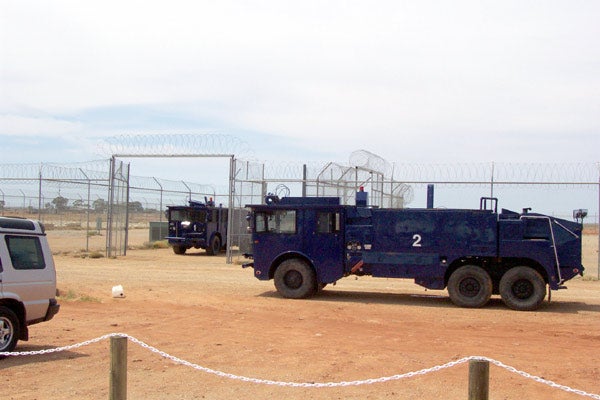
Blue fire trucks sitting outside Woomera, June 2002.
The Inquiry accepts that the equipment used to deploy water onto people may have been purchased for fire safety purposes, but believes that the expression 'water cannon' is consistent with ordinary terminology and accurately describes the use of such equipment. Detainees and former ACM staff used the expression 'water cannon' in giving their evidence to the Inquiry. A Departmental press release in the context of the Woomera riots in December 2001 (when there were 322 children at the detention centre) stated that:(187)
Australasian Correctional Management (ACM) used water cannons to disperse a group attempting to breach fencing and a razor-wire barricade placed in the sterile zone [the area between the inner and outer fences].(188)
A registered nurse who worked at Woomera from early August 2000 until mid-February 2001 described what he was told could be the injuries arising from the use of a water cannon:
There were many, many, many, many, many guards in full riot battle dress around the perimeter and we were told that the use of the water cannon had been authorised, and they explained the types of injuries that the water cannon can inflict, where it will hit the skin and shear the skin off in great flaps.(189)
The Department states that children and parents had the opportunity to move from the compound; however, it is clear that, for whatever reason, many children were present when the water cannons were used. An ACM psychologist at Woomera from October 2000 to December 2001, Harold Bilboe, told the Inquiry:
I also saw a water cannon used 4-5 times on groups involving children during demonstrations. On one occasion when there was a riot in 2001, a water cannon drove through a fence while women and children were present.(190)
While the Inquiry has no evidence that children were physically injured by the water cannons, the psychological impact was readily apparent. The water cannons feature in pictures drawn by very young children.(191) Some of those pictures form submissions to the Inquiry and are placed on the Inquiry's web site.
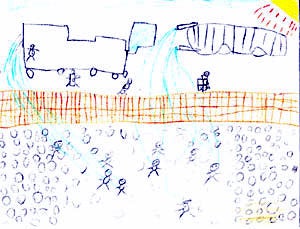
Drawing of water cannons at Woomera by a child in immigration detention.
Children who were at Woomera at the time described the water cannon to the Inquiry:
BOY 1: When one patrol car - you know the water? They used it.
INQUIRY: On children under 18?
BOY 1: All the people, even the kids too!
BOY 2: They care about nothing.
BOY 3: The water was too strong, so strong, yeah, you can't stop in front of the water.(192)
In his complaint to the Human Rights and Equal Opportunity Commission, Shayan Badraie's father said that a water cannon was directed at the Badraie's living quarters during riots at Woomera in early April and in late July 2000.(193) This case is discussed in more detail in the case study at the end of this chapter.
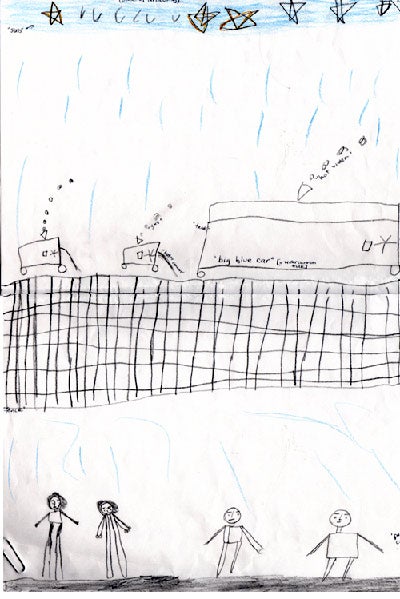
Drawing of children and water cannons by a child detained at Woomera.
8.4.5 'Security' compounds
At different points in time, the detention facilities used certain compounds to separate troublesome detainees from the rest of the population. In Woomera the compound was the Oscar Compound, earlier called Sierra Compound.
An unaccompanied detainee boy told the Inquiry of his experience leading up to his transfer to Oscar Compound at Woomera:
When I was in the camp last year [Woomera 2001] there was violence, the detainees were protesting, ACM came with shields, they had helmets, with everything, sticks they were hitting detainees, those involved with violence were arrested, it wasn't a handcuffs, it was plastic wire [flexicuffs]. They transferred those guys from the main camp to another camp. I think they sent them to Oscar. There is no mirror. I was shaving. I had a small piece of mirror like this. Officer came and said 'Give it to me!' Other guy said, 'don't give it, how can you shave?' I said I'm not going to give it. I took it and put in my donga. Someone was searching and he started abusing me and everything. Then six or seven of them came and searched all over the place. I was taken to Oscar. I said I will kill myself. They do something if you threaten, of course.(194)
The Department stated that the Oscar Compound was sometimes used for families as a result of accommodation shortages rather than for behaviour management. It suggests that Oscar was put to this use in October 2001 and that efforts were made to ensure the safety and security of children in the compound during that time.(195)
ACM, on the other hand, states that families were only ever placed in that compound at the request of parents and that was usually when mothers wanted to join their husbands who had been detained there for behaviour management purposes.(196)Both the Department and ACM highlight that some women refused to leave the compound when offered the opportunity to do so. One reason for this refusal may have been because they wanted to stay with their husbands.
There is evidence before the Inquiry that children were living in the Oscar Compound prior to October 2001, contrary to what the Department suggests. For example, an ACM psychologist appeared to be concerned about the use of Oscar Compound for children in January 2001:
I am of the opinion that all families that are currently in Sierra Compound need to be reviewed, Re: Young persons being in an isolated environment, and precluded from contact with other children and educational/school attendance.(197)
There is also evidence that families were not there by choice, contrary to what ACM suggests. For example, Shayan Badraie, whose case is discussed at the end of this chapter, was also transferred to Sierra Compound on 20 January 2001, at the age of six. No reason was given for this transfer but:
Mr Badraie described Sierra Compound as a 'punishment area' and alleged that, apart from a three year old girl, Shayan was the only child in the compound.(198)
The Commission's findings in relation to Shayan's complaint state that an ACM nurse and counsellor recommended the following day that the family be taken out of the compound given the age and psychological history of the boy:
Shayan had always feared Sierra Compound, by reason of the fact that he understood that anyone who was sent there was 'bad'. The relocation has resulted in Shayan not eating or sleeping. Mr Badraie also stated that Shayan had spent the previous night crying.(199)
However, Shayan was not removed from Oscar Compound until 3 March 2001, when his family was transferred to Villawood.
Problems also arose when parents were moved to 'security' compounds and children were left behind. This seems to have occurred on certain occasions when families received a negative visa decision and staff were worried about the reaction by one or more parents. The Department states that it was not routine practice to transfer both parents to a 'security' compound on receipt of a negative outcome. However, the Inquiry is aware of at least one example where this occurred.(200)
It therefore appears to the Inquiry that, while these compounds may not have been used to punish or control children, there is sufficient evidence to suggest that children had, at different periods of time, been housed with high risk detainees. While this may have been with the consent of parents, it demonstrates the difficulties that arise when families are kept in a closed, tense and crowded environment. It also highlights the problems that occur when parents are faced with a choice between being separated or living in a 'security' compound together.
Thus difficulties arise both when children are detained in 'security' compounds and when children are excluded from those compounds when their parents become a behaviour management risk. This highlights the difficulties that arise within the detention environment and the inappropriateness of detaining children in that context.
The Inquiry also notes that some children suspected of being involved in disturbances at detention centres have been taken to juvenile detention centres, while others have been separated from their parents who have been transferred to State correctional centres.(201)
8.4.6 Observation rooms
The Inquiry heard allegations from community groups and detainees that single occupancy observation rooms were used to punish children.
ACM emphasise that placing persons in observations rooms 'is not a punitive process and used only in case of high lethality (sic) potential ...'(202) The use of such rooms for the prevention of self-harm by children is discussed in section 9.5.3 in Chapter 9 on Mental Health.
The Department contemplates the use of single rooms for behaviour management:
The purpose of an observation room is not to place someone in solitary confinement, but rather to protect detainees who are considered a risk to themselves or to others on a short term basis.(203)
The evidence before the Inquiry is insufficient to conclude that the observation rooms in detention facilities were used as punishment for children. However, it is clear that children perceived the rooms as such. In focus groups, refugee children formerly detained at Port Hedland described their perceptions of 'K Block' to the Inquiry and said that they were very much afraid of the padded room. For example, one child formerly detained at Port Hedland said:
Once I accidentally saw the isolation room, and was very much afraid, and said I wish I never see this room again and ran away.(204)
8.4.7 Findings regarding exposure to 'security' measures
The Inquiry finds that security measures employed in the presence of children include: 'CERT 3' emergency response teams (with detention staff wearing riot gear including batons and shields), head counts (day and night), tear gas, water cannons and separated 'security' compounds.
The Inquiry acknowledges that there is a fine balancing act between trying to protect the safety of children, particularly in the context of violent disturbances, and exposing them to further psychological or physical injury by using certain security response measures. This dilemma highlights the inherent dangers of detaining children within this environment in the first place.
However, within the context of mandatory detention of children it is the Inquiry's view that there was insufficient consideration of the impact of such measures on children prior to their use. Written policies regulating the use of security measures are silent on what additional steps need to be taken to cater for the particular vulnerabilities and needs of children. The policies did not require staff to make the best interests of children a primary consideration prior to using such measures.
Some children became extremely frightened in the presence of the 'CERT 3' teams, tear gas and water cannons, and the psychological impact seems to have lasted some time. Head counts were sometimes insensitively performed and served to increase the distress children felt at being detained.
The Inquiry is also concerned about the placement of children in special 'security' compounds, even if they themselves were not being punished, as it exposed children to higher risks of violence. However, the alternative of being separated from a parent for a period of time also has a negative impact on children. This highlights the serious nature of the compromises that come with the detention of children.
The evidence before the Inquiry does not support a finding that children were held in observation rooms for the purposes of punishment. However, it is clear that some children viewed the room as a form of punishment. Chapter 9 on Mental Health discusses the use of such rooms in the event of threatened self-harm.
8.5 What exposure have children had to direct physical assault in detention centres?
The Inquiry heard several allegations of actual and threatened assaults on children occurring within the detention environment. Some allegations were in the context of major disturbances and others were more isolated incidents, although still influenced by the stressful environment. Much of that evidence was gathered in confidential interviews with detainees. It also came from community groups making submissions to the Inquiry, and former ACM staff.
Given that the focus of this Inquiry is on the systemic problems faced by children in immigration detention rather than on individual events, the Inquiry did not investigate the full factual background of specific assault allegations. Those investigations are better suited to the police, State child welfare authorities and the Commission's complaints function. One such allegation was investigated by the Commission's Complaints Handling Unit. That case concerns an alleged assault by an ACM staff member on a nine-year-old boy during the Easter riots (see further section 8.3.2(b)). The Commission's investigation into the case of six-year-old Shayan Badraie is described fully at the end of this chapter.
In any event, the unspecific nature of many of the assault allegations made it difficult to provide ACM and the Department with an adequate opportunity to respond to these allegations. As a result, it would be inappropriate to reproduce those allegations here.
However, while this Inquiry has not conducted investigations into individual allegations of assault, the combination of evidence from:
- current and former child detainees and their parents
- Department statistics
- ACM incident reports
- South Australian State child protection authority reports
- the 2001 Flood Report
clearly demonstrates that assaults on children in detention have occurred on some occasions. The Department has stated:
The Department acknowledges that assaults involving children, other detainees, their parents and ACM staff have occurred.(205)
Moreover, the evidence from children and parents demonstrates that there is an ongoing feeling of vulnerability and fear in parents and children about the possibility of assault within the detention environment.
As discussed in section 8.3.1 above, the Department's incident trend analysis reveals that 159 alleged, attempted or actual assaults occurred in detention facilities between July and December 2001,(206) 19 of which involved children.(207)From January to June 2002, 116 alleged, attempted or actual assaults occurred in detention facilities.(208)Sixteen of these assaults involved minors.(209)
The South Australian child protection authority also states that it investigated eight allegations of child abuse by a non-family member between 1 January and 31 July 2002.(210) In that same period the authority received 137 reports on children in the centre, 123 of which required investigation. The incidents related primarily to hunger strikes, harm or risk of harm to children due to parental depression, mental illness or stress, and actual or threatened self-harm by children.
The Flood Report also investigated 35 allegations of child abuse between 1 December 1999 and 30 November 2000.
8.5.1 Fear of assault in detention
Families felt an increased vulnerability to assault in detention centres due to the fact that they were often accommodated alongside single men. In April 2002, the South Australian child protection agency noted that the mixed compounds caused a problem at Woomera.
The vulnerability of girls in particular to physical and sexual assault has been highlighted by some families. One father at Woomera said that he escorted his daughters to the toilets, 'as he fears for their safety. There has been an incident in the past where the eldest daughter was touched in a culturally inappropriate way by a male detainee'.(211)
Several fathers at Curtin also reported escorting their children and wives to the toilet at night time as they did not feel safe making the journey alone:
the problem is like one of my daughters, [says] 'Daddy, I want to go toilet', I take her to the toilet. ... And if my wife, if my wife wants to go toilet I still have to accompany her to the toilet night time.(212)
A single mother and three young daughters felt so badly harassed by male detainees at Woomera that they felt they had to keep their curtains shut. The South Australian child protection authority, who interviewed this family, recommended that:
In the short term, measures such as improving privacy for the family while in their accommodation is required, such as extra curtains on their windows ... [men had looked in at them]. In addition [the teenage daughter] and her mother should be offered ongoing psychological support and efforts made to monitor the children and support the parent to ensure that their safety is ensured.(213)
The mother and daughters were eventually moved to the Woomera housing project.
However, the Inquiry notes that boys as well as girls may be at increased risk in mixed compounds.
Harold Bilboe, a psychologist employed at Woomera from October 2000 to December 2001, stated that:
Accommodation [at Woomera] was also inadequate and inappropriate for children. While I was employed [at Woomera], children and families were kept in compounds with large numbers of single adult males with no effective supervision. This exposed children to an unacceptably high risk of sexual and physical abuse.(214)
The Refugee and Immigration Legal Centre (RILC) also spoke of the dangers of placing children in compounds with single men:
[There are] extremely serious situations where children have been accompanied by adults have - including a young girl, were put into an environment in detention with a number of other males, adult males, a situation in which it is absolutely clear from the medical advice and assessments that have been obtained, that it has caused that young girl severe and ongoing psychological and medical trauma.(215)
In the aftermath of the August 2000 riots at Woomera, the Minister stated:
And in relation to [violent detainees] the issue now will have to be addressed as to whether or not those who may feel they've got nothing to lose need to be separately contained so that they don't expose others, particularly women and children, to risks. And that's an issue we'll be looking at.(216)
The Joint Standing Committee on Foreign Affairs, Defence and Trade recommended in June 2001 that, wherever possible, blocks within detention centres be designated for the exclusive use of families.(217) In response to this recommendation, 18 months later, the Government pointed out that Perth, Maribyrnong and Villawood all contain designated areas for women, children and family groups, and that 'courtesy fences' have been erected at Woomera to allow discrete areas to be assigned for special use by these groups.(218)
A former ACM Operations Manager at Woomera said it was not until the end of 2001 that there was separate accommodation for families.(219) During the Inquiry's visit to Woomera in January 2002, the Department's Manager said that women and children were 'balanced through the whole place' and that there was no separate accommodation for families. An ACM officer employed at Woomera at the time told the Inquiry:
A [girl in her early teens] lives in the detention centre with her [family]. When I last saw [her] in late January 2002 she had her wrists bandaged she had tried to kill herself because she could not cope with men pressuring her for sex. There is no women's and children's only compound at the detention centre, hence there was no escape from the threat of sexual abuse for [her]. I know this to be true, [she] told me herself. [Her] mother in tears and desperate told me how she and her daughter were subject to constant harassment because they were not accompanied by a man. Staff reported [her] situation to in-house and government authorities yet the girl remains at the Woomera Detention Centre.(220)
Women said they felt unsafe in the mess hall in Woomera as recently as June 2002:
We are not very safe. And some of the young women don't go to mess for food or eating because they are not relaxed, with too many single men.(221)
ACM told the Inquiry that:
Given the ethnic profile of detainees, the total number of detainees and the infrastructure limitations, the permutations for segregation could have been endless and impractical.(222)
The Inquiry acknowledges that existing infrastructure may well have placed limitations on the ability to separate families from single men. However, these practical difficulties are of little comfort to the parents and their children who are unable to lock out strange men, as they would otherwise do if they were in the community. They are difficulties that should have been foreseen by the Department as an inevitable consequence of the policy of mandatory detention which it was required to implement.
In July 2003, the Department stated that 'wherever possible family groups, women and children are accommodated separately from single men'.(223) However, Maribyrnong and the Baxter facility, which opened in September 2002, are still the only centres with exclusive family compounds. In Villawood, families are separated from single males but are accommodated with single women.
The Inquiry also received evidence that families from the Sabian Mandaean religion felt physically threatened by some Muslim detainees. It has been alleged that Sabian Mandaean children in particular were sometimes subjected to bullying and harassment because of their religion. The Department and ACM state that they investigated all such allegations, but were unable to substantiate any of the claims.(224)The Department offered Sabian Mandaean families the opportunity to move to separate compounds on a number of occasions, but it was not until late 2002 that the Department offered this arrangement to the families at inception, having reserved a compound at Baxter there exclusively for them. This issue is discussed in more detail in Chapter 15 on Religion, Culture and Language.
8.5.2 Examples of alleged assault in detention
For the reasons outlined above, the Inquiry is not in a position to positively determine whether certain assaults did or did not occur. However, the information before the Inquiry demonstrates the difficulty of protecting children from assault within the detention environment and reinforces the Inquiry's view that detention is not a safe place for children.
(a) Alleged sexual assault by detainees
The Flood Report investigated in some detail the processes in place for handling sexual assault allegations between 1 December 1999 and 30 November 2000. Nine of the 35 cases of alleged child abuse examined in the Flood Report concerned allegations of sexual abuse by another detainee.(225) Flood found that:
allegations, instances or situations where there is a reasonable suspicion of child abuse in ...Curtin, Maribyrnong, Perth, Port Hedland and Villawood were handled in accordance with the procedures laid down by the Department ... and relevant Commonwealth and State legislation. However ... at Woomera ... a serious incident of possible child abuse and the broad question of policy on child abuse were not properly handled.(226)
The incident causing Flood the most concern related to allegations of sexual abuse of a 12-year-old boy in Woomera.
At the time of the Human Rights Commissioner's visit to Curtin in July 2000, the Commission was informed that charges were laid against two male detainees regarding sexual abuse of two children. The Department Manager reported that the incident had prompted management to institute education programs for detainees on matters relating to child sex offences under Australian law.
In Port Hedland, in October 2001, the Department Manager reported that, on two occasions, incidents of alleged child abuse 'were not followed by immediate removal of the alleged perpetrator from the compound'. While, 'in both cases the child was put under observation, the perpetrator was left to his own devices for several hours'.(227)
The South Australian child protection authority stated that between 1 January and 31 July 2002, there were very few sexual abuse notifications from Woomera.(228) The Inquiry received specific evidence regarding one of those alleged sexual assaults, which concerned a 12-year-old boy. FAYS investigated the allegations and found that the child was at very high risk of further sexual abuse due to several factors:
- whilst [ACM] staff have him on 'close watch' this is not a viable safety measure for more than a very short term period; the ability of staff to protect [him] from opportunistic abuse is limited;
- [he] has no protective parent able to supervise and influence the child's behaviour ...;
- the centre management has not been able to separate [him] from the compound where the abuse has occurred. Therefore he is continuing to be exposed to high risk.(229)
Although the father and child could have moved compounds, it appears that the father refused because of his friendships with others in the compound. The boy himself 'did not wish to draw attention to himself'.(230) The ACM Intelligence officer stated that:
in reality there are just as many risks in the other compound. The change was not enforced due to the risk of destabilising the detainees and causing a riot if force were used to change compounds.(231)
However, the medical records note that the child was not offered effective protection within the centre in the light of the restricted ability of his parents to protect him. The Woomera GP said:
I have seen him on multiple occasions over the last year at the behest of his parents. He is suffering from bed wetting, stuttering, poor sleep, feelings of depression and prominent suicidal ideation. He has self-harmed by slashing and overdosing on medication on at least two occasions. He has taken part in at least one hunger strike. More recently he has been the victim of an alleged sexual assault by an adult detainee within the camp ... This situation has come about because [his] mother has been in hospital and his father has little motivation to look after him, and states that he cannot control him. In effect [the child] has been an unaccompanied minor in the sense that neither his father nor mother have been able to look after him or protect him. This has left him open to the actions of predators such as the man who has allegedly perpetrated this assault.(232)
FAYS recommended that the matter be reported to the South Australian police and that 'immediate arrangements be made to remove [the child] from the centre itself'.(233)In particular, FAYS suggested that the mother and child be placed in the Woomera housing project. The ACM psychologist also strongly urged that the child be removed from what she believed to be an unsafe environment and noted that:
In the broader community it is agreed that children should be removed from the environment in which the abuse occurred to a safe environment.(234)
The Department Manager expressed 'serious concerns about whether we are currently doing our best for this child' and suggested that an exception be made to the Woomera housing project eligibility rules to allow the mother, boy and his brother to move there.(235) The transfer to the housing project did occur six weeks later.(236)The police investigated the allegations and found that there was insufficient evidence to take the matter any further.(237) In the circumstances, the Inquiry does not draw any conclusions about whether or not the assaults took place. This example demonstrates, however, the restricted options available within the detention environment to keep children safe. The failure to move the child to a safer place is especially concerning given the consistent recommendations from FAYS, Department staff and ACM staff that the child be removed from the source of the violence, as would occur in the general community. The Inquiry notes that since this time the eligibility rules for the Woomera housing project have become more flexible.
A Western Australian case illustrates a more rapid response to sexual assault allegations. In Curtin, in January 2002, there were allegations of sexual assault of a five-year-old boy, and possibly two other very young children who were present, by adult male detainees who lived in the same compound as the children.(238)
ACM incident reports show that upon learning of the allegations, the children were put on hourly watch. ACM also offered to move the family to another compound. While the mother resisted the move, there were consistent efforts to ensure that the family had the opportunity to live in a different compound to the alleged perpetrators. The alleged perpetrators were moved out of the compound the same day and put under watch.
The Department, the Western Australian police and the child protection agency were all notified of the allegations and the WA police and Family and Community Services investigated the incident.(239) The police concluded that the allegations were unsubstantiated and the accused had no case to answer.(240)
(b) Alleged parental abuse
The Department acknowledges that incidents of parental neglect and abuse have occurred in detention centres.(241) The Flood Report investigated five cases of alleged parental abuse in the period 1 December 1999 to 30 November 2000 and found that they were well handled by detention staff.(242) Between 1 January and 31 July 2002, DHS stated that at Woomera:
only 10 per cent [of notifications] would be in relation to physical abuse allegations of children at the hands of their parents.(243)
As set out below, one father was involved in several allegations of parental abuse. This example demonstrates the limitations in responding to such a situation within the detention environment, but it confirms the appropriateness of the response of the detention staff in that context. It also suggests that the detention environment may have been a factor leading to the abuse.
At Woomera in August 2001, the father was caring for his two-year-old son while his wife was in hospital waiting for the birth of their child. He was having great difficulty coping with his son and left him in the care of ACM staff on several occasions. After speaking to the ACM psychologist he apologised for his behaviour, asked for his son back and requested that he be moved to a maternity room with an ensuite to make it easier to look after the child. He was moved to the maternity room and the centre's welfare officers arranged for the boy to attend kindergarten and for another detainee to look after the child to relieve some of the pressure.(244)
In November 2001, the same father was 'allegedly threatening to harm his child with a blade'. ACM medical staff examined the child and found no evidence of any harm but placed the child on watch.(245)
In January 2002, the father attempted to hang himself. He told detention staff that he was tired and upset because his three-year-old son could not go to school. The father was put on 2 minute watch and then went back to his family. When the officers came to take him to the 'Woomera Annex [a cell in Woomera police station] for his own safety and well-being' he allegedly grabbed his child and threatened to hurt him. Detention staff decided to leave him in the family donga but three officers stayed in the room with them. The situation then calmed down. FAYS and the South Australian police were notified and the family were placed on 2 minute observations.(246) Later, when the officers went to take the father to the Woomera Annex again, the mother allegedly threatened to harm herself with broken glass and detention officers were cut in the process of trying to remove the glass from her grip. She was referred to the psychologist.(247) ACM reports from late January and early February 2002 indicate that ACM staff were working with the family on parenting skills.(248)
The South Australian police charged the father regarding the threats to his son but he was permitted to return to his family and see his son under the supervision of ACM staff. FAYS also recommended that the father be able to visit his family.(249)
In July 2002, the parents went on hunger strike but agreed to feed their children. The parents apparently resisted having nurses check on the children. FAYS were notified and recommended that the children be removed from the family donga.(250)
The Inquiry is of the view that ACM staff did what they could to defuse the threats made by this father on his children. However, it is significant that the father's detention appears to have played at least some role in creating those tensions and ACM staff had no power to remove that aggravating factor. This more general issue is explored in greater detail in section 9.3 in Chapter 9 on Mental Health.
The Inquiry also received evidence concerning parental neglect and abuse in another family. Here there were concerns about a 16-month-old baby:
Father is withdrawing from his relationship from [the mother] and not taking any child care responsibility. He has become delusional. Both parents talking about being suicidal and leaving child behind.
Mother admitted to hitting the child around body and face although no injuries were sighted. Both parents have been observed to have uncontrolled anger.
[Mother] lives in a compound that is male orientated with only one other female. All males [including the father] threaten, intimidate and abuse [the mother] if the child cries.
[Mother] has stated that she hits her daughter [name deleted] every day when she cries. It was reported that [the mother] has used sticky tape on [the child's] mouth to keep her quiet.(251)
The FAYS report on this family made the following assessment:
The child ... is totally dependent upon her parents and is, subsequently, very vulnerable to harm because of the depression and mental health issues of her parents. The family relationships are severely fractured and [the baby's] parents are 'negative' in their mood and behaviour. In other words, they see no hope for their future, their marriage, their life and the current environment for their child.
There are specific safety issues for [the baby] in this situation; there is a high risk of physical injury (from smacking whilst frustrated) and there is a chronic lack of emotional nurturing (whilst parents are pre-occupied with visa issues and their own mental health).(252)
FAYS recommended an urgent assessment of whether the baby should 'remain in the sole care of her mother and father'. It also recommended an urgent referral for psychiatric assessment of both parents 'in terms of the capacity of either of them to provide safe and nurturing parenting'.(253)
The Inquiry heard that this family received psychiatric care including parenting assistance. The mother and baby were transferred from the detention centre to the Woomera Residential Housing Project (RHP) in August 2002, which apparently improved their interaction.(254) At a case conference regarding the family on 10 September 2002, child protection and mental health specialists concurred that the mother and baby needed 'professional intervention in a residential facility'. Until this was able to be arranged the mother and baby were seen by the South Australian Child and Adolescent Mental Health Services (CAMHS) weekly and visited by a Parent Aide at Woomera RHP.(255) The mother and baby were transferred to a residential parenting program in a psychiatric hospital in Adelaide for three weeks during October 2002.(256)
The Inquiry also received evidence of isolated instances of parental abuse of children which appear to be directly connected to the detention environment. For example, a Woomera incident report of 6 July 2001 notes that a father struck his ten-year-old daughter around the head after she had been reprimanded by a guard for taking food outside of the mess. The father was removed from the compound overnight, informed that his behaviour would not be tolerated and 'given an official caution by the police and notified that if there was a repeated offence the matter would be taken further by the police'. (257) Meanwhile, medical staff requested ACM guards to, 'PLEASE try to arrange availability of food for children outside of usual feed times if at all possible' (emphasis in original).(258)
From the evidence before the Inquiry, it appears that ACM and the Department generally responded appropriately to situations of actual or threatened parental abuse or neglect. There is also evidence of individual officers doing their best to calm down tense situations. However, as set out in Chapter 9 on Mental Health, it is the Inquiry's view, based on evidence from mental health experts amongst others, that the detention environment may be a causative factor in such incidents. This is not to condone parental abuse or neglect, but to recognise that this is another way in which the detention environment compromises children's welfare and safety.
(c) Alleged assault by ACM staff
As set out above, the Inquiry has not been able to investigate in any detail allegations made by children and parents that ACM staff were sometimes involved in assaults on children. The evidence before the Inquiry does not support any finding of systemic assaults by ACM staff.
However, the Inquiry received quite detailed evidence regarding one alleged assault by ACM officers on an eleven-year-old Afghan unaccompanied boy at Woomera detained from June 2001 to January 2002 (when he was transferred to home-based detention). ACM medical records note that the boy was assaulted by ACM officers on 18 December 2001 as follows:
- Dragged by one officer
- Told he had hit officer in Mike [name of compound]
- Held arms by second
- Third hit with open hand across face on Right side
- Fell back against donga(259)
The medical records contain a drawing of the child's injuries, including bruising on his face and finger-marks on his neck and a graze over his cervical spine.(260) The medical records also say that the child had been sitting quietly when he was 'pulled out by one officer in group of three', and that he had an 'acute red welt on right cheek' and 'red welts on neck' and that he was 'acutely upset crying'.(261)
ACM detention officers reported that on the evening of 18 December 2001, the child had 'expressed his disapproval of being in the customs donga and had threatened to cause trouble if he was not returned to his accommodation in Mike compound'. Three ACM officers were asked to speak with the child. They said that they were with the child for no more than thirty seconds. However, the Detention Manager said he saw the child 'being "pinned" up against the wall in the customs donga'.(262) Another ACM officer also witnessed the incident and reported that disproportionate measures were taken.(263)
On 19 December 2001 the incident was reported to FAYS. ACM initiated an internal investigation the same day which was completed the following day.(264) By 20 December 2001 the Australian Federal Police (AFP) had been notified.(265)
The three officers were dismissed in March 2002 for gross misconduct but when officers appealed they were reinstated, despite ongoing investigations by the AFP.(266)All three worked until the end of their contracts.
In July 2002, the AFP charged all three officers with assault. None of the men could be found to appear before the Magistrates Court on 2 September 2002. On 25 November 2002, the Commonwealth Director of Public Prosecutions (DPP) withdrew the charges against two of the men and on 4 June 2003 the charges were withdrawn against the third man, who was living in New Zealand at the time.(267)
The Department expressed serious concern about this incident and deducted 10 points from ACM in the Performance Linked Fee Report for the quarter ending 31 December 2001.(268)
8.5.3 Findings regarding physical assault
The evidence before the Inquiry does not support a finding that there was systemic assault of children within detention centres - either by adult detainees or ACM staff. However, it is clear to the Inquiry that some assaults did occur and that children and parents were fearful of the possibility of such assaults occurring. The tense environment in detention centres contributed to these fears. The absence of secure separate family accommodation facilities in Woomera, Curtin and Port Hedland - which prevented access by single adult males - exacerbated those fears, particularly in the case of girls. Maribyrnong and Baxter have separate secure compounds for families and Villawood has a separate compound for families and single women.
By August 2001, ACM had issued clear instructions to staff in all centres regarding reporting to State child protection authorities in the event of suspected child abuse. This appears to have resulted in generally appropriate reactions, particularly in the case of suspected parental abuse. However, in some cases there were delays caused by the detention environment itself. For example, the restrictive eligibility rules for the Woomera Residential Housing Project (which were later changed) delayed the transfer of a child at risk in the face of recommendations by State child welfare protection authorities, ACM and Departmental staff.
Furthermore, the declining mental health of parents sometimes restricted their ability to shield children from other adults. The Inquiry also notes that the detention environment itself poses a risk factor regarding parental abuse. This is discussed further in Chapter 9 on Mental Health.
8.6 Summary of findings regarding the safety of children in detention
The Inquiry finds that there has been a breach of articles 3(1), 3(2), 6(2), 19, 22(1) and 39 of the CRC.
The issues considered in this chapter provide a stark introduction to what is a recurring theme throughout this report, namely that the detention of children in immigration detention centres severely limits the ability of children to enjoy their rights under the CRC.
Australia has an obligation to take all appropriate legislative, administrative, social and educational measures to protect children from all forms of physical and mental violence (article 19(1)). It also has an obligation to take all appropriate measures to ensure that the best interests of the child are a primary consideration in all actions that affect children (article 3(1)). The threshold for compliance is very high, in recognition of the fundamental importance of keeping children safe.
The evidence before the Inquiry clearly demonstrates that, between 1999 and 2002, the detention environment was not safe for children. Woomera, Port Hedland and Curtin have been the site of multiple demonstrations, riots, hunger strikes and violent acts of self-harm. The occurrence of such events exposed children to heightened risks of harm. The longer the children were held in such an environment the more likely they were to be exposed to those risks. The case study at the end of this chapter illustrates how serious the impact of the surrounding violence can be on a six-year-old boy.
The Inquiry recognises that the detention environment may pose practical difficulties in fully addressing the safety risks facing children. For example, the lock-down procedures designed to control the extent of violence can also have the effect of trapping children amongst the violence. However, the Inquiry is also of the view that the Department was or should have been aware of those difficulties and the obligations under articles 3(1) and 19(1) require the Department to take all appropriate measures to address and overcome those hurdles.
The Inquiry does not suggest that there be no security measures in detention facilities. However, the security standards, policies and procedures examined by the Inquiry were general in nature. They did not specifically take into account that children may be present nor did they highlight the priority that should be given to the protection of children in detention centres. The Inquiry finds the absence of such specificity meant that the best interests of the child were not a primary consideration in decisions made regarding the maintenance of security in detention centres.
As the Inquiry has observed, sometimes the security measures themselves added to the risk of physical harm for children and exacerbated the climate of fear to which children were exposed. In particular, the use of tear gas, water cannons and 'CERT 3' gear in the presence of children left a deep psychological impact. The headcounts were sometimes obtrusive and distressing for children. Furthermore, children were sometimes placed in special 'security' compounds, even if they were not themselves being punished, exposing them to greater risks of harm. However, the Inquiry does not find that children were placed in solitary observation rooms for punishment purposes (see further Chapter 9 on Mental Health).
While the Inquiry makes no findings as to the frequency of direct assaults on children in detention it is clear that some assaults did occur, and that there was a fear of assault among some detainees, especially girls and women. The intermingling of families and single men increased the vulnerability of children to assault by other detainees. The new Baxter facility addresses this problem; however, that facility only opened in late 2002. Children continue to be detained in mixed compounds in Port Hedland.
Due to the general nature of this Inquiry, it has not investigated allegations of assault by parents, other detainees or ACM staff in any detail. Nevertheless, on the evidence available in the limited number of examples cited in this chapter, it appears that ACM staff took appropriate steps to resolve and report suspected assaults. In particular, the Inquiry acknowledges the efforts of the Department and ACM to clarify the reporting procedures to State authorities regarding suspected abuse or assault. However, the Inquiry is disappointed that these procedures were only put into place in 2001, nearly 10 years after the introduction of mandatory detention.
Similarly, it is discouraging that as at November 2003, the Department still had not finalised Memoranda of Understanding clarifying the role of State and Federal police authorities, nor any State child welfare agency, other than the South Australian authorities, regarding children in detention centres.
The December 2001 MOU with the South Australian authorities makes it clear that while it has the power to enter a detention centre to investigate a child abuse notification, it does not have the power to enforce that recommendation. However, the Inquiry acknowledges that the Department has generally implemented the recommendations of State welfare authorities in the context of immediate safety concerns.(269)
The Inquiry does not accept that, in general, it was the fault of parents that children were exposed to violence in detention. In addition to the fact that parents had no choice about being in detention in the first place, the physical limitations faced by ACM staff were also faced by parents. In some cases the violence in detention centres was so widespread that it would have been impossible for parents to shield their children. However, the Inquiry does recognise that some parents took part in self-harm, riots and demonstrations. Furthermore, some children copied the behaviour of their parents or other adults around them. This demonstrates the inherent danger of detaining children and their parents in such an environment.
In summary, the detention of children in Australia's detention centres simultaneously increases the risk of harm and limits the options available to address those risks. The Inquiry therefore finds that the legislation requiring the long-term mandatory detention of children results in a breach of articles 3 and 19 of the CRC. The detention system as a whole demonstrates an inadequate consideration of the best interests of children (article 3(1)) and a failure to ensure that children who arrive in Australia seeking asylum are given the protection necessary for their well-being (article 3(2)) and afforded all appropriate measures to be protected from harm (article 19(1)).
The Department also failed to adequately consider the best interests of children (article 3(1)) in the development and implementation of policies and procedures related to security. The general nature of those policies and procedures failed to pay sufficient regard to the needs and vulnerabilities of children and accordingly, the Inquiry finds that the Department has not taken all appropriate measures to protect children from harm (article 19(1)), nor has it ensured children such care and protection as is necessary (article 3(2)).
These same factors demonstrate that detention centres were far from the nurturing environment necessary to ensure that a child seeking asylum could achieve the maximum possible development and recovery in accordance with articles 6(2), 39 and 22(1) of the CRC. The Inquiry therefore finds that the policy and laws requiring the mandatory detention of children breach those human rights.
The placement of children in compounds used for adult behaviour management, combined with the sometimes obtrusive surveillance techniques and the failure to take special measures to protect children from exposure to tear gas and water cannons should be taken into account when assessing whether the overall conditions of detention amounted to a breach of the right to be treated with humanity and respect (article 37(c)). The Inquiry discusses this issue further in Chapter 17, Major Findings and Recommendations.
Clearly, the longer children were held in detention centres the greater the risk to their physical and psychological well-being. Thus the most important step towards improving the safety and security of children who arrive in Australia without a visa is to ensure that they are detained as a matter of last resort and for the shortest appropriate period of time in accordance with article 37(b) of the CRC. Such a step requires the legislature to end the practice of mandatory detention in its current form.
8.7 Case Study: Shayan Badraie
This case highlights the negative impact that exposure to major disturbances and self-harm by others can have on children and their families.(270)
In 2002, the Human Rights and Equal Opportunity Commission investigated a complaint made by Mr Mohammed Badraie on behalf of his six-year-old son Shayan regarding his treatment by the Department. The Commission concluded that the Department had breached the CRC and made a number of recommendations to avoid similar practices in the future. The Commission also recommended that the Department pay compensation to the family and that the Minister apologise to them.(271) The Department did not accept the findings or recommendations.(272)
The facts before the Inquiry regarding this case are as follows.
March 2000
Shayan, aged five, arrives in Australia by boat with his parents. The family is taken to Woomera detention centre.
June 2000 - November 2000
There are several periods of unrest in Woomera in 2000. In June 2000 there are two days of protests with 480 detainees breaking out of Woomera and walking out into Woomera township. In August 2000 there are three days of riots and fires at Woomera, involving 60-80 detainees, in which tear gas and water cannons were used. In November 2000 there is a hunger strike by more than 30 detainees.
28 November 2000
Shayan witnesses an adult detainee in a tree about to slash his chest with a shard of glass and jump.(273)
December 2000
On 6 December 2000, ACM medical records note that Shayan is experiencing nightmares, anxiety, not eating well and poor sleep.(274) On 8 December 2000, ACM medical records note a recommendation that the child be removed from Woomera in order to deal with his fears.(275) On 29 December 2000, the ACM counsellor notes that the child is experiencing bed-wetting; sleep disturbance, including waking at night crying and at times gripping his chest and saying 'they are going to kill us'; repeatedly drawing fences with himself and his family portrayed within them; social withdrawal; nail biting; and more aggressive behaviour at school.(276)
ACM informed the Inquiry that by 25 December 2000 ACM staff had made three strong recommendations to the Department that the child be moved from Woomera.(277)
January 2001
On 3 January 2001, ACM medical records note that since witnessing the threatened suicide, Shayan had exhibited bed-wetting at night, nail-biting, aggression and less concentration at school, diminished appetite. The medical records indicate that the case was discussed on this day with a child psychiatrist from Adelaide who suggested monitoring the child and his parents and that a further teleconference could be held in the following week.(278)
The next day, Shayan witnesses an adult male detainee climb a tree and threaten to self-harm.(279) When Shayan was watching the man up the tree, the ACM nurse who was negotiating with the man went over to Shayan and asked him if he would leave:
I remember speaking to a couple of people at the time asking if they could take Shayan away because I did not think this would be good for his mental health.(280)
On 12 January 2001, Shayan is further upset by an incident involving his father and an ACM officer:
Mr Badraie reported that he and Shayan had witnessed an officer making "masturbating gestures". Mr Badraie felt that this was inappropriate in a context in which families were eating and threw an apple at the officer. Mr Badraie was allegedly told by the officer to "fuck off out of here". Mr Badraie further stated that, following that incident, Shayan had a restless night and a "significant increase in bedwetting".(281)
On 20 January 2001, the family is transferred to Sierra Compound (the security compound in Woomera). The next day, the ACM counsellor notes:
- Shayan has always had a fear of Sierra, due to his experience of Sierra in the past. He associates Sierra with 'bad people' and believes that anyone who is sent to Sierra is 'bad'. No doubt, he now believes this about himself as well. Since relocation, Shayan has not been eating, and, has not slept. According to [his father] Shayan spent most of last night crying, despite reassurances from his family that they were safe.
- Yesterday, Shayan allegedly witnessed his father having his arm placed tightly up his back (an action that was apparently contested by a 'supervisor'), and, his mother being told to 'shut up, shut up' by an Officer. This incident allegedly took place because the family were 'slow' to move from the main compound until their request for a large room, in Sierra, was met. Apparently, during this incident a number of Officers were radioed to the site, for assistance, something that was also distressing for the child.
- Shayan is now alone in Sierra, with no other children, a factor that is also contributing to his distress.(282)
The counsellor recommends the family be immediately relocated from Sierra Compound. The family were not moved from this compound until March 2001.
On 25 January 2001, the ACM psychologist notes the impact of witnessing the self-harm incident of 28 November 2000. The report diagnoses Shayan as suffering from post traumatic stress disorder (PTSD), and notes that he was further distressed by the move to Sierra Compound. The psychologist recommends that the family be moved to a more appropriate centre, such as Villawood, and that psychological services and counselling be provided.(283)
February 2001
ACM informed the Inquiry that on 7 February 2001 the Department responded to the recommendation that Shayan and his family be moved to Villawood with 'No action at this time'. FAYS are notified of concerns regarding the family.(284)
On 27 February 2001, the ACM psychologist (who had been working at Woomera since September 2000) sends an impact assessment report to the Department's Manager at Woomera stating:
DIMA requested a follow up review of this small boy, Shayan, following an incident of malicious damage and destructive behaviour by another adult detainee in the SIERRA Compound. ...
Shayan's medical/psychological history shows that he has been experiencing anxiety and distress related to being in the detention centre and the behaviours of adult detainees i.e.: Self-harm and destructive violence.
There has been continuing concern with regard to this young boy's level of anxiety, and the impact of events on him, resulting in reactive anxiety, distress, and impact on him and his emotional and psychological wellbeing. ...
Today, Shayan has again been exposed to inappropriate behaviours of adult detainees, resulting in him evidencing acute emotional distress and anxiety, as for example when Shayan was found hiding under his blanket crying and distressed. ...
The psychologist recommends that the family be relocated to a more appropriate detention centre.(285)
March 2001
On 3 March 2001, the family is transferred to Villawood.
On 8 March 2001, ACM medical records indicate symptoms of post traumatic stress disorder.(286)
On 28 March 2001, a psychologist from the Westmead Children's Hospital assesses Shayan at Villawood. The report notes:
[Mr Badraie] stated that [he] has been concerned over Shayan's emotional state since an incident at Woomera five months ago, at which time Shayan saw a detainee cut himself in an apparent suicide attempt. Mr Badraie reported that immediately following this event, Shayan went to their room and sat curled up on the floor, shaking and crying. He said that Shayan would not sleep for more than short periods that night, and continued to cry and call out for his parents.
The psychologist concludes that Shayan remains at risk of suffering 'prolonged stress syndrome' while he remains at Villawood.(287)
ACM reports that soon after reaching Villawood, Shayan was diagnosed by both the Villawood psychologist and an independent psychologist and psychiatrist with PTSD.(288)
April 2001
On 5 April 2001, Shayan's father takes him to the detention centre medical clinic, because he is distressed at witnessing a fight between detainees.(289)
On 30 April 2001, Shayan witnesses an adult male detainee who had attempted suicide, bleeding from a laceration to the wrist. Medical records indicate that following this event, Shayan would not leave his parents, hid under a blanket, wet himself, would not eat, would only drink small amounts of milk, would not speak, and could not sleep.
May 2001
After three days of exhibiting these symptoms, Shayan is admitted to Westmead Hospital on 3 May 2001. In a 10 May 2001 report, staff of Westmead's Department of Psychological Medicine note the following:
- Shayan was assessed, on admission to Westmead, as being acutely traumatised and at risk of dehydration due to poor fluid intake;
-
Shayan had PTSD which had developed in:
"the context of the physically restraining environment of the detention centres, in which he has now resided for close to fourteen months, during which time he has been exposed to aversive events such as detainees going on hunger strike and self harming. They [Shayan's symptoms] are also perpetuated by the lack of predicability regarding his future and the inability of his parents to reassure him due to their own uncertainty, and furthermore the lack of a stable peer group in that other children move out of the detention centre while he stays behind.";
- there was a high risk of acute recurrence of symptoms unless his environmental circumstances changed;
- "In order for full recovery to occur Shayan would benefit from a more 'normal' living environment ; and continuing to live together with his family";
- the main contributor to Shayan's symptoms was his environmental stress; and
- if he was to remain in Villawood, a consistent peer group would enhance his sense of stability and it would be helpful to send him to a school where he could access such a peer group.(290)
The report notes that he should be protected 'as far as possible from the witnessing of further traumatic events'.(291)
Shayan is returned to Villawood on 9 May 2001. Medical records note that the day after Shayan returned from hospital he saw the man who had 'slashed up' and once again became withdrawn.(292)
May to August 2001
Shayan is readmitted to Westmead Hospital for a period of 8 weeks between 15 May and 12 July, when he is returned to Villawood.
On 18 May, the Head of the Department of Psychological Medicine from the Children's Hospital, Westmead, reports:
Shayan's readmission reinforces that his symptoms recur if he is returned to the environment that he has found traumatic. There are limited psychological interventions that we can provide that will over-ride the aversive stimulus. To prevent further morbidity, we are looking for the co-operation of the Villawood Detention Centre and the Department of Immigration to avoid returning him to an aversive environment and to find a means to provide a community placement with an appropriate peer group and educational setting.(293)
Shayan is admitted to hospital on a further six occasions for a period of a few days each.(294) Several of the admissions were for the purpose of rehydration. Medical staff consistently recommended that Shayan and his family be removed from the detention environment.
On 31 May 2001, a child psychiatrist writes to the Minister drawing a clear link between the child's illness and his experiences in detention:
Shayan is a seven year-old boy [who] has been diagnosed with acute [and] chronic Posttraumatic Stress Disorder (PTSD) as a result of traumatic experiences in his fourteen months in Woomera and Villawood Detention Centres ... this is his second admission [to hospital] for potentially life-threatening symptoms, such as refusal to eat or drink, as well as becoming withdrawn and mute. In the hospital setting, he recovers to some degree, illustrating the difficulty he has with residing in the Detention Centre per se, whilst retaining some features of chronic PTSD.
We are concerned about the risks of discharging Shayan back to Villawood Detention Centre. From the point of view of his psychological treatment, he should not be re-exposed to the emotionally traumatic environment that precipitated his acute deterioration.(295)
ACM informed the Inquiry that Shayan was seen 70 times by the Villawood detention centre medical service and that between March and August 2001, ACM health staff and Westmead Hospital specialists wrote 13 letters setting out the seriousness of Shayan's case and urging the Minister and the Department to remove Shayan from the detention environment in order to prevent further harm.(296)
In June 2001, the Department and ACM begin talking to the Department of Community Services (DoCS) about the possibility of putting Shayan into the care of a foster family in Sydney. In July 2001, DoCS agree that foster care is the most appropriate response for Shayan. On 23 August 2001 Shayan is transferred into foster care detention in the community, without his parents or sister.
January to August 2002
On 16 January 2002, Shayan, his mother and sister are released on bridging visas.
On 9 August 2002 the entire family are recognised as refugees, and live together in the Australian community on temporary protection visas.(297)
Endnotes
- Article 2 of CEDAW requires States parties to 'condemn discrimination against women in all its forms, agree to pursue by all appropriate means and without delay a policy of eliminating discrimination against women'. General Comment 19 states that the definition of discrimination in article 2 includes gender-based violence: Committee on the Elimination of Discrimination Against Women, 1992.
- Note, however, that Parliament's Joint Standing Committee on Treaties recommended that Australia withdraw the reservation. See Report of Inquiry into the Status of the United Nations Convention on the Rights of the Child, August 1998, Recommendation 47, available at http://www.aph.gov.au/ house/committee/jsct/reports/report17/rept17contents.htm, viewed 18 November 2003.
- UNHCR, UNHCR Revised Guidelines on Applicable Criteria and Standards relating to the Detention of Asylum Seekers (UNHCR Detention Guidelines), Geneva, 1999, guideline 8.
- UNHCR Detention Guidelines, guideline 10(ii).
- United Nations Rules for the Protection of Juveniles Deprived of their Liberty (the JDL Rules), Geneva, 1990, rule 33.
- The JDL Rules, rule 64.
- The JDL Rules, rule 28.
- The JDL Rules, rule 87(d).
- DIMIA, Submission 185, p91.
- Immigration Detention Standards (IDS), 1998, para 5.2, www.immi.gov.au/detention/ det_standards.htm.
- IDS, 1998, para 5.4.
- IDS, 1998, para 7.2.2.
- IDS, 1998, para 7.2.3.
- IDS, 1998, para 7.8.3.
- IDS, 1998, para 7.8.4.
- IDS, 1998, sections 7.9, 7.10.
- IDS, 1998, para 9.4.2. See also DIMIA, Submission 185, p91.
- DIMIA, Response to Draft Report, 10 July 2003.
- DIMIA, Managers' Handbook, Section 4.7.
- DIMIA, Managers' Handbook, Section 4.7.
- DIMIA, Managers' Handbook, Section 4.7.
- IDS, 1998, para 13.3.
- ACM Woomera Procedure 18.04, Children's Protection Policy, 1 February 2001. ACM, Response to Draft Report, 8 August 2003.
- ACM, Policy 16.2, Children's Protection Policy, Issue 4, 12 August 2001, para 5.1.
- ACM, Policy 10.16, Assault or other Criminal Behaviour, Issue 4, 12 August 2001, para 1.4.
- ACM, Policy 6.9, Voluntary Starvation, Issue 3, 27 June 2002.
- ACM, Policy 10.24, Pat Searching of Detainees, Issue 2, 23 April 2002, para 4.12. This also applies to elderly detainees.
- ACM, Policy 10.25, Strip Searching of Detainees, Issue 1, 23 April 2002, para 4.15.
- ACM, Policy 11.9, External Escorts, Issue 5, 31 May 2002, para 4.94.
- ACM, Policy 10.15, Use of Tear Gas, Issue 6, 12 June 2002, para 3.1.
- ACM, Policy 12.01, Emergency Management, Issue 5, 31 May 2002.
- ACM, Policy 10.22, Centre Searching, Issue 5, 23 November 2001. ACM state that there is no logical differentiation between children and adults in the procedure for searching a detainee's room because all searches must be done in a professional and dignified manner. ACM, Response to Draft Report, 8 August 2003.
- ACM, Policy 10.4, Detainee Counts, Issue 5, 26 March, 2002, para 4.6.
- ACM, Policy 10.2, Detainee Behaviour (Code of Conduct), Issue 5, 14 May 2002, para 4.7.
- ACM, Policy 20.02, Detainee Management Separation, Issue 6, 26 March 2002.
- ACM, Policy 10.14, Use of Force and Restraints, Issue 5, 31 May 2002.
- The operations of HRATs are discussed in further detail in Chapter 9 on Mental Health.
- ACM, Policy 7.1, At Risk/Self Harm/ Suicide Management, Issue 5, 18 April 2002, paras 4.44-4.45. ACM states that since HRAT Management is developed on an individual basis this policy effectively requires that children's particular needs be considered.
- ACM, Response to Draft Report, 8 August 2003.
- ACM, Response to Draft Report, 8 August 2003, p5.
- Child Welfare Act 1947 (WA); Children and Young Persons Act 1989 (Vic); Children's Protection Act 1993 (SA); Children and Young Persons (Care and Protection) Act 1998 (NSW).
- DIMIA, Submission 185, p92.
- Australian Lawyers for Human Rights, Submission 168, p13. See s27 of the Children and Young Persons (Care and Protection) Act 1998 (NSW); s11 of the Children's Protection Act 1993 (SA); s64 of the Children and Young Persons Act 1989 (Vic).
- Australian Lawyers for Human Rights, Submission 168, p17.
- Philip Flood, Report of Inquiry into Immigration Detention Procedures (Flood Report), February 2001, p26.
- DIMIA Woomera, Manager Report, January-March 2001, (N1, Q4A, F5).
- Department of Human Services (DHS), Submission 181, p39.
- Alliance of Health Professionals, Transcript of Evidence, Melbourne, 31 May 2002, pp27-28. See also Australian Lawyers for Human Rights, Submission 168, p17.
- Drs Sparrow and Carroll, Transcript of Evidence, Perth, 10 June 2002, p76.
- ACM Policy 18.04, Children's Protection Policy, 1 February 2001; ACM, Response to Draft Report, 8 August 2001.
- Mark Huxstep, Submission 248a, paras 39-40.
- ACM, Policy 16.2.
- Flood Report, February 2001, pp26-27.
- DHS, Transcript of Evidence, Adelaide, 1 July 2002, p82.
- Sharon Torbet, Submission 62a, para 31.
- See especially ss 4(12) and 6 of the Commonwealth Places (Application of Laws) Act 1970. DIMIA, Letter to Inquiry, 22 November 2002, Attachment 2, Clarification regarding the application of State and Territory laws in immigration detention facilities; DIMIA, Response to Draft Report, 10 July 2003.
- DHS, Transcript of Evidence, Adelaide, 1 July 2002, pp71-73.
- Western Australian Government, Transcript of Evidence, Perth, 10 June 2002, p50. See also Western Australian Government, Submission 223, p5.
- See section 109 of the Australian Constitution.
- Flood Report, February 2001, p25.
- Memorandum of Understanding (MOU) between the Department of Immigration and Multicultural and Indigenous Affairs (DIMIA) and the South Australian Department of Human Services (DHS) relating to Child Protection Notifications and Child Welfare Issues pertaining to children in immigration detention in South Australia, 6 December 2001.
- MOU between DIMIA and DHS relating to Child Protection Notifications and Child Welfare Issues pertaining to children in immigration detention in South Australia, 6 December 2001, para 4.2. See Minister for Immigration and Multicultural and Indigenous Affairs, Border Protection, Children in Detention, at http://www.minister.immi.gov.au/borders/detention/hreoc_issues/children…, viewed endnote13 May 2003.
- DIMIA, Letter to Inquiry, 22 November 2002, Attachment 2, Clarification regarding the application of State and Territory laws in immigration detention facilities.
- DHS, Submission 181, p38.
- Western Australian Government, Submission 223, p5.
- DIMIA, Letter to Inquiry, 22 November 2002, Attachment 2, Clarification regarding the application of State and Territory laws in immigration detention facilities; DIMIA, Response to Draft Report, 10 July 2003.
- DIMIA, Letter to Inquiry, 6 November 2003, Attachment, Knowledge Enterprises (Australia) Pty Ltd Report, February 2001, paras 6.5.17 re Woomera, 7.4.7 re Curtin, 8.4.6 re Port Hedland.
- Flood Report, February 2001, pp25, 42.
- DHS, Transcript of Evidence, Adelaide, 1 July 2002, p73.
- Z Steel, S Momartin, C Bateman, A Hafshejani, D Silove, N Everson, JK Salehi, K Roy, M Dudley, L Newman, B Blick, S Mares, S Raman, Everett. 'Psychiatric status of asylum seeker families held for a protracted period in a remote detention centre in Australia', in Z Steel, The politics of exclusion and denial: the mental health costs of Australia's refugee policy, Keynote address, 38th Congress Royal Australian and New Zealand College of Psychiatrists, Hobart, 12 -15 May, 2003, pp8-9.
- Conference of Leaders of Religious Institutes, Submission 95, p9.
- Dr Annie Sparrow, Transcript of Evidence, Perth, 10 June 2002, pp73-74.
- Sharon Torbet, Submission 62a, para 39.
- See definition of 'major incident/disturbance' in the IDS, 1998.
- 19 at Christmas Island, 8 at Cocos (Keeling) Islands, 193 at Curtin, 80 at Port Hedland, 235 at Woomera, 19 at Maribyrnong, 29 at Perth and 105 at Villawood. DIMIA, Letter to Inquiry, 13 December 2002, Attachment A, p2.
- 'Alleged, actual and attempted assaults' include events ranging from serious physical harm to 'one toddler biting another toddler'. ACM, Response to Draft Report, 8 August 2003.
- 8 at Christmas Island, 5 at Cocos (Keeling) Islands, 158 at Curtin, 104 at Port Hedland, 337 at Woomera, 41 at Maribyrnong, 22 at Perth and 85 at Villawood. DIMIA, Letter to Inquiry, 29 January 2003, Attachment A, p3.
- DIMIA, Letter to Inquiry, 29 January 2003, Attachment A, pp6-14.
- Neither the Department nor ACM disputed these statistics or sought to provide more accurate statistics about these incidents in their responses to the Draft Report.
- Inquiry, Interview with detainee, Woomera, January 2002.
- DIMIA, Letter to Inquiry, 24 December 2002, Attachment F.
- ACM Woomera Psychologist, Report, Actual Self Harm, 4 December 2001, (N3, F4).
- Inquiry, Interview with detainee parents, Woomera, January 2002.
- DIMIA, Letter to Inquiry, 24 December 2002, Attachment F.
- Sharon Torbet, Submission 62a, Annexure 1, p10.
- ACM Woomera, Incident Report WMIRPC 049/02, Follow Up No.5, 20 January 2002, (N5, Case 16, p71).
- ACM Woomera, Incident Report WMIRPC 049/02, Follow Up No.4, 19 January 2002, (N5, Case 16, p64).
- ACM Woomera, Incident Report WMIRPC 049/02, Follow Up No.6, 22 January 2002, (N5, Case 16, p76).
- DIMIA, Response to Draft Report, 10 July 2003, citing ACM Woomera, UAM Committee Meeting Minutes, 22 January 2003 (sic), (N2, Q5, F4).
- ACM Woomera, UAM Committee Meeting Minutes, 22 January 2003 (sic), (N2, Q5, F4).
- ACM Woomera, Incident Report WMIRPC 049/02, Follow Up No. 6, 22 January 2002, (N5, Case 16, p77).
- Inquiry, Interview with detainee, Woomera, January 2002.
- Inquiry, Interview with detainee father, Woomera, January 2002.
- DIMIA, Response to Draft Report, 8 August 2003, citing ACM Woomera, Incident Report WMIRPC 054/02, 20 January 2002, (N5, Case 16).
- DIMIA, Response to Draft Report, 10 July 2003; ACM Woomera, Incident Report WMIRPC 041/02, 16 January 2002; ACM Woomera, Incident Report WMIRPC 044/02, 16 January 2002. DIMIA, Letter to Inquiry, 17 July 2003, Attachment E.
- ACM, Response to Draft Report, 8 August 2003.
- ACM Woomera, Unaccompanied Minors (UAM) Committee Meeting, Minutes, 22 January 2003 (sic), (N2, Q5, F4).
- ACM Woomera, Incident Report, WMIRPC 051/02, 19 January 2002, (N5, Case 30, p171).
- See ACM Woomera, Medical Records, 20 January 2002 (N3, F2); ACM Woomera, Incident Report WMIRPC 49/02 (Follow Up Incident Reports 1-7), 18-23 January 2002 (N5, Case 16, pp53-78); ACM Woomera Incident Report WMIRPC 054/02 (Follow Up Incident Reports 1-3), 20-22 January 2002 (N5, Case 16, pp79-90); ACM Woomera, Unaccompanied Minor (UAM) Committee Meeting Minutes, 22 January 2003 [sic], (N2, Q5 F4).
- ACM Woomera, Incident Report WIRPC 49/01, Follow Up No.3, 19 January 2002, (N5, Case 16, p62).
- ACM Woomera, Unaccompanied Minor (UAM) Committee Meeting Minutes, 22 January 2003 (sic), (N2, Q5, F4).
- Sharon Torbet, Submission 62a, Annexure 1, pp11-12.
- Two doctors, three psychologists, one program staff. Some of these former staff gave evidence in confidential hearings.
- DIMIA, Transcript of Evidence, Sydney, 5 December 2002, p90.
- Confidential, Transcript of Evidence, Adelaide, 2 July 2002, p82.
- DHS, FAYS, Executive Director, Country and Disability Services, Letter, to DIMIA, Acting First Assistant Secretary, 24 January 2002, (N2, Q7, F6).
- DHS, FAYS Senior Social Worker, Internal Memorandum, to A/Manager, Operations, Country, 22 January 2002, (N2, Q7, F6).
- Harold Bilboe, Submission 268, paras 25-26.
- Dr Marie O'Neill, Transcript of Evidence, Adelaide, 2 July 2002, p10.
- Dr Jon Jureidini, Transcript of Evidence, Adelaide, 2 July 2002, p40. See also Australian Association for Infant Mental Health, Transcript of Evidence, Adelaide, 1 July 2002, p31.
- Western Australian Government, Transcript of Evidence, Perth, 10 June 2002, p51.
- For media reports on the event, see, for example, Lateline, 1 May 2002, at http://www.abc.net.au/ lateline/s545564.htm and 7.30 Report, 1 July 2002, at http://www.abc.net.au/7.30/s595924.htm, viewed 20 November 2003.
- ACM Woomera, Incident Report WMIRPC 10/02, 9 January 2002, (N5, Case 16, p8).
- ACM Woomera, Incident Report WMIRPC 10/02, Follow Up No.2, 25 March 2002, (N5, Case 16, p16).
- ACM Woomera, Incident Report WMIRPC 10/02, Follow Up No.3, 29 March 2002, (N5, Case 16, p19); ACM Response to Draft Report, 8 August 2003.
- ACM Woomera, Incident Report WMIRPC 10/02, Follow Up No.3, 29 March 2002, (N5, Case 16, p19).
- ACM Woomera, Incident Report WMIRPC 10/02, Follow Up No.5, 30 March 2002, (N5, Case 16, p25).
- ACM Woomera, Incident Report WMIRPC 10/02, Follow Up No.8, 30 March 2002, (N5, Case 16, p35).
- ACM Woomera, Incident Report WMIRPC 10/02, Follow Up No.4, 29 March 2002, (N5, Case 16, p23).
- ACM Woomera, Incident Report WMIRPC 10/02, Follow Up No.6, 30 March 2002, (N5, Case 16, p29).
- Fr Frank Brennan, Opening Statement, National Inquiry into Children in Immigration Detention, Hearing, Sydney, 16 July 2002.
- ACM Woomera, Incident Report WMIRPC 10/02, Follow Up No.5, 30 March 2002, (N5, Case 16, p26).
- DIMIA, Letter to Inquiry, 24 December 2002, Attachment C, Summary of video and surveillance tapes from Woomera Easter period 2002, p2.
- See HREOC, Report of an Inquiry into a complaint by MS KJ concerning events at Woomera Immigration Reception and Processing Centre between 29-30 March 2002, Report No.27, 2004.
- Inquiry, Interview with detainees, Woomera, June 2002.
- Inquiry, Interview with detainees, Woomera, June 2002.
- Inquiry, Interview with detainees, Woomera, June 2002.
- DIMIA Woomera, Manager Report, March 2002, (N1, Q3a, F5).
- DIMIA Woomera, Manager Report, April 2002, (N1, Q3a, F5). ACM stated that it conducted significant internal investigations concerning this incident. It has not provided the Inquiry with any evidence suggesting whether the issue of protection of children was considered.
- Minister for Immigration and Multicultural and Indigenous Affairs, Disturbance at Curtin Detention Centre, WA, Media Release, Parliament House, Canberra, 20 April 2002. DIMIA, Letter to Inquiry, 24 December 2002, Attachment F.
- ACM Curtin, Incident Report CNIRPC/149/2002, 19 April 2002. DIMIA, Letter to Inquiry, 22 September 2003, Attachment.
- ACM Curtin, Incident Report CNIRPC/149/2002/b, 20 April 2002. DIMIA, Letter to Inquiry, 22 September 2003, Attachment.
- ACM Curtin, Incident Report CNIRPC/149/2002, 19 April 2002. DIMIA, Letter to Inquiry, 22 September 2003, Attachment.
- ACM Curtin, Incident Report CNIRPC/149/2002/d, 20 April 2002. DIMIA, Letter to Inquiry, 22 September 2003, Attachment.
- ACM Curtin, Incident Report CNIRPC/149/2002/e, 21 April 2002. DIMIA, Letter to Inquiry, 22 September 2003, Attachment.
- DIMIA Curtin Deputy Manager, Facsimile to Department for Community Development, 22 April 2002, (N5, Case 2, p493).
- ACM Curtin, Incident Report CNIRPC/149/2002/I, 24 April 2002. DIMIA, Letter to Inquiry, 22 September 2003, Attachment.
- Inquiry, Interview with detainees, Curtin, June 2002.
- Inquiry, Interview with detainees, Curtin, June 2002.
- Inquiry, Interview with detainees, Curtin, June 2002.
- Inquiry, Interview with detainees, Curtin, June 2002.
- DIMIA Curtin, Manager Report, April 2002, (N1, Q3a, F5).
- ACM, Preliminary Response to Draft Report, 31July 2003; ACM, Response to Draft Report, 8 August 2003, pp26-27.
- ACM, Preliminary Response to Draft Report, 31July 2003; ACM, Response to Draft Report, 8 August 2003.
- ACM, Preliminary Response to Draft Report, 31July 2003, p7.
- DIMIA, Letter to Inquiry, 6 November 2003, Attachment, Knowledge Enterprises (Australia) Pty Ltd Report, February 2001, para 6.3.16. See also paras 7.2.4-7.2.6 re Curtin and paras 8.2.4-8.2.6 re Port Hedland.
- ACM, Response to Draft Report, 8 August 2003.
- DIMIA, Letter to Inquiry, 6 November 2003, Attachment, Knowledge Enterprises (Australia) Pty Ltd Report, February 2001, paras 6.3.14, 8.2.12, 9.2.11. The Department has only provided the Inquiry with extracts of the report.
- Note, however, that a former ACM Operations Manager at Woomera suggested that more could have been done to prevent certain riots. Allan Clifton, Transcript of Evidence, Adelaide, 2 July 2002, p4.
- DIMIA, Response to Draft Report, 10 July 2003, p26.
- DHS, Social Work Assessment Report on the Circumstances of Children in the Woomera Immigration & Processing Centre, 21 August 2002, p8. ACM argued that DHS does not have the expertise to comment on the management of critical incidents. ACM, Response to Draft Report, 8 August 2003. However, it is the Inquiry's view that the child protection expertise of DHS is sufficient qualification to make observations as to the safety of children in these circumstances.
- Allan Clifton, Submission 251, para 21.
- Sharon Torbet, Transcript of Evidence, Adelaide, 2 July 2002, p9.
- Harold Bilboe, Transcript of Evidence, Sydney, 16 July 2002, p39.
- Lyn Bender, Transcript of Evidence, Melbourne, 31 May 2003, p9.
- Inquiry, Interview with detainees, Woomera, June 2002.
- DIMIA, Submission 185, p91.
- Confidential, Submission 61a, p1.
- Inquiry, Interview with detainees, Curtin, June 2002.
- DHS, Woomera Detention Centre Assessment Report, 12 April 2002, Submission 181a, pp14-15.
- Inquiry, Focus group, Perth, June 2002.
- Dr Jon Jureidini, Transcript of Evidence, Adelaide, 2 July 2002, pp38-39.
- DIMIA, Letter to Inquiry, 6 November 2003, Attachment, Knowledge Enterprises (Australia) Pty Ltd Report, February 2001, para 6.3.21.
- ACM, Policy 1.1, Glossary.
- ACM, Response to Draft Report, 8 August 2003; DIMIA, Response to Draft Report, 10 July 2003.
- Dr Bernice Pfitzner, Transcript of Evidence, Sydney, 16 July 2002, p7.
- Inquiry, Interview with detainees, Woomera, June 2002.
- Inquiry, Interview with detainees, Woomera, June 2002.
- ACM, Policy 10.4, para 4.10.
- Kids in Detention Story, Submission 196a.2, p3.
- Child referring to Port Hedland. Inquiry, Focus group, Perth, June 2002.
- Inquiry, Interview with detainees, Woomera, June 2002.
- Inquiry, Focus group, Melbourne, May 2002. Detainee number changed.
- Inquiry, Focus group, Perth, June 2002. See also New South Wales Commission for Children and Young People, Submission 258, pp21-22.
- Inquiry, Focus group, Melbourne, May 2002.
- ACM, Response to Draft Report, 8 August 2003.
- Joint Standing Committee on Foreign Affairs, Defence and Trade, A Report on Visits to Immigration Detention Centres, June 2001, Recommendation 19, p102.
- ACM, Preliminary Response to Draft Report, 31 July 2003.
- ACM, Response to Draft Report, 8 August 2003.
- DIMIA, Letter to Inquiry, 6 November 2003, Attachment, Knowledge Enterprises (Australia) Pty Ltd Report, February 2001, paras 6.3.22, 9.4.5.
- Inquiry, Focus group, Melbourne, May 2002.
- Allan Clifton, Transcript of Evidence, Adelaide, 2 July 2002, pp13-14.
- Inquiry, Focus group, Melbourne, May 2002.
- Inquiry, Focus group, Brisbane, August 2002.
- DIMIA, Response to Draft Report, 10 July 2003; ACM, Response to Draft Report, 8 August 2003.
- Minister for Immigration and Multicultural and Indigenous Affairs, Transcript of press conference, 29 August 2000.
- DIMIA, Letter to Inquiry, 24 December 2002, Attachment F.
- DIMIA, Disturbances Continue as Less Detainees Participate, Media Release, 20 December 2001, at http://www.immi.gov.au/media_releases/media01/d01061.htm, viewed 20 November 2003. See also DIMIA, 'Six Staff Injured as Damage Bill at Woomera Climbs to $2 million', 21 December 2001, at http://www.immi.gov.au/media_releases/media01/d01059.htm, viewed 20 November 2003.
- Mark Huxstep, Transcript of Evidence, Brisbane, 5 August 2002, p31.
- Harold Bilboe, Submission 268, para 22.
- See, for example, children's drawings at http://www.chilout.org/gallery/childrens_art1.html.
- Inquiry, Focus group, Melbourne, May 2002.
- See HREOC, Report of an inquiry into a complaint by Mr Mohammed Badraie on behalf of his son Shayan regarding acts or practices of the Commonwealth of Australia (the Department of Immigration, Multicultural and Indigenous Affairs), Report No. 25, 2002 (HREOC Report No. 25), section 9.3.
- Inquiry, Focus group, Adelaide, July 2002.
- DIMIA, Response to Draft Report, 10 July 2003.
- ACM, Response to Draft Report, 8 August 2003.
- ACM Woomera Psychologist, Memo, to DIMIA Woomera Manager, 25 January 2001, (N3, F16).
- HREOC Report No. 25.
- HREOC Report No. 25, section 9.7.
- See Chapter 9 on Mental Health, Section 9.3.4(b), Example Four.
- See further section 14.6 in Chapter 14 on Unaccompanied Children.
- ACM, Response to Draft Report, 8 August 2003.
- DIMIA, Response to Draft Report, 10 July 2003.
- Inquiry, Focus group, Melbourne, May 2002.
- DIMIA, Response to Draft Report, 10 July 2003.
- DIMIA, Letter to Inquiry, 13 December 2002, Attachment A, p5.
- DIMIA, Letter to Inquiry, 13 December 2002, Attachment A, p9.
- DIMIA, Letter to Inquiry, 29 January 2003, Attachment A, p7.
- DIMIA, Letter to Inquiry, 29 January 2003, Attachment A, p10.
- DHS, Social Work Assessment Report on the Circumstances of Children in the Woomera Immigration & Processing Centre, 21 August 2002, p6.
- DHS, Woomera Detention Centre Assessment Report, 12 April 2002, Submission 181a, p16. See also ACM Woomera Nurse, Memo, to ACM Centre Manager, 8 April 2001 (N3, F6), cited in DIMIA, Response to Draft Report, 10 July 2003.
- Inquiry, Interview with detainees, Curtin, June 2002.
- DHS, FAYS Report, 22 February 2002, (N2, Q7, F6).
- Harold Bilboe, Submission 268, para 29. See also Harold Bilboe, Transcript of Evidence, Sydney, 16 July, p38.
- RILC, Transcript of Evidence, Melbourne 30 May 2002, p31. See also NSW Commission for Children and Young People, Submission 258, pp22-23.
- Minister for Immigration and Multicultural and Indigenous Affairs, Transcript of press conference, 29 August 2000.
- Joint Standing Committee on Foreign Affairs, Defence and Trade, A Report on Visits to Immigration Detention Centres, June 2001, Recommendation 13, p86.
- Response to Recommendations of A Report on Visits to Immigration Detention Centres by the Human Rights Sub-Committee of the Joint Standing Committee on Foreign Affairs, Defence and Trade, Senate Hansard, 9 December 2002, pp7410-7448.
- Allan Clifton, Submission 251, para 23.
- Sharon Torbet, Submission 62, p3.
- Inquiry, Interview with detainee mother, Woomera, June 2002.
- ACM, Response to Draft Report, 8 August 2003.
- DIMIA, Response to Draft Report, 10 July 2003.
- DIMIA, Response to Draft Report, 10 July 2003.
- Flood Report, February 2001, p23.
- Flood Report, February 2001, p36.
- DIMIA Port Hedland, Manager Report, October 2001, (N1, Q3a, F5).
- DHS, Transcript of Evidence, 1 July 2002, p77.
- DHS, FAYS, Woomera Child Protection Investigation: FAYS Assessment Report, 19 June 2002, (N2, Q7, F6).
- DHS, FAYS, Woomera Child Protection Investigation: FAYS Assessment Report, 19 June 2002, (N2, Q7, F6).
- DHS, FAYS, Woomera Child Protection Investigation: FAYS Assessment Report, 19 June 2002, (N2, Q7, F6).
- Medical Practitioner, Woomera Hospital, Letter, to DIMIA Woomera Deputy Manager, 26 June 2002, (N5, Case 18, p33).
- DHS, FAYS, Woomera Child Protection Investigation: FAYS Assessment Report, 19 June 2002, (N2, Q7, F6).
- ACM Woomera Psychologist, Memo, to DIMIA Woomera Manager, 13 June 2002, (N5, Case 18, p69).
- DIMIA Woomera Deputy Manager, Email to DIMIA Central Office, 25 June 2002, (N5, Case 18, p66).
- ACM Woomera Detention Manager, Memo, to ACM Woomera Operations Manager, 9 October 2002, (N5, Case 18, p135).
- ACM Woomera, Follow Up Incident Report 427b/02, 3 July 2002, (N3, F12).
- ACM Curtin, Incident Report 20/2002, 19 January 2002, (N3, F14).
- ACM Curtin, Incident Report 20/2002, 19 January 2002, (N3, F14).
- ACM Curtin, Incident Follow-Up Report 20/2002, 30 January 2002, (N3, F14). Note that the Lebanese Muslims Association's submission to the Inquiry contained a different version of events; however, as much of the evidence used in that submission was hearsay, the Inquiry has preferred the more contemporaneous account in the ACM reports. Lebanese Muslims Association, Submission 123, pp6-8.
- DIMIA, Response to Draft Report, 10 July 2003.
- Flood Report, February 2001, pp23, 26.
- DHS, Transcript of Evidence, 1 July 2002, p77.
- ACM Woomera, Incident Report 415/01, 15 August 2001, (N3, F1); ACM Woomera, Officer Report, 10 August 2001, (N3, F19); ACM Woomera Activities Officer, Memo, to ACM Detention Manager, 17 August 2001, (N3, F19); ACM Woomera, Unaccompanied Minors (UAM) Committee Meeting Minutes, 21 August 2001, (N2, Q5, F4).
- ACM Woomera, Medical Records, 29 November 2001 (N3, F1); ACM Woomera, Medical Incident Report, 29 November 2001 (N3, F1).
- ACM Woomera, Incident Report WMIRPC 023/02, 13 January 2002; ACM, Response to Draft Report, 8 August 2003; ACM Woomera, Medical Records, 13 January 2002 (N3, F1).
- ACM Woomera, Follow-up Incident Report No.1, WMIRPC 023/02, 13 January 2002; ACM, Response to Draft Report, 8 August 2003. See also DHS, FAYS, Email to DIMIA Central Office, 15 January 2002 (N2, Q7, F6).
- ACM Woomera, Unaccompanied Minors (UAM) Committee Meeting Minutes, 29 January 2003 (sic) (N2, Q5, F4); ACM Woomera, Unaccompanied Minors (UAM) Committee Meeting Minutes, 5 February 2003 (sic) (N2, Q5, F4).
- ACM Woomera, Follow-up Incident Report No.3, WMIRPC 023/02, 18 January 2002; ACM, Response to Draft Report, 8 August 2003.
- ACM Woomera, Medical Records, 14 July 2002, (N3, F1).
- DHS, FAYS, Woomera Child Protection Investigation: FAYS Assessment Report, 19 June 2002, (N2, Q7, F6).
- DHS, FAYS, Woomera Child Protection Investigation: FAYS Assessment Report, 19 June 2002, (N2, Q7, F6).
- DHS, FAYS, Woomera Child Protection Investigation: FAYS Assessment Report, 19 June 2002, (N2, Q7, F6).
- Minutes of case conference re family, Woomera Hospital, CAMHS and FAYS, 10 September 2002. DIMIA, Letter to Inquiry, 30 December 2002, Attachment A.
- Minutes of case conference re family, Woomera Hospital, CAMHS and FAYS, 10 September 2002.DIMIA, Letter to Inquiry, 30 December 2002, Attachment A.
- DIMIA, Woomera IRPC - Cases of Concern to DHS (FAYS) and Courts, Extract from 12.11.02. DIMIA, Letter to Inquiry, 30 December 2002, Attachment A.
- ACM Woomera, Incident Report 292/01, 6 July 2001, Follow Up Incident Report No.1, (N3, F18).
- ACM Woomera, Medical Incident Report, 5 July 2001, (N3, F1).
- ACM Woomera, Medical Records, 19 December 2001, (N5, Case 29, pp12-14).
- ACM Woomera, Medical Records, 19 December 2001, (N5, Case 29, pp12-14).
- ACM Woomera, Medical Records, 19 December 2001, (N5, Case 29, p14).
- ACM Woomera, Incident Report 823/01, 19 December 2001, (N5, Case 29, p73).
- Performance Linked Fee Report for quarter ending 31 December 2001.
- ACM, Response to Draft Report, 8 August 2003.
- ACM Woomera, Follow Up Incident Report No. 1, 823/01, 20 December 2001, (N5, Case 29, p76).
- DIMIA Woomera, Manager Report, February 2002, (N1, Q3a, F5).
- Question 1861, Commonwealth House of Representatives Hansard, 11 August 2003, pp18106-7.
- Performance Linked Fee Report for quarter ending 31 December 2001.
- Chapter 9 on Mental Health discusses the implementation by the Department of other types of recommendations from State authorities.
- See also K J Zwi, B Herzberg, D Dossetor and J Field, 'A child in detention: dilemmas faced by health professionals', Medical Journal of Australia, vol 179, no 6, 2003, pp319-322.
- HREOC Report No. 25.
- Minister for Immigration and Multicultural and Indigenous Affairs, Commonwealth House of Representatives Hansard, 2 December 2002, pp9273-9274.
- ACM Woomera, Medical Referral, 8 December 2000, (N3, F16); ACM Woomera Counsellor, Memo, to ACM Woomera Programs Manager, 29 December 2000, (N3, F16); Barrister's submission in Badraie v Minister for Immigration & Multicultural Affairs [2001] FCA 616, Confidential Submission 263, p295.
- ACM Woomera, Medical Records, 6 December 2000, (N3, F16).
- ACM Woomera, Medical Referral, 8 December 2000, (N3, F16); ACM Woomera Counsellor, Memo, to ACM Woomera Programs Manager, 29 December 2000, (N3, F16).
- ACM Woomera Counsellor, Memo, to ACM Woomera Programs Manager, 29 December 2000, (N3, F16).
- ACM, Response to Draft Report, 8 August 2003.
- ACM Woomera, Medical Records, 3 January 2001, (N3, F16).
- Mr Badraie claimed that this incident occurred on or around 4 January 2001. This is confirmed by the Department. DIMIA, Response to Draft Report, 8 August 2003.
- HREOC Report No. 25, p12.
- HREOC Report No. 25, p12; ACM Woomera Counsellor, Memo, to ACM Woomera Programs Manager, 12 January 2001, (N3, F16).
- ACM Woomera Counsellor, Memo, to ACM Woomera Programs Manager, 21 January 2001, (N3, F16).
- ACM Woomera, Psychological Assessment Summary, 25 January 2001, (N3, F16).
- ACM, Response to Draft Report, 8 August 2003; ACM Woomera Psychologist, Client's Session Summary, 8 February 2001, (N3, F16).
- ACM Woomera Psychologist, Psychological Impact Assessment Report, to DIMIA Woomera Manager, 27 February 2001.
- ACM Villawood, Medical Records, 8 March 2001, (N3, F16).
- Clinical Psychologist and Neurospychologist, Children's Hospital Medical Centre, Westmead, Letter, to ACM Health Services Manager, Villawood, 28 March 2001, (N3, F16).
- ACM, Response to Draft Report, 8 August 2003.
- ACM Villawood, Medical Records, 5 April 2001, (N3, F16).
- HREOC Report No. 25, p19.
- Department of Psychological Medicine, Children's Hospital, Westmead, Letter, to Medical Practitioner, Villawood, 10 May 2001, (N3, F16).
- ACM Villawood, Medical Records, 11 May 2003, (N3, F16).
- Child Psychiatrist, Department of Psychological Medicine, Children's Hospital, Westmead, Letter, to Villawood Detention Centre, 18 May 2001, (N3, F16).
- Periods of hospitalisation: 3 May - 9 May; 15 May - 12 July; 14 July - 17 July; 19 July - 24 July; 26 July - 27 July; 31 July - 1 August; 5 August - 6 August, HREOC Report No. 25.
- Child Psychiatrist, Department of Psychological Medicine, Children's Hospital, Westmead, Letter, to Minister of Immigration and Multicultural Affairs, 31 May 2001, (N3, F16).
- HREOC Report No. 25, sections 9.9-9.14; ACM, Response to Draft Report, 8 August 2003.
- DIMIA, Response to Second Draft Report, 17 December 2003. See also ABC television, 7.30 Report, 19 August 2002 at http://www.abc.net.au/7.30/s653244.htm, viewed 20 November 2003.
13 May 2004

