
Know your rights about disability discrimination and harassment
 Disability Rights
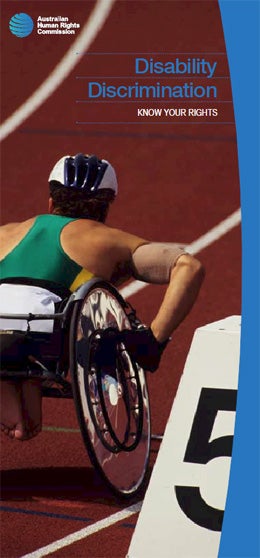 Know your rights: Disability discrimination
Australian Human Rights Commission
2012
Download in PDF
Download in Word
What is disability discrimination?
Disability discrimination is when a person with a disability is treated less favourably than a person without the disability in the same or similar circumstances.
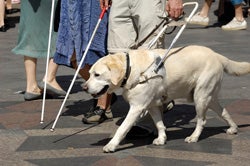
For example, it would be ‘direct disability discrimination’ if a nightclub or restaurant refused a person entry because they are blind and have a guide dog.
It is also disability discrimination when there is a rule or policy that is the same for everyone but has an unfair effect on people with a particular disability.
This is called ‘indirect discrimination’.
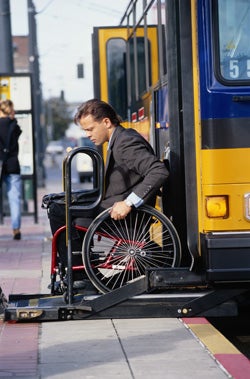
For example, it may be indirect disability discrimination if the only way to enter a public building is by a set of stairs because people with disabilities who use wheelchairs would be unable to enter the building.
How can I be protected from disability discrimination?
The Disability Discrimination Act makes it against the law to treat you unfairly because of your disability.
You are also covered if you had a disability in the past, may develop a disability in the future or if people think you have a disability.
People who are relatives, friends and carers of people with a disability are also protected by the Disability Discrimination Act.
What does the Disability Discrimination Act do?
If you have a disability, the Act protects you against discrimination in many areas of public life, including:
- employment – getting a job, terms and conditions of a job, training, promotion, being dismissed
- education – enrolling or studying in a course at a private or public school, college or university
- accommodation – renting or buying a house or unit
- getting or using services – such as banking and insurance services, services provided by government departments, transport or telecommunication services, professional services like those provided by lawyers, doctors or tradespeople, services provided by restaurants, shops or entertainment venues
- accessing public places – such as parks, government offices, restaurants, hotels or shopping centres.
The Act also protects you if you are harassed, because of your disability, in employment, education or in getting or using services.
How is ‘disability’ defined?
The definition of 'disability’ used in the Act is broad.
It includes physical, intellectual, psychiatric, sensory, neurological and learning disabilities. It also includes physical disfigurement and the presence in the body of disease-causing organisms, such as the HIV virus.
The Act covers disabilities that people have now, had in the past, may have in the future or which they are believed to have.
What is harassment?
Harassment occurs when someone makes you feel intimidated, insulted, humiliated or places you in a hostile environment.
Harassment because of a disability, such as insults or humiliating jokes, is against the law if it happens in a place of employment or education, or from people providing goods and services.
Kimberley was employed as a part-time receptionist in a busy medical practice.
The employer became aware that Kimberley had previously claimed workers compensation for occupational overuse syndrome and she was dismissed from the medical centre a few weeks later.
She claimed that she was told that the reason for her dismissal was her previous compensation claim.
The complaint was resolved with the employer providing Kimberley with financial compensation.
A small business operator, who is blind, complained that he could not use a government website because it didn’t provide an accessible version of the content.
The man needed to use the website regularly for his work.
As a result, the government department agreed to upgrade its website in line with web content accessibility guidelines.

What about discrimination and harassment at work?
A person with a disability has a right to the same employment opportunities as a person without a disability.
If a person with a disability can do the main activities or ‘inherent requirements’ of a job, then they should have an equal opportunity to do that job.
In some cases, an employer may need to make some workplace changes so that the employee can best perform the job, such as providing an enlarged computer screen or installing ramps.
Employers are not required to make workplace changes if it would cause major difficulties or unreasonable costs. This is called ‘unjustifiable hardship’.
However, employers would need to show how making those changes would cause such hardship. Many adjustments involve little or no cost, and the Australian Government’s Workplace Modifications Scheme can assist where there are costs in modifying the workplace or purchasing equipment for eligible employees with disability.
Employers should also have policies and programs in place to prevent discrimination and harassment in the workplace.
Two friends complained that they had been forced to leave a bar because one of them was accompanied by a guide dog.
The complaint was resolved and the bar owner provided an apology, financial compensation and a donation to a charity.
When is disability discrimination not against the law?
 Like other anti-discrimination laws, the Disability Discrimination Act says that in some circumstances treating someone differently because of their disability won’t be against the law. This is known as an exception or exemption.
For example, the Disability Discrimination Act says it may not be against the law to refuse to employ a person with a disability if, because of their disability, they cannot perform the inherent requirements of a job.
However, the Act also says that employers must consider how the person with a disability could be provided with reasonable adjustments to help them do the job. An adjustment is reasonable if it does not impose ‘unjustifiable hardship’ on the employer.
As mentioned earlier, unjustifiable hardship also applies to other situations. For example, it may not be against the law to only provide entrance to a cinema or theatre by a set of stairs if the owner can show that it would cause unjustifiable hardship to modify the building to provide wheelchair access.
What if I’m not able to do the tasks that make up the job?
It is not against the law to refuse someone a job if, because of their disability, they can’t perform the ‘inherent requirements’ of the position.
In other words, you must be able to carry out the essential duties of the job.
For example, a person with low vision may not be able to meet the ‘inherent requirements’ of a job as a delivery driver.

What can I do if I experience discrimination?
You may want to deal with the situation yourself by raising it directly with the person or people involved or with a supervisor, manager or discrimination/harassment contact officer.
Making a complaint to the Commission
If this does not resolve the situation, or you do not feel comfortable doing this, you can make a complaint to the Australian Human Rights Commission. You can also have someone such as a solicitor, advocate or trade union make a complaint on your behalf.
It does not cost anything to make a complaint to the Commission.
Your complaint needs to be put in writing. The Commission has a complaint form that you can fill in and post or fax to us or you can lodge a complaint online at our website. If you are not able to put your complaint in writing, we can help you with this.
The complaint should say what happened, when and where it happened and who was involved.
A complaint can be made in any language. If you need a translator or interpreter, the Commission can arrange this for you.
What will happen with my complaint?
 When the Commission receives a complaint about something that is covered by the Disability Discrimination Act, the President of the Commission can investigate the complaint and try to resolve it by conciliation.
The Commission is not a court and cannot determine that discrimination has happened. The Commission’s role is to get both sides of the story and help those involved resolve the complaint.
Commission staff may contact you to get further information about your complaint.
Generally, the Commission will tell the person or organisation the complaint is against (the respondent) about your complaint and give them a copy of the complaint. The Commission may ask the respondent for specific information or a detailed response to your complaint.
Where appropriate, the Commission will invite you to participate in conciliation. Conciliation is an informal process that allows you and the respondent to talk about the issues and try to find a way to resolve the complaint.
If your complaint is not resolved or it is discontinued for another reason, you can take your complaint to the Federal Court of Australia or the Federal Magistrates Court.
What can I do to prevent discrimination?
You, and other people from the community, can help ensure that people with disability have the same opportunities as other Australians to participate in the political, economic and social life of our communities by letting us know what is happening.
The Commission looks at the many different areas of life that can be improved for people with a disability, such as public transport, employment, e-commerce, going to the cinema and using the Web.
The Commission collects the views of everyone involved through public inquiries, round tables and other processes.
We then make practical suggestions to government, business and other organisations about how things can be changed for the better.
What about employers and other organisations?
The Commission provides advice and assistance to employers and other organisations about how they can prevent discrimination and meet their responsibilities under the Disability Discrimination Act.
We do this directly and through information and resources on our website.
We also run community education programs and support organisations to develop Disability Action Plans.
Action plans are a way for an organisation to plan the elimination, as far as possible, of disability discrimination from the provision of its goods, services and facilities.
You can find out more about what we’re doing by visiting:
www.humanrights.gov.au/disability_rights/
Zack and Eva, who have hearing impairments, said they were unable to enjoy performances at their local entertainment venue because the venue does not have adjustments to accommodate the needs of people with hearing impairments.
The complainants, who have hearing impairments, said they were unable to enjoy performances at their local entertainment venue because the venue does not have adjustments to accommodate the needs of people with hearing impairments.
The complaints were resolved through conciliation, with an agreement that the venue operator would install a hearing support system and invite the complainants to trial the system.
 Where can I get more information?
The Australian Human Rights Commission’s contact details are:
Postal Address
Australian Human Rights Commission
GPO Box 5218
Sydney NSW 2001
Street address: Level 3, 175 Pitt Street
Sydney NSW 2000
Phone: (02) 9284 9600 or 1300 369 711
TTY: 1800 620 241 (toll free)
Fax: (02) 9284 9611
Email: communications@humanrights.gov.au
Website: www.humanrights.gov.au
Complaints
Complaint Info line: 1300 656 419 (local call)
Email: complaintsinfo@humanrights.gov.au
Online: You can make a complaint online by going to
www.humanrights.gov.au/complaints_information/online_form/index.html.
If you need an Auslan interpreter, the Commission can arrange this for you.
If you are blind or have a vision impairment, the Commission can provide information in alternative
formats on request.
If you are thinking about making a complaint, you might also want to consider getting legal advice or contacting your trade union.
There are community legal services that can provide free advice about discrimination and harassment. Contact details for your closest community legal centre can be found at https://clcs.org.au/.
Disability discrimination legal services
There are also legal services which provide free specialist advice about disability discrimination. Contact details for your nearest Disability Discrimination Legal Centre can also be found at https://clcs.org.au/.