
Retail Industry National Employee Relations Summit
 Sex Discrimination
Paid maternity leave - will
it become a reality for the retail industry?
Speech presented by Commissioner
Pru Goward Federal Sex Discrimination Commissioner at the Retail Industry
National Employee Relations Summit, Sunshine Coast Queensland, 23 May
2002.
-
Ladies and gentlemen,
when Valuing Parenthood: Options for paid maternity leave was
launched, it was intended to begin an informed and fair-minded public
debate about the need or otherwise for a national paid maternity leave
scheme for Australia. -
Apart from a
most annoying diversion over whether or not employers should pay,
which has never been recommended in either the paper or in any public
comment I've ever made, more of that furphy a little later. -
To be honest
the most we hoped for was that the Government might agree to pay for
some economic modelling on a couple of options. -
Well weren't
we under-achievers! -
None of us anticipated
the strength and depth of the public support for the issue. But perhaps
we should have. -
Perhaps we should
have known that if work wasn't working for women, then it wouldn't
be working for anyone else much either- their parents, partners, their
children and babies. -
Perhaps we should
have believed that the anxieties we hold for the struggle women still
face in Australia were anxieties shared by others, a lot of others. -
Perhaps we should
have realised that if we think we can no longer put off facing up
to some of the profound social challenges emerging in Australia, then
the rest of the country might be thinking the same way. -
And they are.
-
Challenge Number
One is a profound challenge to the future of human existence- the
challenge of who will have our children. -
Every year,
slightly fewer women of child-bearing age in Australia, as elsewhere,
decide to have children. -
Every year they
get older when they have their first child, every year maternity becomes
medically more difficult. -
A variety of
economic, biological and social changes have contributed to this trend. -
First- education
and training periods are longer, meaning earning capacity begins later
in life for most young men and women. -
Then, the nature
of work has changed. Few young people enter the workforce with permanent
full time jobs the Bank is going to lend money for a home on. Contract
and project work is very common, with the consequence that not only
do home mortgage lenders feel understandably uncertain about the young
couple's prospects, but so does the young couple! They too, are unwilling
to commit to family responsibilities when the job is over in a few
months time! -
Next, the long
run economic viability of families today means that paid work today
is compulsory for most parents, whether they are mothers or fathers.
Sure, one parent might only need to work part time, but work they
both do. -
It's not about
saving up for the overseas family holiday, if indeed it ever was. -
Today the majority
of women will have to work part or full time for at least part of
their parenting years. -
Why? Because
the real cost of living is high. In particular, housing affordability,
Australia-wide, has declined by 29% with in the space of a generation.
You need two incomes to carry the mortgage on the slum of your dreams,
forget the 4 bedroom mansion with the spa bath and optional pool room! -
Finally those
hard one qualifications and work experience soon get out of date. -
As employers,
you know the first question you ask recruits is "when was your
last job?" -
Qualifications
and jobs of five or seven years ago do not count any longer. -
Workforce qualifications
and experience toady very rapidly reach their used-by date. -
Into this heady
pressure pack, you can now add the fact that women still bear children
and somehow have to cope with all this while juggling a major responsibility
that hasn't changed for thousands of years and isn't likely to! -
God might have
given us university degrees but he forgot to change our child bearing
years! -
Young women
find out, very quickly, that there is considerable workplace disadvantage
to be had as a result of their motherhood. -
As Sex Discrimination
Commissioner, the workplace discrimination that women face as a result
of their pregnancy or potential pregnancy is my point of entry on
this issue. -
Women receive
less pay, less opportunity, less financial support in the workplace
because they bear children. They still only earn 84 cents in the male
dollar, when comparing average weekly ordinary full time earnings. -
This disparity
most obviously occurs when earnings of men and women over 30 are compared. -
Before this
the earnings of men and women are about the same. -
It is no coincide
that 30 is the age when women are most likely to be combining work
and family. It occurs because they won't take the promotion, they
won't do the extra hours, they won't act in a senior position at the
interstate office for three months, because they need to get home
to their kids. -
Once you add
in casual and part time workers, the majority of whom are women, and
almost entirely because they want and need to be full time mothers,
and the disparity is even greater. The earnings ratio drops to 66
cents in the dollar. -
It still
comes as something of a shock for many independent and confident
young women when they discover a whole new world of discrimination
or barriers to work when they enter parenthood. -
During pregnancy,
there are still many employers who consider that women's brains turn
to mush, that they do not work as productively, while pregnant- they
often demote or dismiss them, deny them training or otherwise allow
their careers to stagnate. -
That is the story
of complaints received by the Human Rights and Equal Opportunity Commission. -
This treatment
does not end after the birth. -
For women who
want and choose to breast-feed, many work places cannot or will not
provide suitable conditions for this (even for the expressing of milk). -
Women often experience
a lack of sufficient financial support during maternity, no guarantee
that a job is there when they return from maternity leave, difficulty
accessing affordable childcare, difficulty finding hours that suit
their families, or poor access to flexible work conditions which would
allow them to occasionally take time off for family reasons. -
In addition to
the implications of this for earnings ratios, women are also the ones
who end up taking large amounts of unpaid leave, or just time out
of the workforce, further contributing to the direct economic cost
they bear for having our children. And if you feel all this works
out in the end, if you think that families share their income, let
me remind you of the high rate of divorce over the long term and the
official figures that demonstrate the higher reliance of older women
on social welfare compared with the reliance of older men. -
But I digress.
What is the consequence of all these new social and economic forces
for family formation? - Fundamental. -
Young people
are understandably reluctant to partner until they are sure of their
economic futures. -
Young women in
particular are increasingly reluctant to forego the investment they
have made by withdrawing from the workforce in order to have children.
Their parents, who have often sacrificed a great deal to get their
daughters through endless TAFE courses or a university degree, understand
how they feel! -
The average age
of mothers of first children is now 29.8 years. -
People wishing
to have children today are forced to 'family cram'. -
The biological
clocks start to tick and there is a scramble for the pram. -
This is assuming
there can be - women who haven't borne a child by the age of 35 are
most unlikely to do so after that age. The ability to conceive and
complications of pregnancy and birth all start to compound as women
enter their thirties. -
At the same time
there is still a mortgage to be paid, a cost of living to be met and
a career to be established. Women have to keep working. -
This is a social
paradigm shift that can't be reversed - and the sensible thing is
to work with it, not against it. -
This is where
a national scheme of paid maternity leave comes in. -
In writing this
options paper I have consulted widely with employer groups, employee
groups, unions, Government and academics. -
The message
from most is clear - the time has come to introduce a national scheme
of paid maternity leave in Australia. -
Another clear
message from those with whom I have consulted is that any national
scheme of paid maternity leave should not be funded by individual
employers. -
Inevitably, whether
we introduce a national scheme of paid maternity leave is not up to
myself or the groups with whom I have consulted, but up to Australia
as a nation. -
In making this
decision there are only two questions we need answer. -
One, what can
a paid maternity leave scheme do for us? And two, to what extent do
existing schemes already cover it? -
A decision is
then simple. -
If we believe
that a national scheme of paid maternity leave can meet worthwhile
aims not currently being met by the existing government benefits on
offer - we introduce paid maternity leave. -
What are the
possible aims of a national paid maternity leave scheme? -
There are three
I would like to highlight today: -
First, while
the birth of a child is often a special time for families for women
it is also a time characterised by colic, croup, cracked nipples,
six feeds a day and sheer physical exhaustion. Post natal depression
is common, as is the need for a physical recovery from caesarean section
births. -
The 'family cram'
means that dragging yourself out of bed after your head has just hit
the pillow-following feed number five- to go to work is 'that's life'
for many women with newborn babies. -
Paid maternity
leave will allow women the time needed directly after the birth of
a child to recover physically from childbirth and establish a feeding
routine without being forced to return to work due to financial necessity.
-
Secondly, a
period of paid maternity leave can also play a role in addressing
Australia's disturbing trend towards a fertility strike - we are literally
becoming a society without a future generation. -
The current fertility
rate is 1.75. This figure sits well below the replacement rate of
2.1. Since 1961, when it hit a high of 3.6 children per woman, it
has slid continuously- a decade ago this rate was 1.9. -
We need a next
generation to financially support Australia's increasingly aging population. -
More importantly,
we need a future generation to ensure that we continue to be a functioning
society - we need a next generation of consumers, innovators, creators
and workers. -
At the moment
this is far from guaranteed. -
Let me show you
what I mean. -
Overhead 1:
The current age structure (or spread of ages in Australia). Based
on the total fertility rate in 2000, 1.75, and migration of 80,000
persons per annum.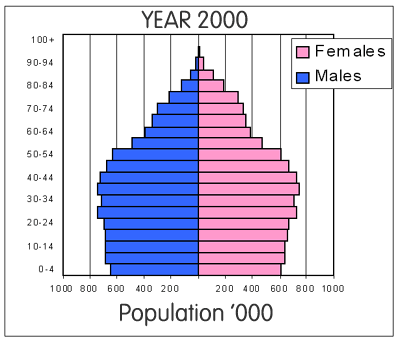
-
As you can see
we have a nice beehive shaped structure, with a slight bulging in
the 34-44 age groups. But still, more tax payers and worker bees than
dependents. -
Now let's look
at age structure projections for Australia in 2050. - Overhead
2: Standard projection for the year 2050. Assumes that the total fertility
rate falls to 1.65 in 2005 however remains stable at this rate.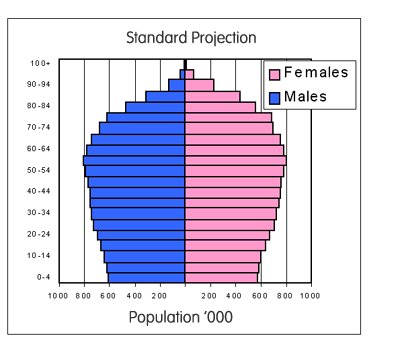
-
Assumes also
that the number of migrants remains constant. -
What do we get?
- Perhaps a few
more queen bees and a few less worker bees as we see the bulge rise
slightly, to the 44-64 years age groups, however our beehive structure
still remains. There are still more workers than dependents.
- Overhead
3: This projection assumes our fertility rate continues to decline.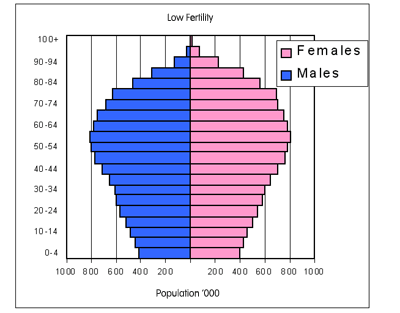
-
It falls to
1.65 in 2005 and then to 1.3 in 2015 where it remains constant. Again,
immigration remains constant. -
The result?
-
A grim projection.
-
The bulge moves
to the 50-70 year old age groups. -
Our beehive structure
is replaced by a coffin. Dependents out-numbering supporters. -
Why am I showing
you this? Because this is the macro picture, that is the result. - And often, as
in this case, the macro picture is the sum of many micros.
- And here the
micro issue is about women and choice - at the moment women not having
choice - not having the choice to be both mothers and workers.
- Not having certain
rights, entitlements and support. And the impact this lack of choice
has on society as a whole.
-
I am not suggesting
that paid maternity leave alone can rectify this trend and ensure
the existence of a next generation. It must be part of a suite of
measures that supports families and work. - What a period
of paid maternity leave can do however is respond to some of the financial
concerns discouraging women from having babies at all, or having only
one, or delaying having babies.
-
Paid maternity
leave means that following the birth of a child there will not be
a total loss of income by one, or sometimes the only income earner
in a family. It means new mothers can choose to stay home from work! -
As 'saving for
a baby' gets added onto the family crammers' list of things to do,
the provision of payment through a paid maternity leave scheme may
mean that families are more able to have children at a time when they
want to, rather than having to delay the decision for money reasons. -
France and Sweden
have been much more ambitious. France has introduced paid maternity
leave as a deliberate attempt to tackle their birth rate drop- France
for example, got down to 1.7 in the year 2000. But they recognised
that substantial periods of paid maternity leave must be offered.
In France it's 16-26 weeks paid maternity leave and in Sweden it is
well over a year - and social insurance pays. -
In most countries
the introduction of paid maternity leave is too recent to test its
effect on fertility rates, however since introducing paid maternity
leave for a third child, the streets of Singapore are said to be full
of strollers. -
A third objective
of a national scheme of paid maternity leave is benefits for the Australian
labour market and the fostering of Australia's economic growth. -
In 2000 women
made up 46 per cent of all Australians with post school qualifications. -
Women are spending
years studying and training to enter the workforce - Women are attending
university, entering TAFE and doing other a variety of other training
courses. -
They are qualifying
as lawyers, accountants, chefs, beauticians and aroma therapists.
That's an enormous public and private investment. -
At the same
time, the majority of women are having children between the ages 30-34. -
It is when women
have committed at least 10 years to their field, in study and/or experience,
and are often on their way to becoming leaders in their fields, that
they leave the workforce. -
If they leave
for five to seven years, those hard won qualifications and years of
experience are out of date. -
Australia therefore
fails to maintain its most skilled labour force, crucial in the increasingly
competitive global market. -
None of you
here today need to be told that high pressure and low margins make
retailing increasingly difficult in this market. -
· Most
retailers struggle to differentiate themselves on their product. It
is their staff that value-add. -
And who are
retail staff? -
Women.
-
You don't need
me to tell you that 60-70 percent of retail sector employees are female.
Most are aged between 20-40 years. -
Large numbers
of retail sector employees are women retuning to work part-time or
casual after having children. -
These casuals
make up 30 per cent of the retail sector. They work approximately
15 per cent of all retail hours. Together with part-timers they make
up a large number of retail sector employees - And the majority are
women. -
Overall, the
retail sector is starting on the right path to valuing their most
precious commodity - your people. But there is a long way to go. -
Your workforce
has particular challenges - high turnover and shift work means your
workforce is not always stable enough so that problems like harassment
can easily be picked up. -
When it comes
to turnover, the retail sector has a rate of 60-100 percent per annum.
Most of this is explained by the extra staff put on over Christmas
or school holiday periods; and employment in the retail industry being
seen as 'job experience' rather than a career. -
This turnover
rate indicates however that most employees leave the retail sector
within a year. -
This is a huge
cost for retailers and one that is regularly incurred. -
A major retailer
found that it costs a minimum of $3800 to recruit a new full time
employee. [1] This does not include calculations
for training or loss of experience. -
The provision
of paid maternity leave, if the experience of other employers is any
guide, could reduce this cost as women using this leave are most likely
to return to work. -
Despite professing
otherwise, hiring and training someone to fill the position of a woman
on maternity leave will actually benefit retailers who operate in
competitive markets and incur high levels of turnover and associated
costs. -
Paid maternity
leave may see their pool of committed and skilled workers grow as
they retain women who return after having children and benefit from
newly trained employees. This gives retailers greater flexibility
in increasingly competitive marketplaces. -
Perhaps greater
staff valuation, through offering entitlements such as paid maternity
leave would actually reduce staff turnover in this sector, dominated
by young female employees. -
Business case
arguments suggest that it would. Paid maternity leave can reduce attrition
rates and encourage women to return to the workforce and their employer
- AMP reported an increase in retention rates from 52% in 1992 to
90% in 1997, following the introduction of paid parental leave. [2] -
At the employer-of-choice
level, this has been achieved through employer-provided pay. A national
government funded scheme would not have this retention effect for
individual firms. -
These are just
some of the aims that paid maternity leave can meet. -
Are these aims
important? -
They certainly
address issues relevant to the retail sector. -
Are they of national
significance? -
I think they
are and that anyone would find it hard to disagree. -
Next it is worth
looking at whether existing government benefits are meeting the aims
I just outlined. -
The government
provides a range of income support payments to families to assist
with the cost of raising children. -
Last financial
year, the Federal government committed over 10 billion dollars to
direct family assistance, including the maternity allowance, family
tax benefits A and B and a maternity immunisation allowance. -
Add the amount
spent on child care and parenting payments and this amount increases
to 16 billion. -
None of these
existing benefits respond directly to the main aim of a paid maternity
leave scheme - the need to financially support women in employment
at the time of childbirth and immediately thereafter. To help them
stay home. -
The Government's
new First Child Tax Rebate, costing half a billion dollars a year,
will also not assist that rising number of women who presently need
to go back to work within the first year. -
The lack of direct
financial support by the Government for women who are in employment
and have children, suggests to me that the rapidity with which the
generation jam has descended upon us has not been picked up in Canberra.
That is easy to change. -
Facts help.
-
For 100 years
Australian taxpayers have supported families. -
Now that the
family has changed, the sort of support we give them has got to change. -
Public debate
on paid maternity leave has recognised this. It has focused on who
should bear the cost for paid maternity leave. -
This is good
news. -
Our debate is
merely about what type of national scheme of paid maternity leave
we wish to introduce. - In this 'who
pays' debate two issues have repeatedly emerged. - I would like
to address both of these briefly.
- First, there has
been much concern expressed that employers alone will be forced to pay
for maternity leave.
- This is of particular
concern to small business - in the retail industry alone although 50
per cent of retail employees are employed by the top 50 companies there
are still many small businesses unable to afford to pay for maternity
leave. -
· As stated
in the options paper, mandatory payment of maternity leave by employers
to employees is not a desirable option. -
Why ever the
employer pays option become so central to our debate is surprising
for a number of reasons. -
First, the discussion
paper clearly identified the problems of such a scheme. -
Second, it is
the third world scheme. -
No where in the
developed world is paid maternity leave funded through mandatory employer
payments alone. -
Third, International
Conventions such as the ILO discourage it. -
Next, the Federal
Government and the Democrats have not shown support for an employer
funded scheme, while the Opposition talks of a partnership approach. -
Finally, employers
and employer group spokespersons keep telling us that women would
suffer under this scheme. -
Employers, especially
small business, would stop employing women of child bearing age to
avoid this cost. -
Any scheme which
would result in women being further discriminated against in the workforce
is obviously unacceptable and must be avoided. -
There are more
appropriate options for a national scheme of paid maternity leave
as set out in the interim paper. - These are largely
based on schemes that have been successfully implemented in other countries.
- They are worthy
of meaningful consideration and include:- Government
funded universal payment: A payment through the welfare system to
women who give birth; a separate payment for unemployed women would
be provided.
- Government
funded employment based mode: Flat payment to women, made via either
the tax or welfare system. Alternatively paid by employers who are
reimbursed by the government.
- Social insurance/superannuation
style scheme: Government, employers and employees contribute to
a fund from which maternity leave would be paid.
- Employer
levy: Employers pay a levy based on total salaries to avoid men
being hired over women. Small businesses may be exempt.
- Government
-
We have decided
we support the introduction of paid maternity leave. We have identified
a number of options for funding it at a national level, now what?
-
The next step
is submissions from the public and consultations with employee and
employer groups, business organisations, unions and experts in the
field on the feasibility of these options. -
Submissions outlining
other options for funding paid maternity leave are welcome. -
These submissions
will form the backbone of the final report on the options for paid
maternity leave due out towards the end of this year. -
The second issue
that has been repeatedly raised in Australia's debate on paid maternity
leave concerns the choice to parent. -
The argument
has been made that as parenting is an individual choice why should
society contribute to the payment of maternity leave? In particular
women without children and men. -
From the outset,
this notion of choice needs to be challenged. -
Governments
support many personal choices - such as living in a country town or
playing elite sport. They support these choices when there are also
benefits for all of us in doing so. -
And the choice
to have children is a peculiar one; it is far from universal: the
fact is if women do not have children, no one will - biology bestowed
women with this child bearing role and science has not yet been able
to delegate it to men. -
And I don't see
any queues forming demanding it. -
What women can
choose however is if they have children, when they have them and the
number of children they have. -
The trend towards
fewer children, later in life, if at all tells us women are choosing. -
Now the rest
of us have to make a choice. -
We either -
support women in their dual role as members of the workforce and as
bearers of children - or we don't - we tell them to go home - or we
support all groups of women, whatever combination of work and family
they choose. - If we want them
to go home it makes more sense to stop them from being in the workforce
altogether at least once they are married. We could re-enact the
marriage bar.
-
No, marriage
is too late. Let's take women out of university... such a waste for
a five year job and school, and then I suppose, it's hardly possible
to justify reading and writing - We'll tell young
girls today, there's a nice spot for you in the home.
-
Barefoot, pregnant
and in the kitchen. -
Or we take the
other road. With work with, not against, the wishes of our young women.
We support women and men so that they can manage a combination of
work and family responsibilities. Paid maternity leave is part of
doing that. Just ask the rest of the world.
1.
Human Rights and Equal Opportunity Commission consultation with Phil Naylor,
CEO Australian Retailers Association 19 September 2001; Australian Retailers
Association, Department of Employment and Workplace Relations and Equal
Opportunity for Women in the Workplace Agency Balancing the Till: Increasing
profits and building a better workforce Commonwealth of Australia Canberra
2002, 11.
2. George
Trumbell "Creating a culture that's good for business" in E.M.
Davis and V. Pratt (eds) Making the Link: Affirmative Action and Industrial
Relations No. 8 Labour-Management Studies Found Sydney 1997, 31 -33 at
32.
Last
updated 14 June 2002.

